A game nobody wins

The oldest boy is playing basketball this winter. I am happy to report he appears to have a brighter future as a basketball player than he does as a soccer player. For one thing, he’s taller than most of the other kids. Now if he would just learn that he’s allowed to jump for a rebound, he’d be on the road to stardom.

My son’s team is made up of role players. On a team of 1st and 2nd graders, every kid (my boy included) is convinced his role is to shoot the ball as often as possible in each game. If this means picking up his dribble, taking a large hop to one side, then resuming his dribble in the clear, in order to get a better shot, then that’s just the strategy adopted. Passing the ball to a teammate is the last resort, only to be considered when one is in danger of being crushed by five closing defenders.

It occurred to me that if I were the coach of such a team, I would tell the boys, “If you want to win games, you’ve got to work as a team.” Upon thinking this, I realized I would say no such thing, and for one simple reason: Nobody wins games in our league. There are no winners or losers, just a bunch of elementary schoolers running around the gym, each craving the chance to add to the number of baskets he’s scored.

Nobody keeps score. Officially. Some of the parents keep it quietly in their heads. The kids try to keep it, but their tallies vary widely. They are much more precise at counting the number of points they have scored individually, which bodes ill in this team sport.
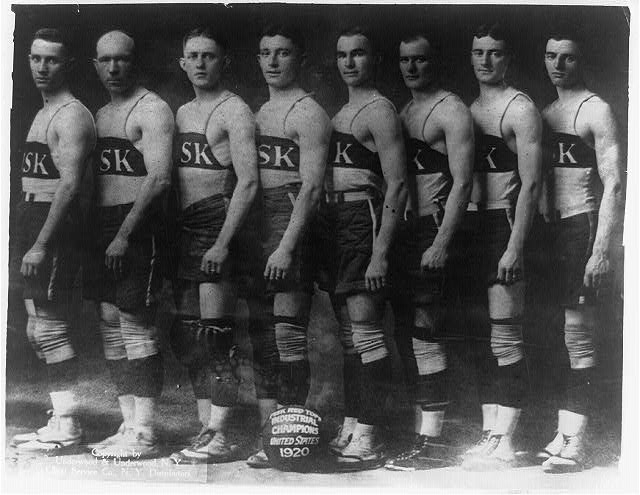
Your 1920 American Industrial League Champions

You’ll never become Industrial League Champs if you don’t learn to work as a team. Also, you may to keep score in some of the games.

Not keeping score is society’s admission that it no longer trusts parents to teach sportsmanship. There may be good reasons for this lack of trust, but it is a mournful admission just the same. It means society doesn’t trust itself to produce humans that are, on balance, kind people. That’s too bad, because nothing improves that doesn’t trust itself.

In our league, and probably most leagues like it, we have limited the chances of gloating, hurt feelings, and the other disappointing aspects of competition. In doing so, we have limited the opportunity to experience the inspiration of contributing to a team effort, and the ideal of putting the team’s success ahead of one’s own. Is the tradeoff worthwhile? Can they make up for lost teamwork concepts when they’re older? I’ll have a more fully developed opinion on that in a few years.

Meanwhile, there are rumors that the refs are going to crack down on traveling and double dribbles. This has to keep the coaches up at night. I would much rather have to teach these kids good sportsmanship, citizenship, civics, and probably even advanced mathematics than how to resist the urge to shuffle a few feet to the right to get a clear shot at the hoop.

We got the milk, now let’s tackle those cookies

Buster, our three-year-old,  struggles to pronounce certain consonant sounds. The most famous of these is the k or hard c sound. Buster has always compensated for this lack by substituting another sound where the k goes, usually a t. Hence, milk becomes milt and work becomes wort.

We’ve learned to recognize these hybrid words, allowing him to express himself. At the same time, I have been trying to train him how to pull his tongue back into his mouth in order to pronounce the elusive k.

where's that tongue?

Civil Defense workers searching mouths for the elusive k sound. Everyone did their part to help the war effort. (Image: Ann Rosener/U.S. War Information)

Our practice had yielded limited results. Then one day, he requested a bowl of cereal. When I asked if he wanted milk in it, his answer was non-committal. “Yes, milk or no, milk?” I asked again.

“Yes, milk,” he replied, clear as bell, whenever a bell perfectly pronounces the word milk.

I did a double take. “What? What did you just say?”

A smile of recognition stole over his face. “Yes, milk,” he belted out proudly.

I picked him up and hugged him. “You said, milk. What a brilliant boy! You did it!” I gushed as I spun circles with him in my arms. He beamed at me proud and happy at how proud and happy he’d made me.

When Mommy came home, he ran to her to show off the word milk like she’d never heard it before. More hugging and spinning ensued.

In the week since, he’s showed his mastery of milk to the next door neighbor and anyone else who happened by. When it’s eluded you for all your life, milk becomes powerful juice.

Even when I was a child, Mr. K stood in  the shadows of Mr. M and Mr. T.

Even when I was a child, Mr. K stood in the shadows of Mr. M and Mr. T.

The other night, Buster, Mommy, and I were enunciating about milk. I happened to be about to eat a cookie that Buster had his eye on. “I’ll give you my cookie if you do two things,” I told him. “First, say cookie.”

Up until now, cookie has always be tootie. Buster thought hard. “Cootie,” he said, followed by “Tookie.” Getting two hard c sounds into one word is daunting work.

“Okay, that’s close enough. Now say candy.”

Buster focused. “Canny.”

“That’s so close. You got the c right but you left out the d.” D has never been a problem for him, but apparently there was no room for it in a word that already had a c.

“You’re very close. Try one more time.”

Buster looked longingly at my cookie. The pressure was too much. He couldn’t focus on the c and hit the d too.

“I know you can do it. One more try,” I pleaded .

Perhaps he saw the cookie drifting away from him. He looked at me hopefully, then shifted his gaze to the always compassionate Mommy. He took a deep breath and said with clarity and confidence:

Milk.”

Sometimes it’s not the cards in your hand; it’s how you play them. He won two proud smiles and a cookie.

Reflections inspired by a German class for second graders

Our eldest is beginning an after school German class today. This is not the sort of news that normally makes one reflective, but here I go anyway.

In a perfect world, I should be the one to teach my kids to speak German. Implicit in that perfection would be my knowing how to speak German. My father spoke German, fluently. In the perfect world I mentioned, he would have taught it to me when I was little. I would have soaked it up, and it would be as natural as English to me.

In the imperfect world that formed me, my father did no such thing. He was a teenager during the Second World War, living in the USA and speaking German as smoothly as his immigrant parents. Not surprisingly, something in that combination convinced him not to speak German to his children.

I took German as a freshman in college. It was either a language or Math, and I felt done with Math. I picked German. Maybe something in my genes would mold it to my tongue more securely than the high school Spanish that had always merely swilled about in my mouth before dribbling down my chin.

German 101 supplied me the worst grades of my academic career, if you discard the high school Geography class I nearly failed because I was too busy protesting the methods of the high school Geography class and the methods of high school in general.

The edition I used didn't have such a lovely cover, which is probably why I wasn't inspired to do better in class.

The edition I used didn’t have such a lovely cover, which is probably why I wasn’t inspired to do better in class.

After freshman year, I transferred to a school that required no more Math or foreign languages out of me, which was good since I was done applying myself mathematically and I had no aptitude for foreign languages.

In fact, I was a pretty lousy student overall.

As the undergraduate years rolled by, it became clear that I was a poor classroom learner. Yet, for the very best of reasons (I couldn’t find a job), I attempted graduate school.

Graduate school taught me only one thing: there is nothing like higher education to suck the life out of a subject matter you love (or thought you loved).

I thought I loved History, until I tried to pursue it as a graduate degree. Apparently, it was something else I loved, an academic Cyrano de Bergerac, hiding in the bushes, feeding enchanting lines to the deceitful mouth of History. History itself is mind-numbingly boring; they taught me that in one semester of graduate school.

Since I’d learned everything I needed to know about History, I determined I didn’t require more than one semester of grad school.

That was the end of my formal education in German or Math or History or anything. Abrupt, but okay for a rotten student.

My son is excited about his German class. I hope that excitement lasts. I hope he’s a good student. I hope he inherited his mother’s love for school.

I hope he goes on to become much more than a grad school dropout who can’t even speak German.

Poop your Butt!

I wish three-year-olds devoted as much effort to learning their letters and numbers as they do to perfecting potty talk. If working poop into every conversation were a preschool subject, Buster would be at the top of his class. He’s not as much into the alphabet or counting, although he can count to 19, by 19s, but the numbers in between 0 and 19 are white noise.

Going potty at the appropriate time and place is a big deal in a preschooler’s world. As such, poop is an important word to know and use in the development of good hygiene routines. That’s where it ends for the grown-ups, but for the three-year-old, the word poop is an expressive cornucopia.

And in those rare circumstance when poop doesn’t quite fill the bill, butt usually works as a good substitute to bring the point home.

For instance, Buster might offer his impression of Mommy or Daddy giving an ultimatum this way: “If you don’t pick up these toys right now, Big Brother will poop in his pants!”

This is not the conventional ultimatum, in that it involves his brother providing the negative consequence, but even this third-party ultimatum meets the minimum requirements: there is a demanded action and a consequence for not acting. I certainly don’t want Big Brother to poop in his pants. I don’t want anybody in the house to poop in their pants. When it comes down to it, I don’t want anybody anywhere to poop in their pants, if that’s an option.

Where the threat fails is in the fact that Big Brother has not been consulted, and the method of enforcing  the threat is news to him. Big Brother will balk at his role in the proceedings, which may lead Buster to call him a butthead. This is tough on Big Brother as he is sensitive about what part of his body he carries atop his neck. Buster seems to have thicker skin than Big Brother. He is also more ruthless with the trash talk, which leaves him in better shape to endure the times when sibling rivalry goes verbal-nuclear.

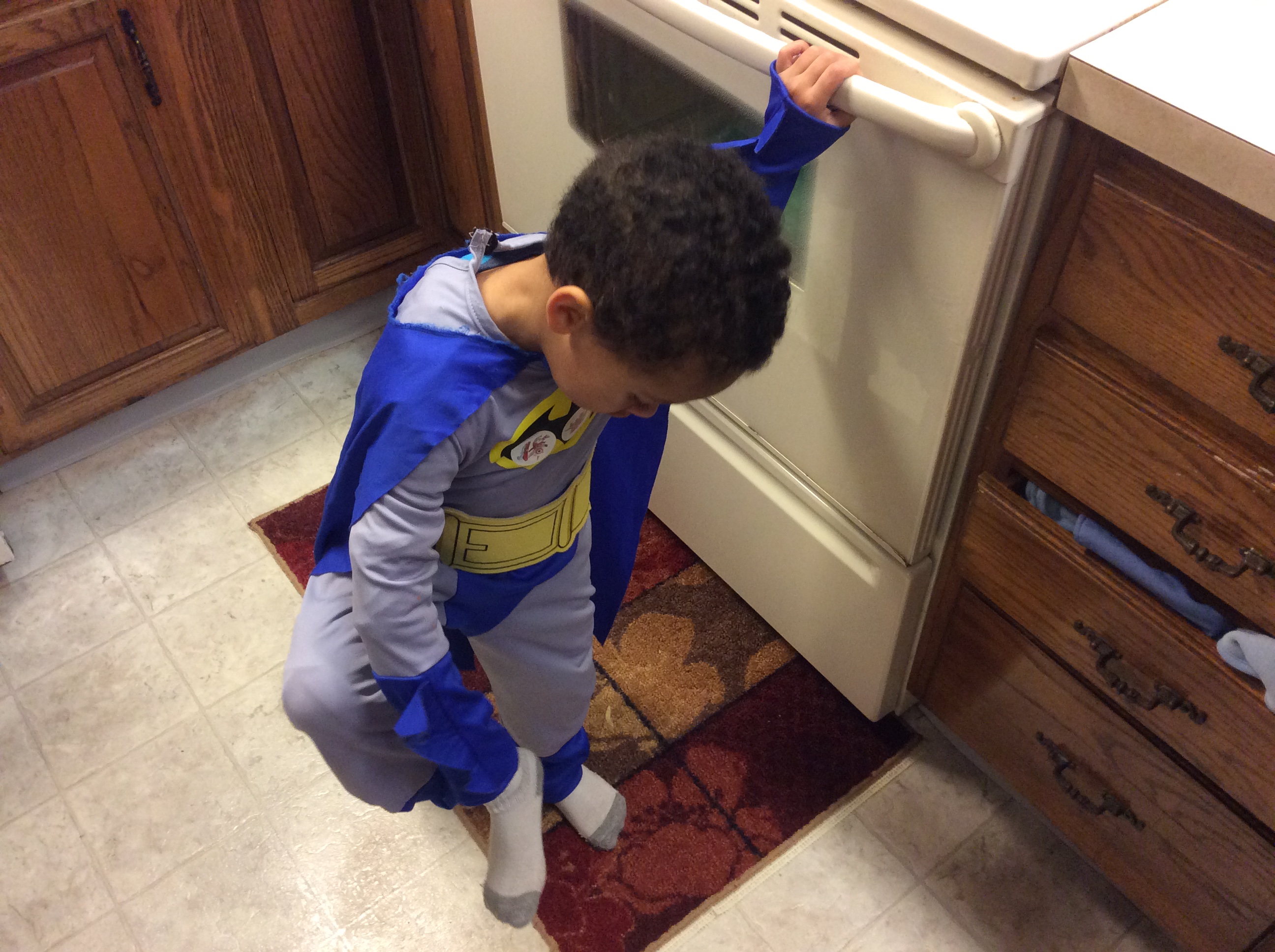
Butts are not just a conversation piece. Sometimes they are real and can be a menace to society. One day, I came home to find Buster dressed in his Batman outfit, looking for bad guys to vanquish. He ran over to me and announced, “Your butt is the Joker.” Without giving my butt a chance to profess it’s innocence, he punched it in right in the proverbial nose. I was just happy I was facing the counter at the time because some villains can take a punch and some villains can’t.

Uh-oh! Looks like Batman stepped in something when he started accusing innocent butts of being arch-villains.

Uh-oh! Looks like Batman stepped in something when he started accusing innocent butts of being arch-villains.

I can stand a butt punch from a crime fighting three-year-old as well as the next guy, but that doesn’t mean I should have to. I sat Buster down to have a long talk with him. Within minutes, our heart-to-heart devolved into a discussion about . . .

                                                                                                                  you guessed it . . .

poop.