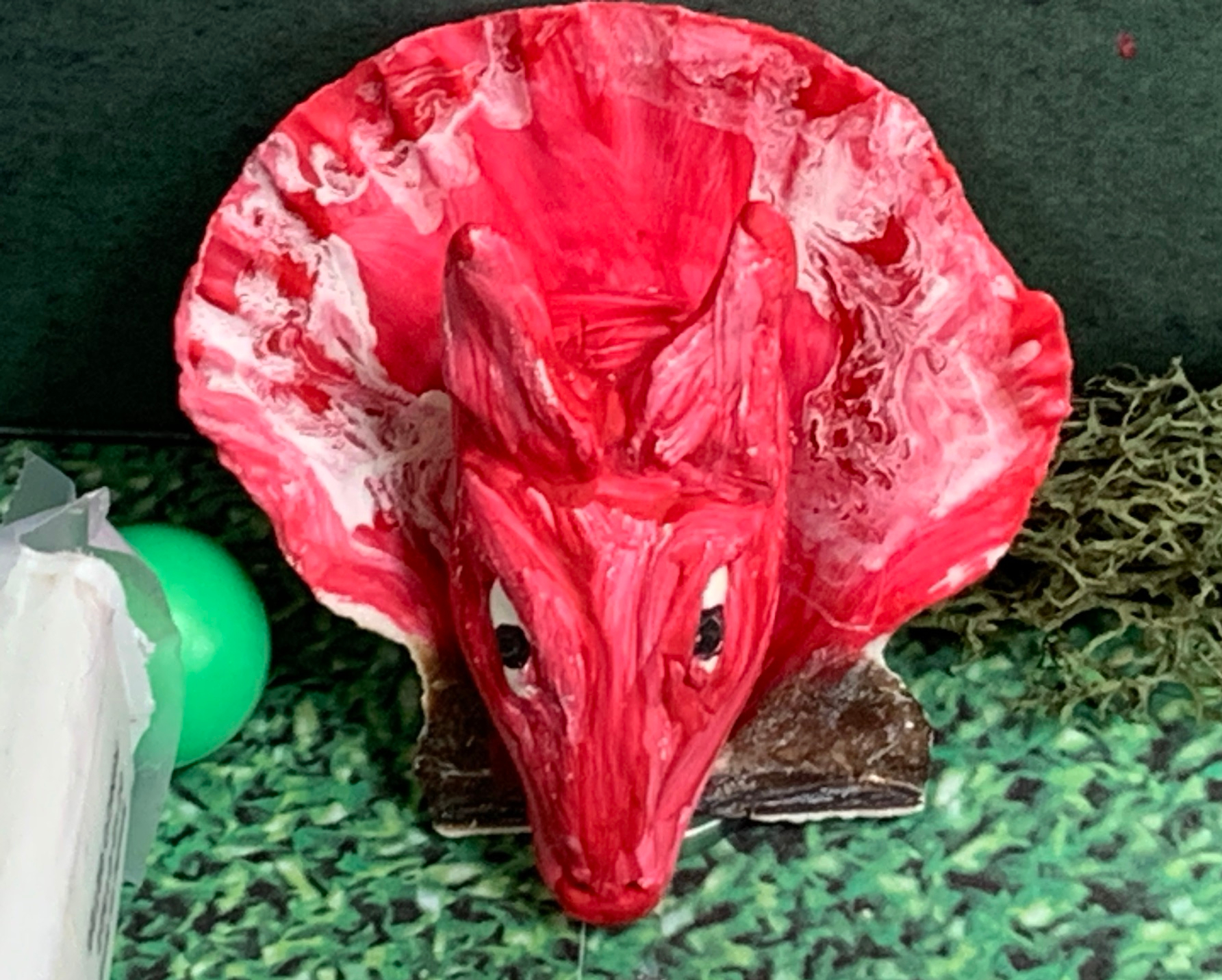
The spirit is unwilling

Every so often, our schools have “Spirit Week.” Students are encouraged to dress within a common guideline each day.  I’m unsure what spirits they’re conjuring, but it hardly seems like school spirit. One day is for wearing school colors, but the other four could more accurately be termed “Dress Up Week.”

Our older two boys were, to put it mildly, never very keen on Spirit Week. Big Brother tried it in kindergarten. After one Spirit Week, the thrill was gone. It was too much like homework.

Buster was never interested. If you’d asked him about Spirit Week, Buster would have replied, “I don’t know what it is; I don’t know when it is; and I don’t care.” Maybe you can see why Buster is a Gen X dad’s delight.

Big Man, the youngest of the three, is more interested in Spirit Week, though not fully indoctrinated into the cult of uniformity. He does not always observe a full Spirit Week, but on occasion he remembers that he’s supposed to wear a tie-dye T-shirt on a given day.

Unfortunately, he remembers this within two minutes of needing to leave for school.

Also unfortunate, his dad ranks Spirit Week low on the list of events worthy of last-minute disruption. His mom, though more sympathetic to the cause, is not prepared for an unexpected deep dive into the closet when she’s holding car keys in her hand.

This leads to Spirit Morning Strife.

Exhibit: Thursday, September 24, 2026.

At school commute -3 minutes, I was informed that it was “Anything but Backpack” day.

When I was a kid, nobody wore a backpack. We carried only what we needed at any given time. I wish it were that way still, but it’s not. Young hermit crabs, carry all their belongings on their backs. I don’t love it, but I’ve accepted it. A backpack is core to the routine.

Except this day. With tardiness looming, our kid announced that he must transport everything in his backpack to school in something that was not his backpack.
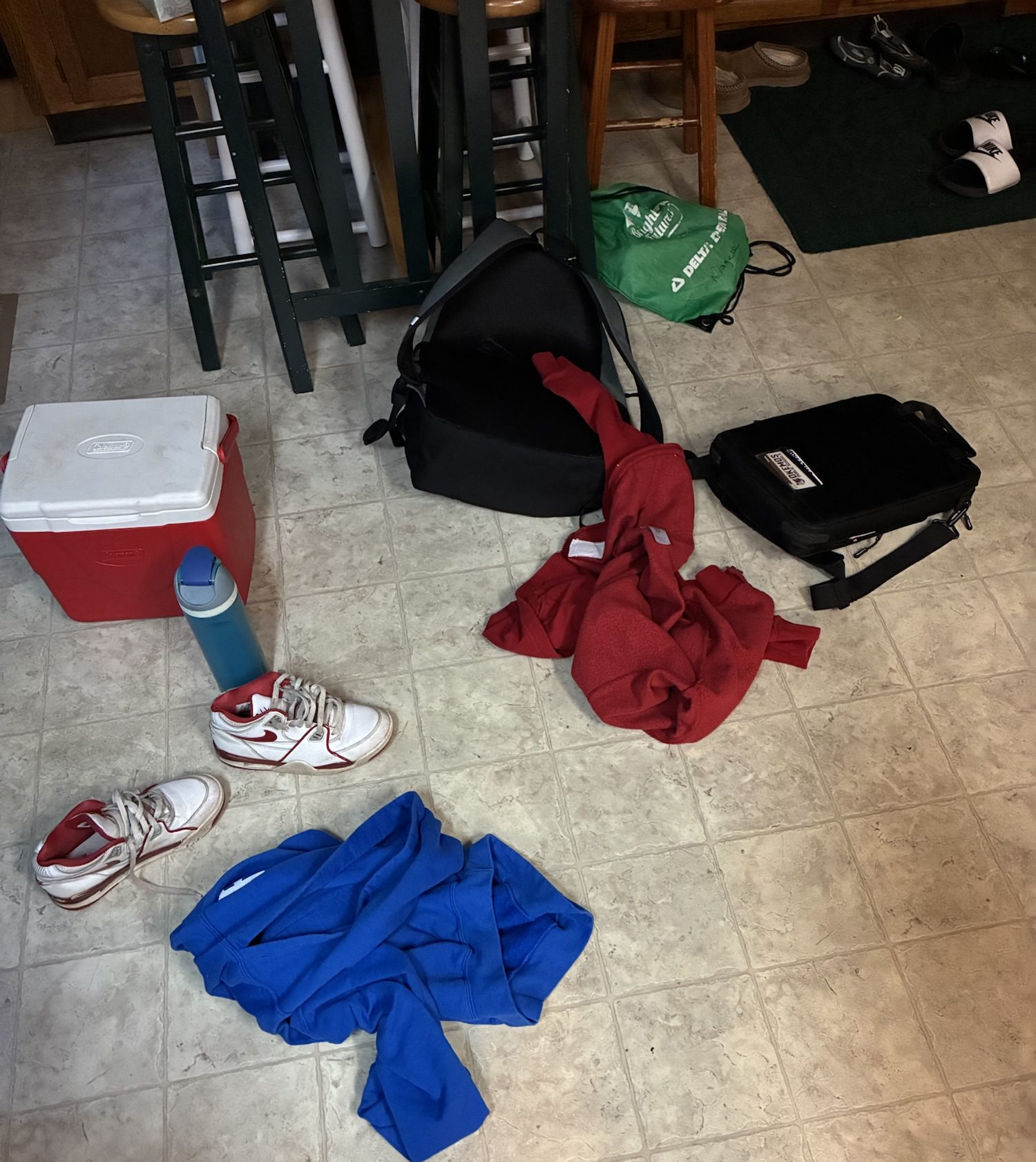
Once we get the laptop, gym shoes, and sweatshirts packed, we can move on to the real school supplies.

I told him he had two minutes to find a substitute.

“Daa’ aad!” he whined in the tone that attempts to dump responsibility for his fiascos on my shoulders.

I said he might better just use his backpack, but he was invested in this ill-conceived special occasion.

He tried a picnic cooler, which fit his water bottle and nothing else.

“Use a garbage bag,” I said.

He shuddered and attempted a wicker basket, which was too awkward even for him.

Mom appeared, noted the spilled backpack contents, and raised her voice. After the squall, she used some mom magic to produce, from thin air, a huge food service bag with straps.

Big Man frowned as his parents’ faces told him this was his last option.

The sulking boy loaded school supplies into the bag. He was last seen lumbering behind and tripping over the unwieldy parcel that would make him late for this episode of Spirit Week.

I’m glad I was young at a time when our schools left us responsible for our own morale.
My promotion to 5th grade in 1977 must have been a clerical error

“Dad, how do I do this?”

I get this question every time there is a big 4th grade or 6th grade project due.

I thought I had completed both of these grades back in the 1970s. I never suspected I would be made to repeat them, and certainly not after this many years.

Big Brother, now a 10th grader, doesn’t ask my help on schoolwork anymore. Once he got to high school and settled into being a teenager, the notion struck him that he was smarter than me. This notion does not only pertain to scholarly pursuits, but also, and more importantly, to the scope of freedoms and privileges a young man should be allowed while making the most of his parents’ hospitality.

If Buster and Big Man believe they are smarter than I am, they keep dark about it. They realize the unseemliness of asking the big dumb guy to do your homework for you. For now, they let me believe I’m smarter than a 4th or 6th grader. I suppose they’ll let me know how things really stand after they don’t need me anymore.

I don’t mind helping them here and there with a difficult math problem or vocabulary word. It’s the big projects that are trouble. They are both daunted, nearly to the point of paralysis, by big school projects. They hide from the project for five and half weeks, hoping it will fade out of existence in the last three days.

At some point within the last three days, they realize it is still there. This is when the problem gets referred to Dad.

Most of their projects require the reading of a book. They may, or may not, have read the first 20 pages in the previous 39 days.

Dad’s first task is to hound them to read the book, or at least enough of it to know the main character’s name and to be able to make a wild guess as to what the major conflict could be.

That’s the easy part.

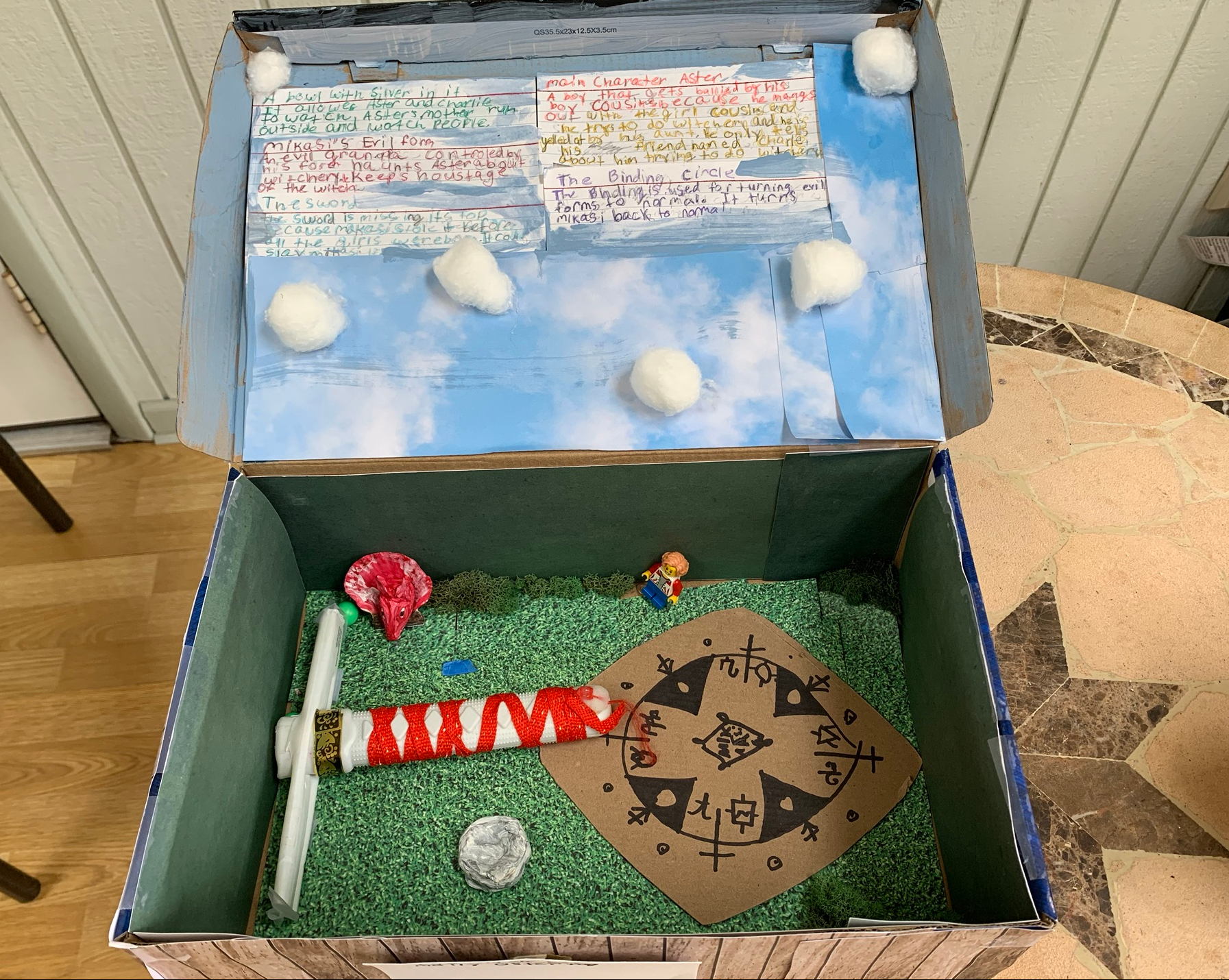
Today’s teachers aren’t satisfied with students reading a book and showing their comprehension of its themes. They want pupils to be able to do arts and crafts about it.

Buster, Big Man, and I are all creative in our own ways, but rarely does that creativity spill into the realm of arts and crafts. I read a lot of books, yet I can’t recall a time when I’d finished a novel and been inspired to fashion a paper doll in homage to the protagonist.

Perhaps I am out of touch with modern times, because it seems that every book must inspire some diorama or figurine. After stumbling through the book, this is where my boys fall flat. They fall flat on top of me, the man who waits, with his bag of popsicle sticks and Elmer’s glue, to memorialize in sculpture every book his reluctant children are forced to read.

I would be a more active blogger, but with Buster so close to junior high, I must devote my time to perfecting Play-Doh replicas of Romeo and Juliet.

We’re empty netters now

It’s amazing how a little dose of parenthood can change your perspective. I suppose this is true in regard to human children too, but I’m thinking about the parenting of adopted insects.

For Big Man’s birthday, we got him a butterfly kit. This is a plastic cup of caterpillars and some mysterious earthy substance that we assumed was their food.

The caterpillars looked dead when we took their plastic habitat out of its box. At that point, our emotional attachment to them went no deeper than figuring out how to return a box of dead insects for a full refund.

The caterpillars were not dead; they were sleepy from their long, dark journey from the caterpillar factory. With a little light added to their world, they came to life, eating the mass of brown stuff and growing at an impressive rate. At the moment we discerned the change in their sizes, our emotional attachment to a cup full of bugs began.

They were supposed to climb to the lid of the container and there attach themselves for cocoon construction. We all gasped with awe at baby’s first steps as one, then another, began the climb. They must have been still a little hungry, because one after another they came back down for a snack, putting us all on an emotional roller coaster as they went up and down without attaching themselves to anything.

At last one of them hung from the lid and began the transformation. There was rejoicing throughout the land. One by one, they all followed suit, with the exception of one confused late bloomer. We wrung our hands over him, speculating upon whether he was ill or just daft. Finally, he joined his comrades and we all breathed easier.

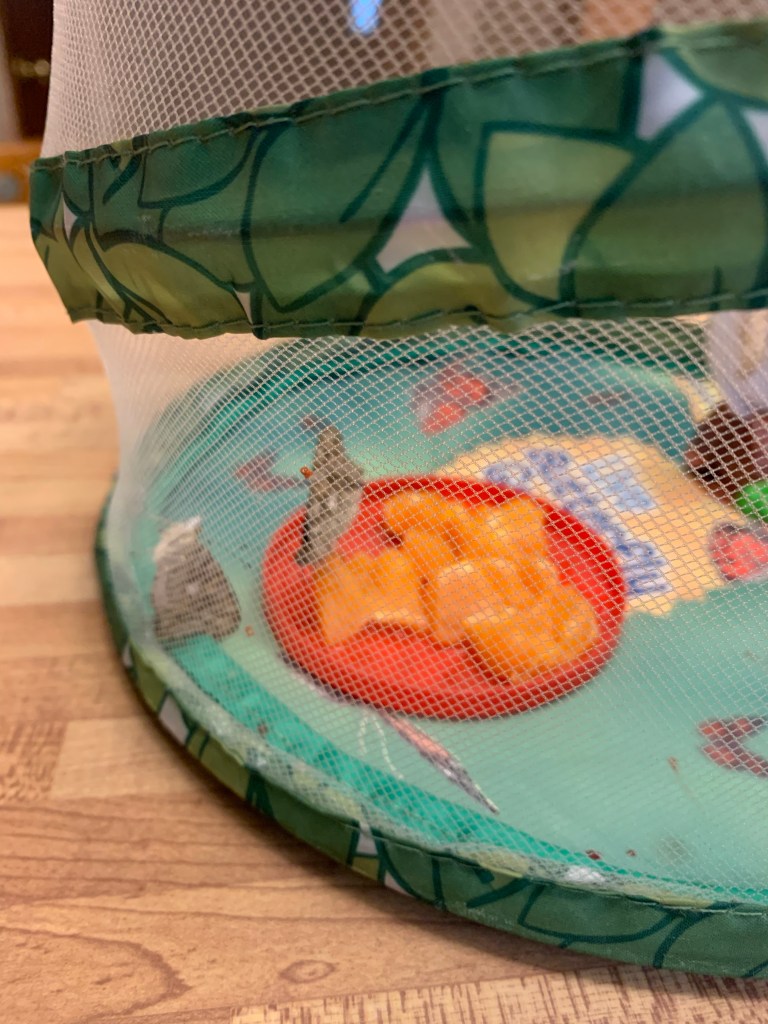
We transferred them to their netted nursery. How long was it supposed to take them to be (re)born? No one knew. Days of doubt followed. One morning, there was a real, live butterfly clinging to the netting, his cocoon an empty shell. More rejoicing ensued.

It’s so hard to get children to smile for the camera.

Another butterfly appeared, then another and another. All but one had emerged victorious. While we waited and worried about the last, we cut up tangerines and carefully set the fruit inside the cage for food. I busied myself making our babies happy and comfortable, careful not to let anyone escape.

This made me realize that if a cousin of these precious creatures had flown into the house from outside, my wife would be chasing it with a bottle of Windex and a fly swatter. She’s not fond of insects, except the ones that are family.

We prepared ourselves for the worst regarding the remaining cocoon. Just when we had given up hope, there was movement. The butterfly struggled, but could not free himself. It was heartbreaking to watch him entangle himself deeper in silk and cocoon wreckage.

My wife prodded me to help him. With a toothpick I tore away his sticky fetters. I freed him, but alas, his wings were malformed. At my wife’s bidding, I set our poor Tiny Tim down next to the fruit, so the doomed child might live out his days in comfort.

The day came to send the kids out on their own. All but one found their way out into the open air. The last stayed by the fruit. My wife was convinced he was refusing to leave his wounded buddy. He might have just been hungry. The next day, the injured one expired. We gave the last healthy butterfly another chance to go. Having a clear conscience, he did not stay for the eulogy.

I wonder where the kids are now. Have they stayed nearby or are they off to see the world. I hope they don’t come home to visit. We don’t like insects in our house.

3 kids x 3 different schools = 9 billion emails

I attempted to write a post about having three kids in three separate school buildings this year, and how I’m feeling, more than ever, like I am going back to school alongside my kids. That post wasn’t good: it came off as whiney; it wasn’t entertaining; and its tone insinuated that the blame for parents being inundated with emails and homework belonged to the schools and the teachers.

While some schools and teachers are better than others at managing the information dump on parents, they are all following the dictates of a society that, yearning so mightily to make things easier, has made things more difficult.

The best way to illustrate this may be to compare school life today, with school life during the 1975-76 academic year, when I was in third grade (the same grade as my youngest child today).

During the 1975-76 school year, my mother became a single parent. She had seven children still in the public school system. There was no such thing as email. This, no doubt, prevented her jumping off a tall bridge.

CAR LINES

Our schools’ car lines block traffic in the streets around the schools. They allow parents to display the worst of their angry impatience or disregard for the time of other parents. Consequently, every school sends out a two-page email of car line procedures.

In 1975, the car line was three cars speeding up to the front door 15-30 minutes late. Only kids who had fallen behind schedule were driven to school. Everyone else walked or rode the bus.

LUNCH MONEY

The web site our schools use to keep track of lunch accounts changed. I must set up a new account and register each of my children. To do this, I need a student number for each child. I know one of them. My high schooler also needs a PIN number to access the money on his account in the cafeteria. I wish he could just be concerned with the numbers in math class.

My mom gave me enough money every Monday to buy a lunch ticket for the week. Each day the lunch lady punched a hole in the ticket. After five holes, the ticket was discarded. If I forget my money, they made a note in their book that I had “charged” lunch. The next day I got two holes punched in my ticket. There were no extras to buy; lunch was lunch, no more, no less.

Demonstrating car line procedures in the days before PDF diagrams and email.

PROGRESS REPORTING

Our schools use another website/app for parents to follow their kids’ assignments and grades. I set up an account this year. I was able to get one kid on it, but only the app accepts my login. Of course you can only add students via the web site (which doesn’t recognize my credentials). Also, you need a separate code number (different from the student ID) for each kid. This is another secret number I have for only one kid. Looks like the others will be monitoring themselves.

My mom monitored our progress by leaving things alone until she got a note from a teacher. She would address the issue and then go back about her own business. But things were far less competitive then, and she already had one child attending a state university, so she understood that not going to Harvard would not mean the end of the world to any of us.

RULES OF CONDUCT

Today I received an email with a link to the Orchestra Handbook for our middle school. My son and I are supposed to read the handbook together and sign the last page. This is just one of the multiple school activities where the rules need to be in writing and the parents must acknowledge receipt of them.

If any rules were in writing, it was most likely a placard on the wall of the classroom that read:

RULES:

Sit Down.

Shut Up.

Rules beyond that were based upon the general principles of proper decorum, and if the teacher had to explain them, it was already a bad day. When we broke the rules, we were punished, and if we whined about it at home, we were punished there too. However, we were almost never sued for breach of contract.

There are other examples, but this is already a long post. We shouldn’t be surprised that our schools reflect our frightened, angry, litigious, password-protected (without so much protection), ease-of-use (difficult) society. But nobody needs to carry cash, so that’s awesome.