Should I immunize my child against the scourge of adverbs?

One Saturday morning, our kindergartener was watching cartoons when one of the toy commercials that saturate children’s programming came on. I don’t remember what the toy was, but it doesn’t matter; just as he does in response to every other toy commercial, my son told me that he wanted it. He’s like fish in a barrel to toy advertisers. They never miss him.

This commercial must have made the toy look exceptionally fun, because the boy added emphasis to his desire. “Daddy, I want that really badly,” he said.

His statement left me with mixed feelings – not the part about him wanting the next random toy that was advertised. I know how I feel about that; I don’t like it.

My mixed feelings were about his word usage. At first, I was pleased at his understanding of the adverb form. I was happy that he didn’t say, “I want that real bad.”

I could only afford to be impressed for a moment, though, before the word really began raining on my parade. Really is most often a wasted word. We all, including me, use it too much. Nine times out of ten, it adds nothing to the sentiment. “I want that badly,” would have conveyed the depth of his desire just as well. Omitting really doesn’t make me think he wants it the opposite of really badly; I’m not left wondering if he wants it fictitiously badly.

Then, I thought about his choice of the word badly, and the clouds burst above my proud Papa parade. Adverbs take up a lot of space in our sentences without doing much to earn their place. Of the total, questionable population of adverbs, badly is a bad one. I guess it has its place in statements like: “The child expressed his desire badly.” But when you want to use an adverb to add emphasis to a desire, isn’t it better to use one like dearly?

What does it even mean to say you want something badly?
 

barrier parenting

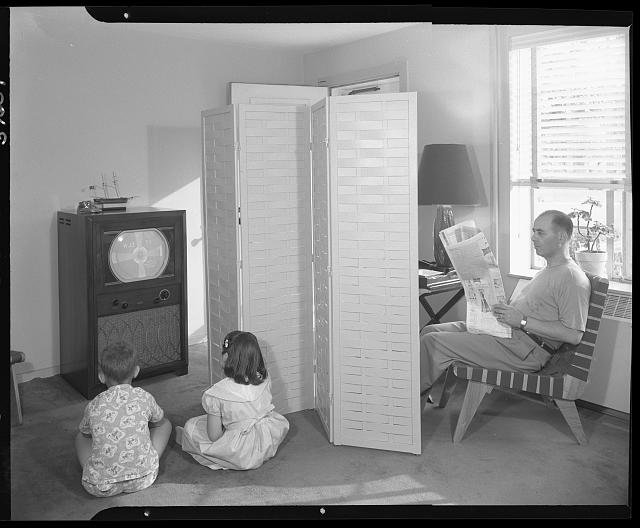
“You’ve erected a barrier between us with your constant desire for toys and your inefficient use of language.” (Image: Gottscho-Schleisner)


This is what too much writing gets you. Sometimes it brings rain to parades that should be clear skies and sunshine, as this one should have been. “I want that really badly,” is a fantastic use of language for a five-year-old. Moreover, what five-year-old is ever going to say, “I want that dearly.”? What 50-year-old says that? The only person I know who would say something goofy like that is neither five nor 50, but he reads too much Victorian era literature.

In the end, I am proud of the boy’s grammar, although I wish he would go back to his simple, “I want that,” at the end of every toy commercial. It’s concise and it will disappoint him no worse than “I want that really badly,” will when he doesn’t get the toy.

Meanwhile, I am happy that I didn’t vocalize my mixed feelings. They were misguided, and I wouldn’t like to embarrass myself speaking such unnecessary words in front of my son.

Be it ever so humble, there’s no place like a house with the right kind of bed in it

On the days I pick my son up from kindergarten, we come home through the neighborhood. There are a lot of very nice, roomy houses on the school side of our neighborhood. The homes get smaller and plainer as we get closer to ours. When there is nothing left to envy about the houses we pass, we know we are home.

dream home

What our house surely looks like from the other end of the neighborhood. (Image: Marion Post Wolcott/US Farm Security Administration)

There have been three or four houses for sale along our path since we began taking it. They are all near the school, over on the swanky side of town. We couldn’t afford to upgrade to any of them, but with the addition coming to our family, it is tempting to fantasize about living in a bigger house.

My son always points out each house with a for sale sign in the front yard. We make a game of picking out which property each of us thinks is the nicest. It’s kind of a stupid game, since they are all nicer than people of our ilk can afford. But it passes the time.

One day, on our trip home, I asked the boy, “Would you like to move to a new house?”

“No.”

“Not even a nice, big, fancy one like these?”

“No.”

“Why not?”

“Because the new house might have a girl’s bed in it.”

“A girl’s bed? What does that mean?”

“It might come with a girl’s bed in my bedroom instead of a boy’s bed.”

I’d never thought of that. Who would want to take such a chance? “When you move to a new house, you take your own bed with you,” I explained.

“Oh. That’s a good idea. I should keep my same bed.”

Yesterday was my morning to take him to school. All of his favorite pants and shirts were in the hamper, so we had to make do with whatever was clean. He balked at the two pairs of pants I could find that fit him. Then, when I finally got him to understand that there were no other choices, he complained that the shirt I found went with a different pair of pants. The situation escalated. I yelled at him to just put something on before we were late. He whined and got all pouty about having to wear such unappealing clothes.

fresh laundry

All his other clothes were dirty. (Image: Dorthea Lange/US Farm Security Administration)

And there I was arguing fashion with my five-year-old son. I’d never imagined a scenario that would lead me to this result.

It’s a good thing I don’t have any money to buy a new house. There was an hour yesterday morning when I might have shopped for one that came with a girl’s bed.

That knee-jerk reaction faded fast. It soon occurred to me that he was arguing about his loss of control more than about fashion. Even so, he can be into fashion or whatever else he wants. He’ll always be my boy and he’ll always be able to bring his own bed wherever we might go.

Into each life some shrimp must fall, but too much is falling in mine

My son’s favorite food is shrimp tempura. But he only likes the shrimp tempura sushi rolls from one particular restaurant. He eats shrimp only at this restaurant, and he eats nothing but shrimp at this restaurant. Consequently, when he was about three, he renamed this restaurant Shrimp, as in “Let’s go to Shrimp for dinner tonight.”

I, being incorrigibly out of touch with what’s current and trendy in the world, don’t care for sushi. Fortunately, Shrimp makes a pretty good bowl of chicken teriyaki, allowing me to associate with the in crowd at dinner time. My wallet helps in this regard as well.

My son asks to go to Shrimp constantly. I can only eat so much teriyaki. Besides that, he can pack away three shrimp tempura rolls by himself. Then, my wife has to have her sushi, and I my hanger’s-on dish. It gets kind of pricey. We can’t afford to eat there every week.

Enough shrimp to feed a kindergartner

Did somebody order the child-sized shrimp basket ? (Image: John Ferrell/U.S. Farm Security Administration)

Meanwhile, at my son’s school curriculum night, his teacher showed us some little squares of yellow paper, referred to in Kindergarten parlance as Golden Tickets. Children earn a Golden Ticket by being exceptionally well-behaved. For those of us who looked worried about our child’s ability to ever meet this sky-high threshold, she guaranteed that every child would be sure to earn one during the year. Not only did this reassure me, it also put me under the impression that Golden Tickets would be scarce.

After two weeks of school, what does the boy bring home but a Golden Ticket. Okay, I thought, the teacher is unloading Golden Tickets early to get the kids excited about good behavior and spread some confidence. We’ll make a big deal out of this one, because we don’t know how many we’ll see once things in the classroom get real.

As expected, the boy asked to go to Shrimp that night. Who am I to refuse the bearer of a Golden Ticket? At the restaurant he shoveled sushi away like the deserving soul he was. When the bill came, I was first struck by poverty, and then by genius. “If you want to come back here again,” I told him, “you’ll have to earn another Golden Ticket.”

I felt good about the months of dinner savings I had just won for myself. This child was the perfect blend of his mother’s talkative nature and his father’s rebelliousness to invite a long drought of Golden Tickets. His most strenuous efforts to win favor would be doomed by biology.

Four whole days later, my wife called me at work with a message from the boy. “He wants you to guess what he brought home from school,” she said.

There was a substantial part of me that hoped for head lice. But I knew the awful, golden truth.

It’s going to be a long, expensive year. My genius lies shattered on the ground – under the table with the rice crumbs from my son’s three plates of shrimp tempura.

Fridge of Golden Tickets

Since the writing of this post, we have acquired a third Golden Ticket. We’re going to need more Presidents and sting rays.

Dad, can I have a Sugar Mama?

When I talk to my son, I try not to give him stereotypical parent-speak in reply to his questions. My hope is that he will learn to put thought into his words rather than repeat the things he hears most often, just to keep his voice prominent in conversations. This is the goal, but sometimes it is difficult to avoid backsliding. Sometimes, I find myself uttering phrases to him that are so hackneyed they could have been written in Hollywood.

We had a few people visiting our house. They were all unmarried, young adults. Our guests discussed among themselves the topic of whom they each were, or were not, dating. Since my son and I had little to add, we played while the grown-ups were talking. I didn’t think my son was paying any attention to the discussion, which means he drank in every word of it.

The next day, we had to drop my wife off at the home of one of our erstwhile visitors. After my wife exited the car, my son asked me, “Who lives here?”

“Jill.”

“Who’s Jill?”

“Remember the blonde-haired lady who was at our house yesterday?”

“Oh. That’s Jill?” There was short pause, followed by, “Daddy, do you think I should date her?”

After picking my jaw out of my lap and replacing it onto my face, I told him, “No.”

“Why not?”

This was my fatherly moment of truth. I could have used it to have an intelligent discussion with my son. I might even have taught him something. Let’s examine the options.

Intelligent thing #1 I could have said, but didn’t:

“Do you know what it means to date someone?”

This might have produced a meaningful discussion about relationships. Once he learned that dating has been known to lead to kissing, he would have thrown himself into reverse.

Intelligent thing #2 I could have said, but didn’t:

“Because four-year-olds, even if they are four-and-a-half, don’t date anyone.”

This would have allowed me to explain that, at his age, playing in the dirt is so much more fun than dating would be. Moreover, even as an adult, he would have dates when he wished he could just walk out and go fling himself into a dirt hole.

Mud puddle crew

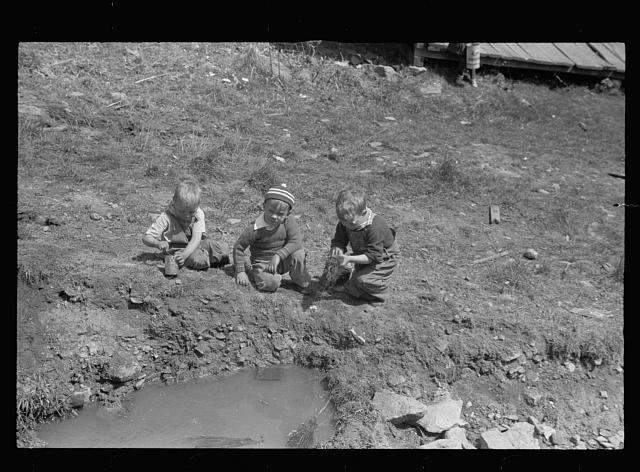
“Wha’d’ya say fellas? Should we go back to our dates or fling ourselves into this hole?” (Image: John Vachon/U.S. Farm Security Administration)

And the winner is . . . . .

Trite thing I blurted out without thinking:

“Because she’s old enough to be your mother.”

Every grown woman on Earth is old enough to be his mother. That doesn’t concern him because the boy has no idea what age has to do with dating. He doesn’t know the difference between dating and saying hello. I might as well have told him not to say hello to Jill because she’s old enough to be his mother.

It made that much sense, and yet I said it.

And he accepted it.

“Who should I date then?” he asked.

“Someone your own age, when you’re much, much, much older,” I said.

And we left it at that.

Mending pants

Don’t get tangled up with an experienced woman. She’ll only string you along.