It will be quiet someday; meanwhile, let’s have some noise

Someday they’ll stop calling me Daddy. My name will change to Dad. I won’t mourn that day. There will be, I hope, benefits to them becoming self-sufficient. Maybe I’ll even catch up on my reading.

In the next few weeks, Buster and Big Man will turn four and two, respectively. There are no more babies in the house. I’m happy I haven’t had to heat a bottle in a year, and I look forward to the day the last one says goodbye to diapers. Maybe we’ll take a vacation with the diaper money.

I appreciate all the things Big Brother can do for himself, from making a snack to going to the bathroom without me having to know about it, although sometimes he still likes to announce his intentions. I’m sure I’ll enjoy feeling less like a servant in my own home when the little boys can do things for themselves. I may even gain weight from all the sitting down for more than two minutes in a row I plan on doing.

I imagine being able to go places without someone falling asleep in the car, or what really blows my mind: going places by myself. The really fine thing will be spending time with each individually, free of the competition that comes so naturally between them and turns them into a raucous mob. I’m looking forward to talking instead of shouting over the din.
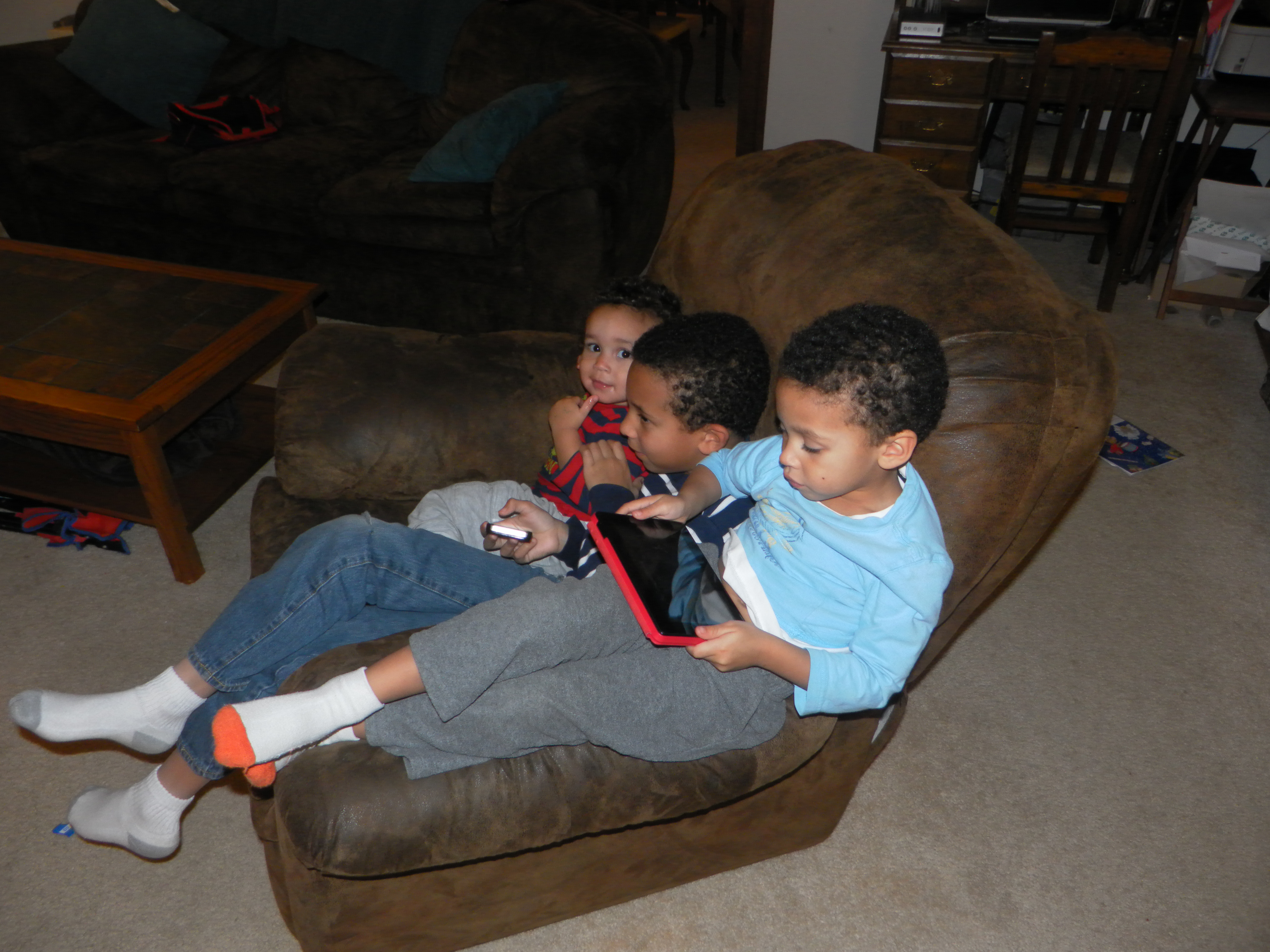
The raucous mob does settle down from time to time, but always in Daddy's chair.

The raucous mob does settle down from time to time, but always in Daddy’s chair.

I look forward to many good things that will come with my boys getting older, yet I am old enough to know I can wait for those things. They will come whether I appreciate the days preceding them or not. It’s best to appreciate all the days; they never come around again.

There are days when keeping on top of all these boys’ needs runs both parents ragged. In spite of this, my wife would go on having babies forever if that were possible. I’m too feeble for that, but I will concede that nobody hugs quite as good as toddler. I will further admit that nobody’s mind matches the waterfall of discovery of a preschooler’s. And while I’m at it, nobody’s imagination is more entertaining than a grade schooler’s.

As much as I look forward to more peace, I’m in no hurry to say goodbye to toddler giggles or preschool jokes or grade school stories. I can’t hold onto them forever, and I have no desire to. I only want to enjoy them to their fullest while they are all around me. I want to experience the things yet to come, but I can be patient for those seasons to have their place.

Time doesn’t need my help. It moves too quickly already. Sometimes it’s easy to anticipate the future at the expense of the present. I hope to catch myself when I fall toward this trap; though I will not mourn the day I become just Dad, I will, a little bit, mourn the loss of the day when I was Daddy.

The secret league of horrible parents

We just won a moral victory of sorts. It took two months, and there were times I doubted the Fates would allow it, but now that it’s done, I feel free to speak of it.

I mentioned that our seven-year-old son was on a basketball team. If you saw that post, you may think our victory is a decision to keep score at the games, but it’s not. It may be even more valuable than that.

Over our three years in sports, there has not been a team that didn’t require a rotating list of hapless parents to bring healthy snacks for the kids to eat at the end of every game. The Team Snack was the Sacred Cow of youth athletics. God knows, kids playing ball for an hour would wither to dust if not fortified with granola and sugar-free fluids within seconds of the final whistle.

When I was a boy, we played all afternoon without a thought to our bellies, but then we were not enlightened enough to know we were doomed to die young for our bad habits. We drank whole milk too, to give you an idea of how recklessly ignorant we were. Our parents were the worst, making us have fun all the way until dinner time. For shame.

My wife and I dislike game-day snacks because we struggle to get to the games on time without having to remember the groceries, and it’s not like we can just grab a bag of Doritos or Oreos on the way out the door. These evil snacks we have, but only because our tragic upbringings neglected to teach us any better. Blame the 1970s.

old school

After the game, we had to take up the planking from the pasture and milk the cows before we could even think about eating. (Image: Russell Lee/US Farm Security Administration)

They told us it couldn’t be done. They said the kids on a snackless team would grow envious of the other team’s snacks, though I don’t know a single kid who covets a V8 juice box and a bar of pine needles. Still, no one would want to be on the team whose bad parents didn’t do exactly what the good parents do.

So after the first practice, we waited for that email – the one organizing the snack rotation. We’d highlight a game on the schedule, dread it’s coming, and hope we were both available to attend, so all our children and all our snacks could be at the same place at the same time.

The email never came. The coach was new, and I don’t think she even thought about snacks, which makes me love her a little bit. For the entire season, we went to games where other teams had snacks. Our team never bemoaned our lack of snacks. I saw no indication they even noticed. From our team’s other parents, I never heard a peep about snacks. Our snackless rebellion was our little secret.

I now suspect that many parents dislike the post-game snack, but no one publicly decries it, because that might make them the worst parent ever, and who would ever dare flirt with that consequence?

A game nobody wins

The oldest boy is playing basketball this winter. I am happy to report he appears to have a brighter future as a basketball player than he does as a soccer player. For one thing, he’s taller than most of the other kids. Now if he would just learn that he’s allowed to jump for a rebound, he’d be on the road to stardom.

My son’s team is made up of role players. On a team of 1st and 2nd graders, every kid (my boy included) is convinced his role is to shoot the ball as often as possible in each game. If this means picking up his dribble, taking a large hop to one side, then resuming his dribble in the clear, in order to get a better shot, then that’s just the strategy adopted. Passing the ball to a teammate is the last resort, only to be considered when one is in danger of being crushed by five closing defenders.

It occurred to me that if I were the coach of such a team, I would tell the boys, “If you want to win games, you’ve got to work as a team.” Upon thinking this, I realized I would say no such thing, and for one simple reason: Nobody wins games in our league. There are no winners or losers, just a bunch of elementary schoolers running around the gym, each craving the chance to add to the number of baskets he’s scored.

Nobody keeps score. Officially. Some of the parents keep it quietly in their heads. The kids try to keep it, but their tallies vary widely. They are much more precise at counting the number of points they have scored individually, which bodes ill in this team sport.

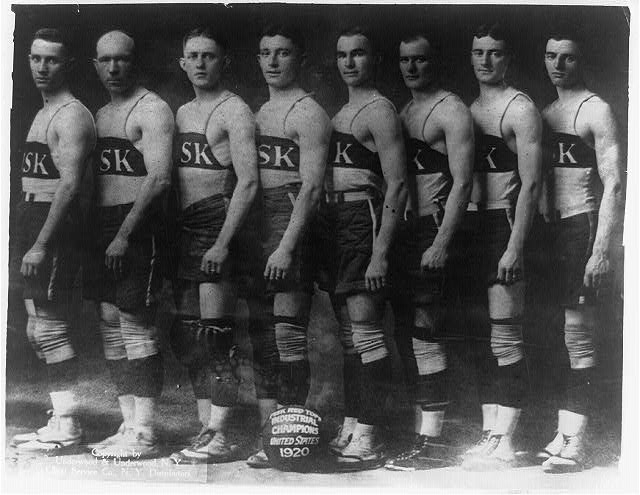
Your 1920 American Industrial League Champions

You’ll never become Industrial League Champs if you don’t learn to work as a team. Also, you may to keep score in some of the games.

Not keeping score is society’s admission that it no longer trusts parents to teach sportsmanship. There may be good reasons for this lack of trust, but it is a mournful admission just the same. It means society doesn’t trust itself to produce humans that are, on balance, kind people. That’s too bad, because nothing improves that doesn’t trust itself.

In our league, and probably most leagues like it, we have limited the chances of gloating, hurt feelings, and the other disappointing aspects of competition. In doing so, we have limited the opportunity to experience the inspiration of contributing to a team effort, and the ideal of putting the team’s success ahead of one’s own. Is the tradeoff worthwhile? Can they make up for lost teamwork concepts when they’re older? I’ll have a more fully developed opinion on that in a few years.

Meanwhile, there are rumors that the refs are going to crack down on traveling and double dribbles. This has to keep the coaches up at night. I would much rather have to teach these kids good sportsmanship, citizenship, civics, and probably even advanced mathematics than how to resist the urge to shuffle a few feet to the right to get a clear shot at the hoop.

We got the milk, now let’s tackle those cookies

Buster, our three-year-old,  struggles to pronounce certain consonant sounds. The most famous of these is the k or hard c sound. Buster has always compensated for this lack by substituting another sound where the k goes, usually a t. Hence, milk becomes milt and work becomes wort.

We’ve learned to recognize these hybrid words, allowing him to express himself. At the same time, I have been trying to train him how to pull his tongue back into his mouth in order to pronounce the elusive k.

where's that tongue?

Civil Defense workers searching mouths for the elusive k sound. Everyone did their part to help the war effort. (Image: Ann Rosener/U.S. War Information)

Our practice had yielded limited results. Then one day, he requested a bowl of cereal. When I asked if he wanted milk in it, his answer was non-committal. “Yes, milk or no, milk?” I asked again.

“Yes, milk,” he replied, clear as bell, whenever a bell perfectly pronounces the word milk.

I did a double take. “What? What did you just say?”

A smile of recognition stole over his face. “Yes, milk,” he belted out proudly.

I picked him up and hugged him. “You said, milk. What a brilliant boy! You did it!” I gushed as I spun circles with him in my arms. He beamed at me proud and happy at how proud and happy he’d made me.

When Mommy came home, he ran to her to show off the word milk like she’d never heard it before. More hugging and spinning ensued.

In the week since, he’s showed his mastery of milk to the next door neighbor and anyone else who happened by. When it’s eluded you for all your life, milk becomes powerful juice.

Even when I was a child, Mr. K stood in  the shadows of Mr. M and Mr. T.

Even when I was a child, Mr. K stood in the shadows of Mr. M and Mr. T.

The other night, Buster, Mommy, and I were enunciating about milk. I happened to be about to eat a cookie that Buster had his eye on. “I’ll give you my cookie if you do two things,” I told him. “First, say cookie.”

Up until now, cookie has always be tootie. Buster thought hard. “Cootie,” he said, followed by “Tookie.” Getting two hard c sounds into one word is daunting work.

“Okay, that’s close enough. Now say candy.”

Buster focused. “Canny.”

“That’s so close. You got the c right but you left out the d.” D has never been a problem for him, but apparently there was no room for it in a word that already had a c.

“You’re very close. Try one more time.”

Buster looked longingly at my cookie. The pressure was too much. He couldn’t focus on the c and hit the d too.

“I know you can do it. One more try,” I pleaded .

Perhaps he saw the cookie drifting away from him. He looked at me hopefully, then shifted his gaze to the always compassionate Mommy. He took a deep breath and said with clarity and confidence:

Milk.”

Sometimes it’s not the cards in your hand; it’s how you play them. He won two proud smiles and a cookie.