If you keep asking me to lie for you, how are you ever going to learn to do it for yourself?

Buster came home from 4th grade with a job application. This labor shortage must be getting pretty bad, I thought, if they’re recruiting workers in elementary school. On the bright side, if it were an application to work in a restaurant, maybe he’d get a gig as bartender and I could score some free drinks.

It turned out it was only an application for one of the classroom chores listed on the back of the paper. There are classroom tasks for the kids to do, and they must choose which one they’d prefer and apply for it. This strikes me as a creative exercise for the students, but I’m still a little disappointed at the lost dream of free drinks.

Buster was not as appreciative of the exercise as I was. First, he couldn’t decide which job he wanted. He asked me to choose for him, but I refused. I wasn’t going to spend the school year hearing him whine that I had picked out a lousy career for him. Besides, it wasn’t my choice to make.

Take care choosing your 4th grade job; you could be doing it a long time.

At last, he decided to apply to be the class “Substitute.” This is the kid who does the job of any of the more ambitious kids when they call in sick. The choice didn’t exactly scream “initiative” at me, but it was his choice.

Next he had to explain why he wanted this job. This was a huge hurdle for the boy. He fretted and pouted and whined, begging me to answer this for him.

I told him I couldn’t explain his choice. He was the only person who could do that. “Just write down why you chose that job,” I told him.

“I don’t know why,” he whined. “I just picked it randomly.”

“Then write that down,” I replied. I knew he didn’t feel like that was as adequate answer. Also, I had a feeling it wasn’t 100% true.

“I can’t say that!” he protested.

“Is that why you picked it?”

“Kind of.”

“And?”

“And you don’t have to do much.”

Aha! The truth comes out! Imagine a nine-year-old boy wanting to avoid doing chores! Scandalous!

“But I can’t put that down as my reason,” he said. “Can you tell me what to write?”

“No. I can’t. This is where you have to think for yourself. If you don’t want to tell the real reason, you have to think of something else that makes sense.”

“Can you just tell me?” he pleaded.

“No. This is why you go to school. To learn how to think, so you can lie plausibly.”

After more pouting, he settled upon the explanation that he liked to do a variety of jobs, which I thought was as credible as it was disingenuous.

Some people work hard at useful tasks, and some people work hard at excusing themselves from such tasks. Sometimes the excuses end up being more burdensome than the original tasks. I wonder if, in all his application angst, that truth ever occurred to Buster.

Don’t be a Puzzled Penguin

In the past six months, I’ve learned more about being a first grader than I have since I was a first grader. Part of each of my days is spent in first grade, learning to read and do addition and subtraction. Part of each day is spent in third grade as well, learning to read a little better and do multiplication and division.

There are a lot more parents, like me, in first grade this year than there were in the 1973-74 academic year. As I recall, it used to be mostly little kids, but now parents are having to figure out how to use all the many online tools that make the remote learning elementary school go. Fortunately, we all have a six or seven-year-old nearby to help us.

It’s kind of a vicious cycle, but in order that we don’t get too frustrated, we call it a symbiotic relationship: Big Man wants help with his homework; before I can begin to help him, he must teach me how to use the online platform that jealously guards this day’s homework inside its electronic labyrinth.

It can be taxing, but we’re getting through it together. Our two heads combined are enough to graduate one of us from first grade. I just hope it’s the one still full of potential.

Along the way, we’ve have had some adventures and met some characters. One of the noteworthy entities I’ve met in electronic first grade is the Puzzled Penguin. The Puzzled Penguin shows up occasionally on one of the arithmetic applications.

I first met the Puzzled Penguin when Big Man and I encountered a math problem that went something like this:

                The Puzzled Penguin thinks 7 + 5 = 10 + 3. Is he correct?

Before I had even finished reading the problem, Big Man announced with certainty: “Nope, he’s wrong!”

I was amazed at the speed of his calculation. “Wow! How’d you do that addition so fast?”

“I didn’t add anything.”

“Then how do you know he’s wrong.”

“Easy. The Puzzled Penguin’s always wrong.”

“But why is he wrong?”

Big Man shrugged. “Because he’s dumb?”

“I mean why is he wrong in this case?”

“Because he’s still dumb?”

I put the screen squarely in front of him. “Okay. Do the math and tell me why he’s wrong.”

He gave me an exasperated look. “I already told you the answer. Because the Puzzled Penguin is always wrong.”

As he was speaking, Buster entered the room. “Oh, the Puzzled Penguin,” Buster mused. “I remember him. That dumb bird is always wrong.”

The only thing we learned about arithmetic that day is that penguins are consistent.

Believe me, we’ve tried to help him.

The opposable thumb of our family

Buster and Big Man got into a debate, separate and apart from the many outright fights they have over LEGOs, somebody calling somebody else Butt Cheek, or the billion other potential provocations. This debate involved no hitting or kicking, probably because I intervened before it had a chance to run its normal course.

The debate revolved around the fingers of the hand as they related to our family structure. We happen to be a family of five, which means each person gets to be represented by a digit on the standard human hand.

They agreed that Daddy was the middle finger, because of its relative length, not because of its proclivity to become rude when left unattended. Mommy was the ring finger, because in our family, ring fingers run slightly taller than index fingers, just like Mommy is still slightly taller than Big Brother. Conversely, Big Brother was the index finger.

The point of contention was over which of the debaters was the pinky finger and which was the thumb. Each boy claimed to be the pinky finger and relegated the other to the distant position of the thumb.

The thumb is set apart and stands on a lower pedestal than the rest. This is what they saw when they looked at their hands. It was different and apart. Nobody wanted to be either of those things.

Our family hand print as debated by Buster and Big Man. Image Credit: Buster’s right hand.

They went on casting each other in the role of thumb, without a thought to its uniqueness or value.

Because the debate was becoming annoyingly monotonous, somebody had to step in and tell them who was right and who was wrong.

“You’re both wrong,” I told them. They looked at me with incredulous faces. How could they both be wrong? There were only two positions in question, and between them, they had all the possibilities covered.

I held up my hand and pointed out the fingers. Daddy was the middle finger. Big Brother was the ring finger. Buster was the index finger (although there are certain properties of the middle finger that suit him best). Big Man was the pinky, and Mommy was the thumb.

They stared at me dumbstruck. How could Mommy be the lowly thumb, the digit nobody wanted to be?

How little they understood the miracle of the thumb, the digit that brings all the fingers up to their potential.

“It’s true,” I told them. “Mommy is the opposable thumb of this family. She’s the one who makes it all work. She is what separates us from the animals. Without her, we might as well be a family of skunks.”

Somebody farted.

Well, Mommy does her best to differentiate us from a family of skunks, but she has her work cut out for her in this house full of stinky boys. Sometimes I think she should move away to someplace nice and let us revert to our natural state, but a good thumb never abandons the hand.

Goodnight half moon

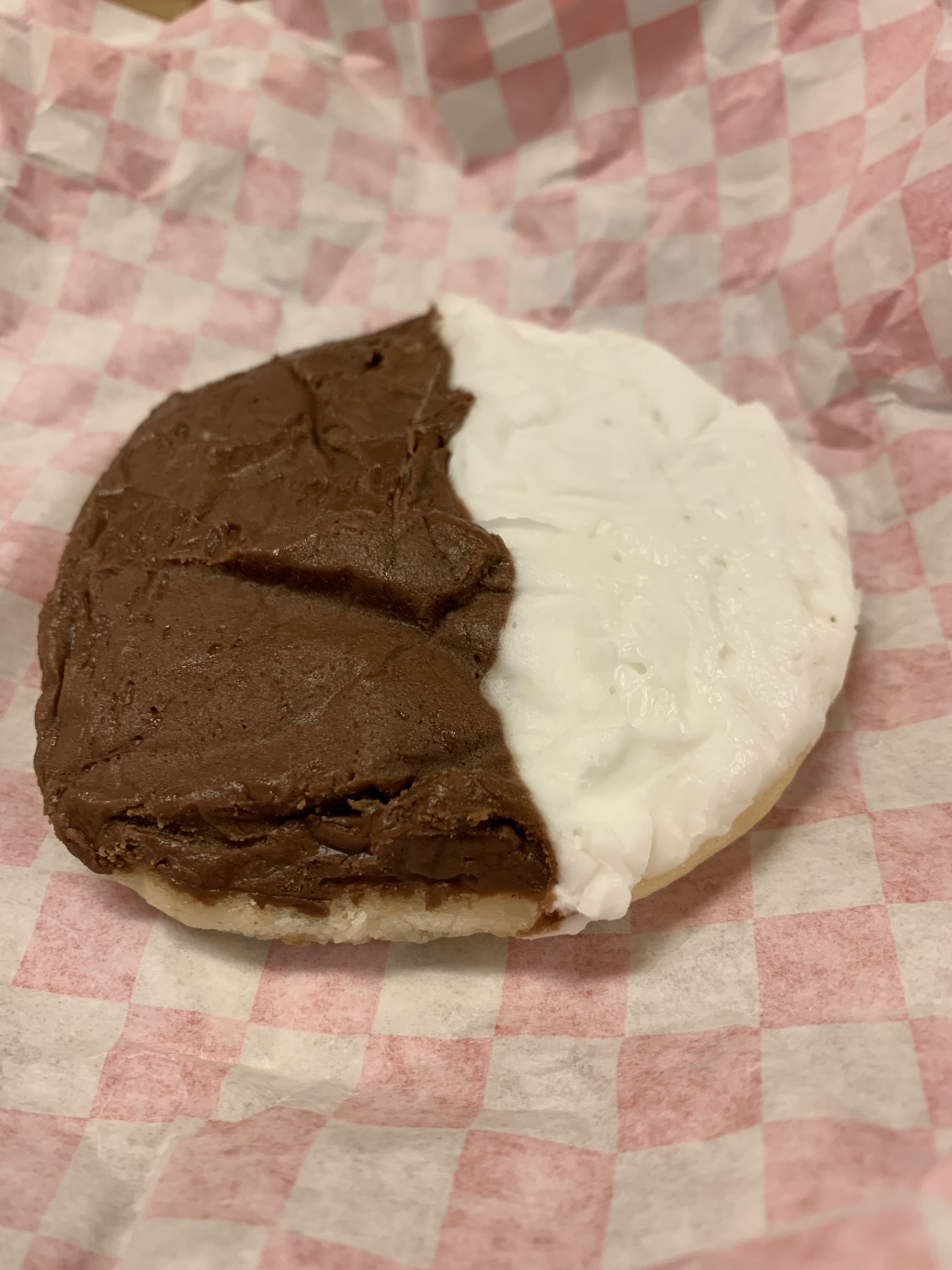
If you’re not from Central New York, you may not understand the significance of this little bakery gem.

Not the perfect example, but a respectable effort.

It’s a half moon cookie, not to be confused with New York City’s black and white cookie, which looks similar to the naked eye, but is something else entirely.

Half moon cookies were part of my childhood. There were many shops in the Mohawk Valley that sold them, but they were not all created equal. There was one little bakery in the village of Fort Plain that made the perfect half moon. They made the éclair to end all éclairs too, but we little boys couldn’t get enough of their half moons.

I remember going to the bakery with my mother, before I was old enough for school. The ladies who worked there knew us, and they never failed to offer me a free cookie as they boxed up our order. I was a shy kid, and even though I wanted that cookie like nobody’s business, I always said no to the first offer. They knew me well enough to not take my no for an answer. I always came out with a free cookie, in spite of my hindering bashfulness.

There are no half moon cookies where I live now. For years, a requisite part of any visit back home was a trip to that Fort Plain bake shop. Those perfect half moons were the delicious taste of childhood at a small-town price that was nothing less than a steal. Then, about 10 years ago, the bakery closed down. I don’t know why, but I suspect a fragile, rural economy and aging ownership had something to do with it.

In the years since, I haven’t had any half moons. Any other bakery’s cookies would disappoint me, so I resigned that piece of my childhood to history.

A few weeks ago, I was overcome by a wave of nostalgia for the half moon. I found a bakery in a different part of the Mohawk Valley that would ship a dozen cookies to me. Emotion got the better of me. Even though I expected to be disappointed, I paid more than I should have for the shipment.

I envisioned sharing the experience with my boys, but they had no interest in the cookies. They’d never seen half moons before, and these cookies were too far out of their experience to be appealing. They wouldn’t even take a taste. So I froze the cookies and ate them one by one at my leisure. They were not perfect cookies, but they were better than my cautious expectations (even after a 3-day journey). The most disappointing thing about them was that none of my boys was interested in sharing in them. Some things must pass away with the generations.

In the end, it was my own sweet journey back in time, and another bitter revelation that you can’t go home again. Childhood, after all, is for children. And that’s how it should be.