A child of the world

About a year ago, I wrote about taking the family to an international festival. This was the event where I won happiness by transferring M&Ms between dishes with chop sticks.

At this festival, two Indonesian ladies showed us a traditional marble game called Congkak. They skillfully moved the marbles between wells cut into a wooden tray as I futilely attempted to follow the strategy. It seemed like a fine game, but it involved more thinking than I like to do at my age. My wife was rather taken with it. She continued to watch the women play as I wandered off to enjoy my first taste of Gangnam Style on a large screen Samsung at the South Korean exhibit.

Later in the day, we noticed people at the Malaysian exhibit playing their own version of the game. This redoubled my wife’s interest. I had to agree that if the populations of two countries so culturally distant, and separated by so many thousands of miles, as Indonesia and Malaysia both enjoyed this game, it must be an exceptional entertainment. Having contributed my requisite wise crack on the subject, I forget all about Congkak in the accompanying flash of euphoric smugness.

Congkak board

A traditional Congkak board – not available at Target. (Image: Tropenmuseum)

My wife did not. A year later, she found something that looked like it at Target. It has a different name, so we can’t tell if it is indeed the same game, but the picture on the box shows marbles on a wooden tray, and that’s good enough. She put the game into the cart, declaring that one of the boys would give it to her for her upcoming birthday.

Can't go wrong with wood and marbles

A game that is available at Target, which we bought on the strength of its wood and marbles.

That night, our son found the game on the kitchen counter, where all things we buy that don’t have a preordained spot in the fridge or the pantry sit until we figure out what to do with them. The marbles in the picture must have reminded him of Chinese Checkers. “Is this a Chinese game?” he asked.

“No,” I replied. “I think it’s Indonesian or Malaysian.”

“Can I play it?”

“It belongs to Mommy. You’ll have to ask her. But I think it’s for her birthday, so she probably won’t open it until then.”

He thought for a minute, then put together a statement constituting a powerful argument for letting him play. “Well, I’m Indolaysian.”

“You are? I didn’t know that.”

“Yeah. Just a little bit. But it’s mixed in with the German and Polish and American and all the other stuff, so it’s hard to see.”

“Oh. Well, even so, you’d better go ask Mommy.”

He let it drop. If his lineage bombshell didn’t move me, it sure wasn’t going to do anything for Mommy.

Now, whenever I take a good look at my boy, I try to pick out the Indolaysian traits. He’s right though. The Indolaysian is mixed in seamlessly with the German and Polish and American, and especially all that other stuff. I can hardly pick it out at all.

How to drive a toddler over the edge

This truth is self-evident. One-year-olds are patriots in their zealous devotion to the pursuit of happiness. They want happiness, and they want it now. They’ll let you know, quickly and unambiguously, when the path they are on deviates from that ultimate goal.

The path deviates regularly, because the things that make a one-year-old happy are often disruptive, destructive, dangerous, or all of the above. Further frustrating the pursuit of happiness is their reluctance to abandon the notion that parents can make all their wishes come true, regardless of the laws of physics or better judgment.

Our one-year-old’s happiness is hindered by baby gates. He isn’t bothered that they prevent him from going down the stairs; someone will carry him down, if he asks. Baby gates frustrate him because they have a mechanism that he cannot operate. He doesn’t need freedom to pass the gate; he wants the knowledge to open it, to liberate himself from ignorance.

gateway to hell

This gate has a long history of vexing one toddler and numerous adults. It has been pulled out of the wall twice – probably not by the toddler.

Once, when he was especially frustrated by the gate atop the basement stairs, I tried to explain the purpose of baby gates to him. I told him that baby gates wouldn’t be useful if all manner of little people could operate them. I was careful in my explanation, but he acted like he didn’t even understand most of the words.

I asked him if he would like me to take him to the basement. The look he shot me said, “Mommy, my juice, and the gate I was working on before you butted in are all up here. What the hell would I want with the basement?”

Toy trains are another frustration to the boy. He loves playing with his big brother’s trains. Big Brother, in adherence to rule number one of The Boys’ Guide to Optimal Utilization of Toy Trains and Real Dads, owns several incompatible sets. The cars of one set won’t hook to the cars of another. This drives the one-year-old into a toddler-sized fit of apoplexy.

His dream is to make a single chain of all the diverse engines and cars in the house. He gets annoyed when he can’t get two cars to hook together. Then, he taps me with his hand and points to the troublesome connection. Since I can’t make incompatible trains fit together, I’m left trying to explain.

the problem with trains

All the connectors are the same color, but somehow that’s not enough. Were the baby Vanderbilts saddled with such trials?

Incidentally, if you want to know what frustrates a man in his 40s, it’s trying to explain compatibility to a toddler.

I finally got him to understand the color coding – blue hook doesn’t fit into white hole. Then he brought me two engines with only white holes as connectors, tapping me on the shoulder and pointing to the work he needed done. You should have seen his face when I tried to teach him that the two whites couldn’t connect without any hook pieces. Knowing what I know of his toddler language, I’m pretty sure he called me a lying sack of something or other before he flung the engines across the room.

How could any child build a viable transportation system with parents like this?

Stuck training the new guy

If you’ve ever had to train a new employee, and the guy was taking a long time to catch on to tasks you could do without a moment’s thought, you might have found yourself thinking the same things as I did the other afternoon.

I was attempting to train a new worker how to use the leaf blower to herd dead leaves into one big pile. There is a profound difference between creating wind and using it to affect some purpose. His insensibility to this, and the resulting random rearrangement of leaves, led me to my first great trainer’s cliché. “It would be so much easier to just do this myself,” I thought.

But that would mean sending my trainee away discouraged. I worked with him on the rudiments of directional leaf blowing. It was a hard sell, which inspired my next trainer’s lament. “This guy has the intellectual capacity of a five-year-old,” I said to myself.

I spent 20 minutes walking sideways with him, shrinking the perimeter of ground covered by leaves. It was probably that I was uncomfortably hunched over the entire time, helping him aim the blower nozzle, that led me to my final nugget of trainer’s wisdom. “I’d be better off trying to teach a first-grader to do this,” I muttered.

This is when I discovered that statements made to relieve frustration (and back pain) lose much of their impact when reality robs them of their comforting hyperbole.

The new employee had the intellect of a five-year-old because he was exactly five years old. It wasn’t my idea to hire him for this work. He volunteered. In fact, he volunteered so vehemently that I’m sure he would have run into the house crying if I’d denied him his training.

Little boys are fascinated by power tools. Combine the necessity of plugging it in to an electrical outlet with the magic of creating wind, and the leaf blower is a kid magnet. Unfortunately, the power of the gods comes with a steep learning curve for a kindergartener.

To his credit, he stuck with the training, and the associated parental scowls, long enough to get the hang of it. When our herd of leaves was under control, I let him go solo.

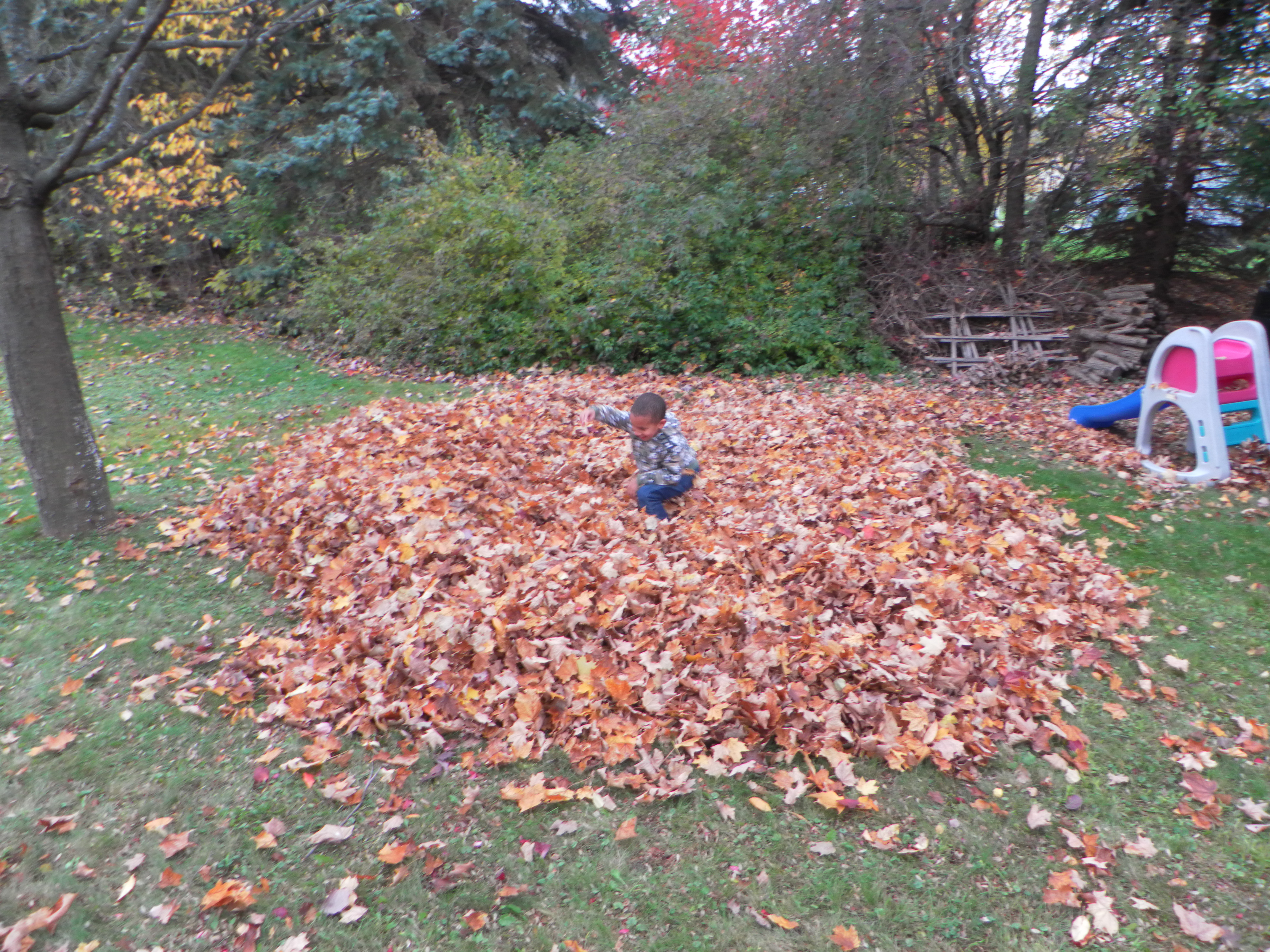
He even earned a short break for the obligatory leap into the pile.

rewards of hard work

I just hope this doesn’t make him think that after his first day of training at McDonald’s they’ll let him jump into a pile of hamburgers.

But the days grow short this time of year, and there was a large pile of leaves to vacuum and bag. He wanted to take training on this process too, but the machine was a little tall and heavy for him to hold upright. It was clear that his workday was over when he began throwing armfuls of leaves at me and shouting, “Confetti!”

Leaf fort

Makes you wonder how many children get bagged up and carted away with the leaves every year.

In the end, he learned a little bit, and I learned a lot. I have to practice being more patient with my volunteer helpers. As to whether I would be better off trying to train a first grader, well, I guess we’ll find that out next year.

I’m the Einstein of chicken strips

One day, when our older son was barely three, I decided to make chocolate chip cookies. He was in the other room playing as I mixed up the batter. He must have smelled them when they were about half way through baking. He came into the kitchen and peered through the glass in the oven door. “Chocolate [chip] cookies!” he exclaimed. “Daddy, you’re a genius!”

Back then he pronounced genius “genjus.” He used to call me a “genjus” once in a while, when I did something really smart, like making cookies. I’m not sure when, exactly, he began pronouncing genius correctly. He kept getting smarter and smarter, which meant my intellectual pedestal became proportionally diminished.

Einstein avoids chicken

Sure, he was good with simple stuff, like time travel, but could he handle the confounding problem of chicken strips? (Image: Ferdinand Schmutzer)

By the time the boy began saying genius the right way, I rarely heard it used in reference to me anymore. He understood that a person could learn new things every day. This being the case, of course Daddy had learned a lot of things during his many days. That didn’t make him a genius; it just made him old.

During the past two years, the boy has spent his time developing his own genius, which is right and proper. He knows nearly everything now, which must be a good thing. He’ll know even more tomorrow, his vast knowledge knocking another block out of the height of Daddy’s pedestal. The once colossal Daddy gets more life-sized every day, which is necessary, but also a little sad to shrinking giants.

morsels of enlightenment

The semi-sweet building blocks of my early genius.

The other night we were at a restaurant. The boy ordered chicken strips, which is another way of saying he decided against the grilled cheese sandwich. As usual, he asked me to cut up his strips for him.

“Can’t you cut up your own chicken?” I asked. “You’re a big boy now.”

“No. You can cut it,” he replied.

I cut up half of his chicken and then moved on to my steak. After watching me cut off a few pieces, he said, “Daddy, I want to help you cut your steak.”

“You can’t even cut your own chicken,” I told him. “You have to be able to do that before you can cut somebody else’s steak.”

A few minutes later, he had finished the strips I’d cut for him. He picked up his fork and knife and attempted cutting up the rest. After dragging his food across the plate with his knife, he asked me for help.

“Try switching hands with your knife and fork,” I said.

“Why?”

“You have more strength and control in your right hand. That’s the hand you should hold your knife in.”

He switched the utensils and cut through the chicken with ease. His eyes lit up. “Daddy, you’re right! You are so right! You’re a genius!”

For one day, my pedestal didn’t shrink. It may even have inched higher. I treasure that day; I don’t know when I’ll see another like it.