The stubborn contrarian doesn’t fall far from the tree

We had our spring parent conference with the boy’s kindergarten teacher last week. The good news is that the boy is doing well academically. As I often tell him, he’s too smart for his own good.

On the citizenship front, he’s not quite the hotshot he is academically. He’s getting better at focusing on his work, but he still has too much of his parents in him to be the most conscientious pupil. Like his mom, he’s a social butterfly, getting lost in chit-chat when he should be working quietly. He is too much like his dad when it comes to being a stubborn contrarian who knows it’s enough to be right – they don’t have to know why you’re right.

Even with the burden of his chatty, mulish genetics, the teacher likes having him in her class, so we ended the conference feeling good. But the most enlightening things were yet to come.

Outside the classroom, the kids’ projects were on display. For St. Patrick’s Day, each child had cut out a pot of gold, with coins labeled as things that were more precious than gold to them. As we walked down the line of these, the recurring words were, Mommy, Daddy, Grandma, and the like. It was sweet to see how the children valued their families. At our boy’s pot of gold, we squinted to make out the names on the coins. Don, Mikce, Leo, R-something – who were these people? They weren’t family members. They weren’t even kids in his class.

The teacher was still with us. Noting our confusion, she explained. “That’s Donatello, Michelangelo, Leonardo, and Raphael. The Teenaged Mutant Ninja Turtles.”

More precious than turtles?

It’s not that Mommy and Daddy aren’t precious; they’re just a little trite for this pot.

The way I’m going to spin this is that the boy doesn’t value cartoon turtles more than his parents; he just didn’t want to do the same thing all the other kids were doing. That’s plausible, isn’t it?

Next, we looked at a book called If I Were President. Each child did a page on which they wrote a phrase to complete the sentence, “If I were President, I would . . .” and drew an accompanying picture.

The book was full of compassion. “Help the world,” was the common theme, with variations toward “Make the whole world safe,” or “Help poor people.” The pictures were of the Earth or of a group of presumably poor people.

On my son’s page were drawn fighter jets and soldiers. It said the following: “If I were President, I would control the Air Force.”
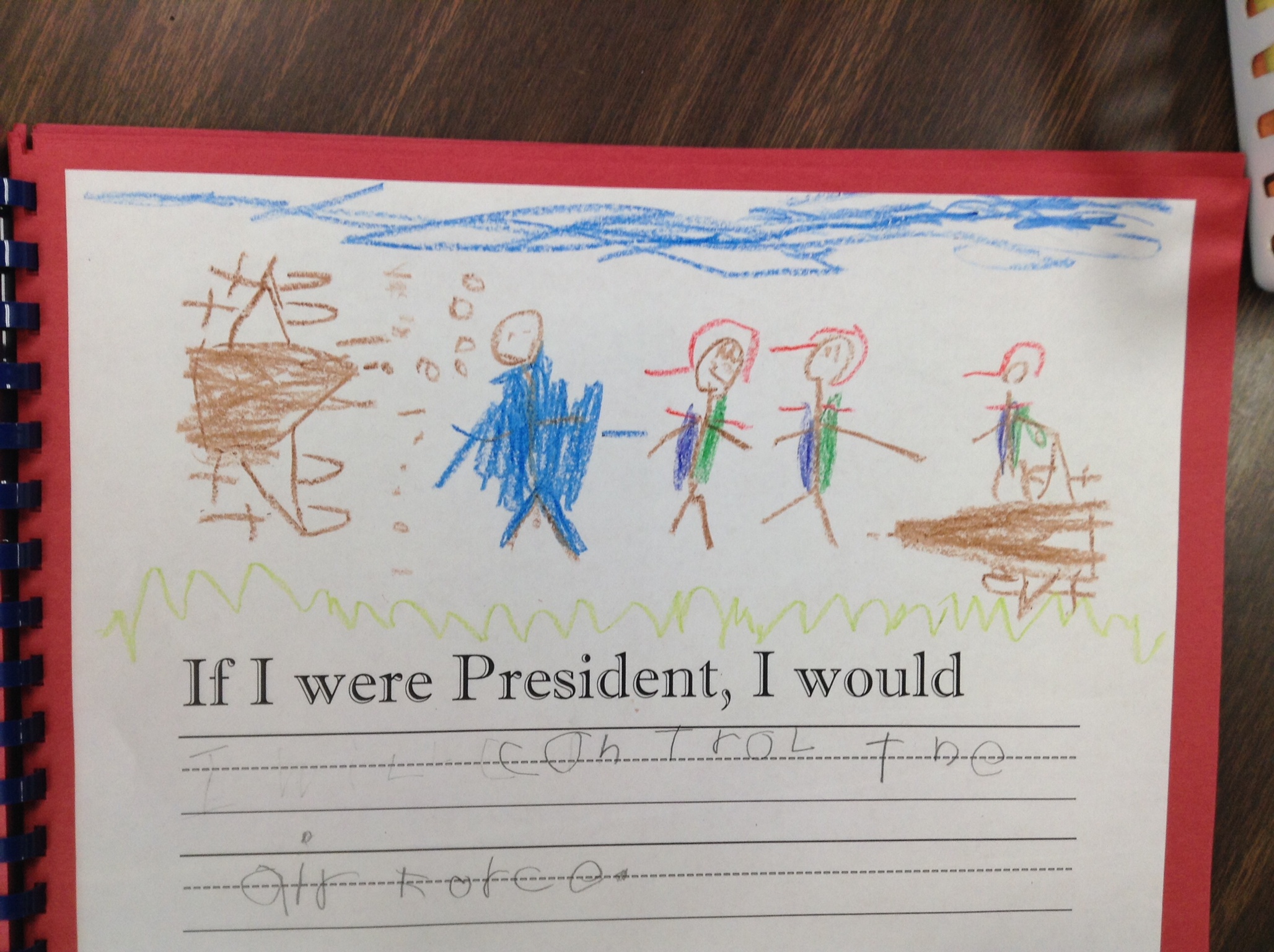
My son (you may call him, Mr. President) is the big, blue guy. He is commanding the troops to put on their saucepans and scramble their brown jets to go save the world.

My son (you may call him Mr. President) is the big, blue guy. He is commanding the troops to put on their saucepans and scramble their brown jets to go save the world.

As I see it, he’s not limited by the naïve idealism of his classmates. If you want to protect the world, you need to formulate a specific plan for doing so, and that plan had better entail adequate air power.

This boy has as much compassion as any five-year-old, but he understands that caring goes a lot farther at Mach 3. I’m sure Don, Leo, and those other guys who are collectively my son’s favorite people would agree with me.
No, we’re not really morning people

My last post was about things I am thankful for. This one is about something I’m not thankful for. I am starting a new tradition (if it doesn’t already exist) that I will call the Post-Thanksgiving Bitch and Moan Fest. You in?

Good.

Because of the nature of the floating shifts at my wife’s part time job, I must often use pieces of my vacation time to take the kids to school and day care or pick them up. Picking them up is easy; you just show up and ask for your kid. You repeat the process until you have everybody you started the day with. Then you go home.

Dropping them off in the morning is a royal pain in the butt. Specifically, getting the kindergartener up, clothed, fed, and into the car in reasonable amount of time will be the death of me.

The kid is not a morning person. I get that. I’ll never forgive 7 a.m. for showing up uninvited day after day, and yet I get up every morning because it’s part of my job. Kindergarten is his job. On one level, he understands that, but that one level is the last to become conscious in the morning. The intervening levels complain that the light hurts their eyes. Hurt eyes make it difficult to go back to sleep.

They say breakfast is the most important meal of the day. He’s not buying it. It’s infuriating, how much like me he can be. I make him eat, which he does in tiny, protesting bites. I even set an example by choking down something myself, if I can find a moment between prodding him to eat and packing a lunch that he might nibble at before recess. His master plan is to build up his appetite for a big snack after school before pestering his parents to take him out to eat shrimp. It’s a bad plan.

Who wants my sandwich?

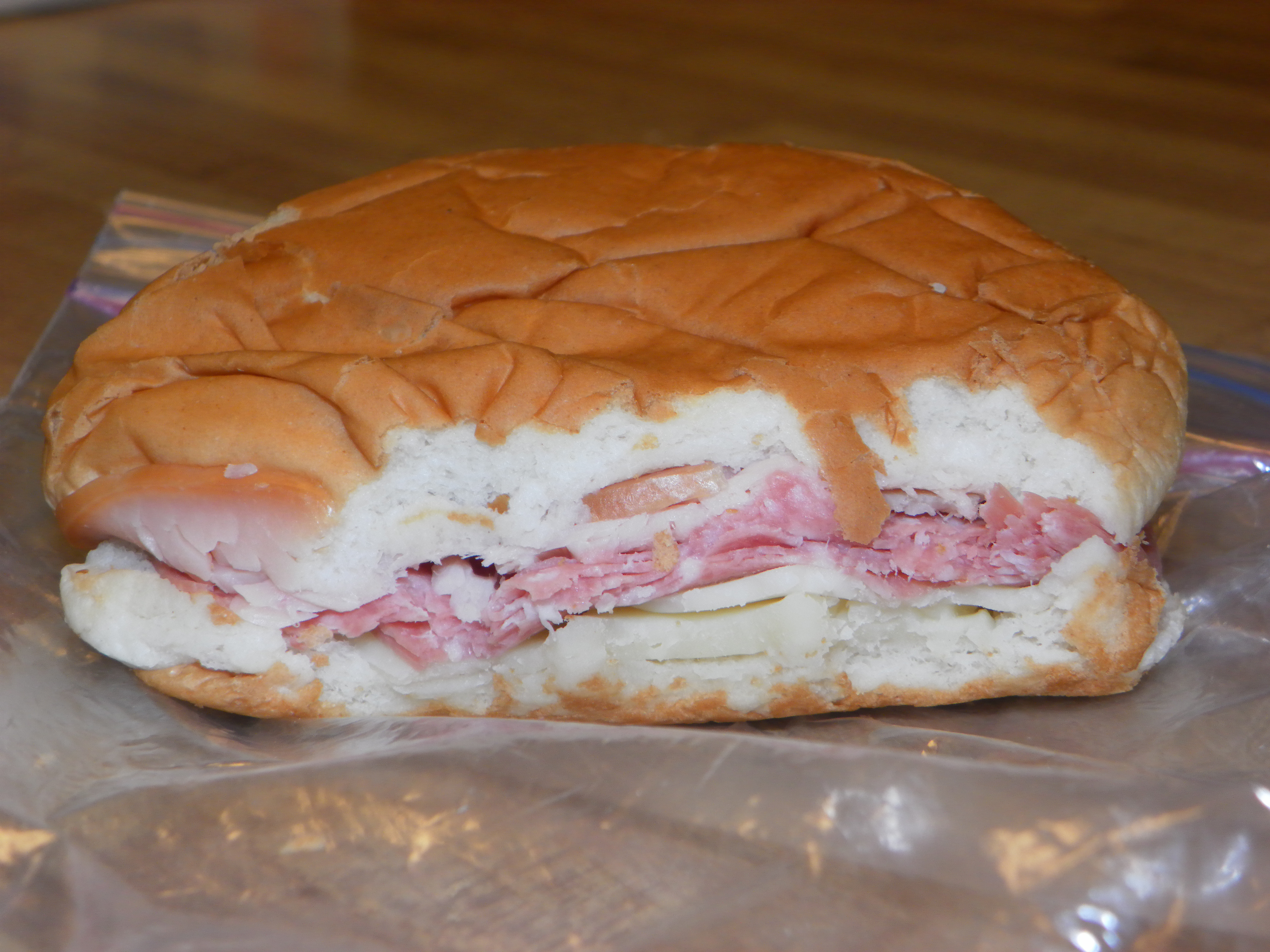
The lunch sandwich: made with love, battered in transit, nibbled at with indifference.

Assuming we didn’t spend a half hour pouting over the lack of stylish clothes to wear to kindergarten, we will only be moderately late when it’s time for coats and shoes. Perhaps there is no five-year-old who can maintain a sense of urgency; there is none in my morning. When a dad says “Hurry up!” 100 times in the space of five minutes, you might think there’d be no time in between for a boy to be distracted by a piece of lint. There 99 such opportunities.

Finally delivering the boy to school, it is only a matter of dropping off his brother at day care and trying to escape before the little boy’s crying stabs the dagger of guilt into my heart. Feeling like I’ve already had a full day’s work, I head to my job to hunt with the other late-comers for a precious parking spot, because the university we work at doesn’t believe that all its daytime employees should be able to park there on the same day.

My eye stops twitching about an hour later.

This leads me full circle to something I am very thankful for: my wife, who conducts this process more often and with much more grace than I do.

Stuck training the new guy

If you’ve ever had to train a new employee, and the guy was taking a long time to catch on to tasks you could do without a moment’s thought, you might have found yourself thinking the same things as I did the other afternoon.

I was attempting to train a new worker how to use the leaf blower to herd dead leaves into one big pile. There is a profound difference between creating wind and using it to affect some purpose. His insensibility to this, and the resulting random rearrangement of leaves, led me to my first great trainer’s cliché. “It would be so much easier to just do this myself,” I thought.

But that would mean sending my trainee away discouraged. I worked with him on the rudiments of directional leaf blowing. It was a hard sell, which inspired my next trainer’s lament. “This guy has the intellectual capacity of a five-year-old,” I said to myself.

I spent 20 minutes walking sideways with him, shrinking the perimeter of ground covered by leaves. It was probably that I was uncomfortably hunched over the entire time, helping him aim the blower nozzle, that led me to my final nugget of trainer’s wisdom. “I’d be better off trying to teach a first-grader to do this,” I muttered.

This is when I discovered that statements made to relieve frustration (and back pain) lose much of their impact when reality robs them of their comforting hyperbole.

The new employee had the intellect of a five-year-old because he was exactly five years old. It wasn’t my idea to hire him for this work. He volunteered. In fact, he volunteered so vehemently that I’m sure he would have run into the house crying if I’d denied him his training.

Little boys are fascinated by power tools. Combine the necessity of plugging it in to an electrical outlet with the magic of creating wind, and the leaf blower is a kid magnet. Unfortunately, the power of the gods comes with a steep learning curve for a kindergartener.

To his credit, he stuck with the training, and the associated parental scowls, long enough to get the hang of it. When our herd of leaves was under control, I let him go solo.

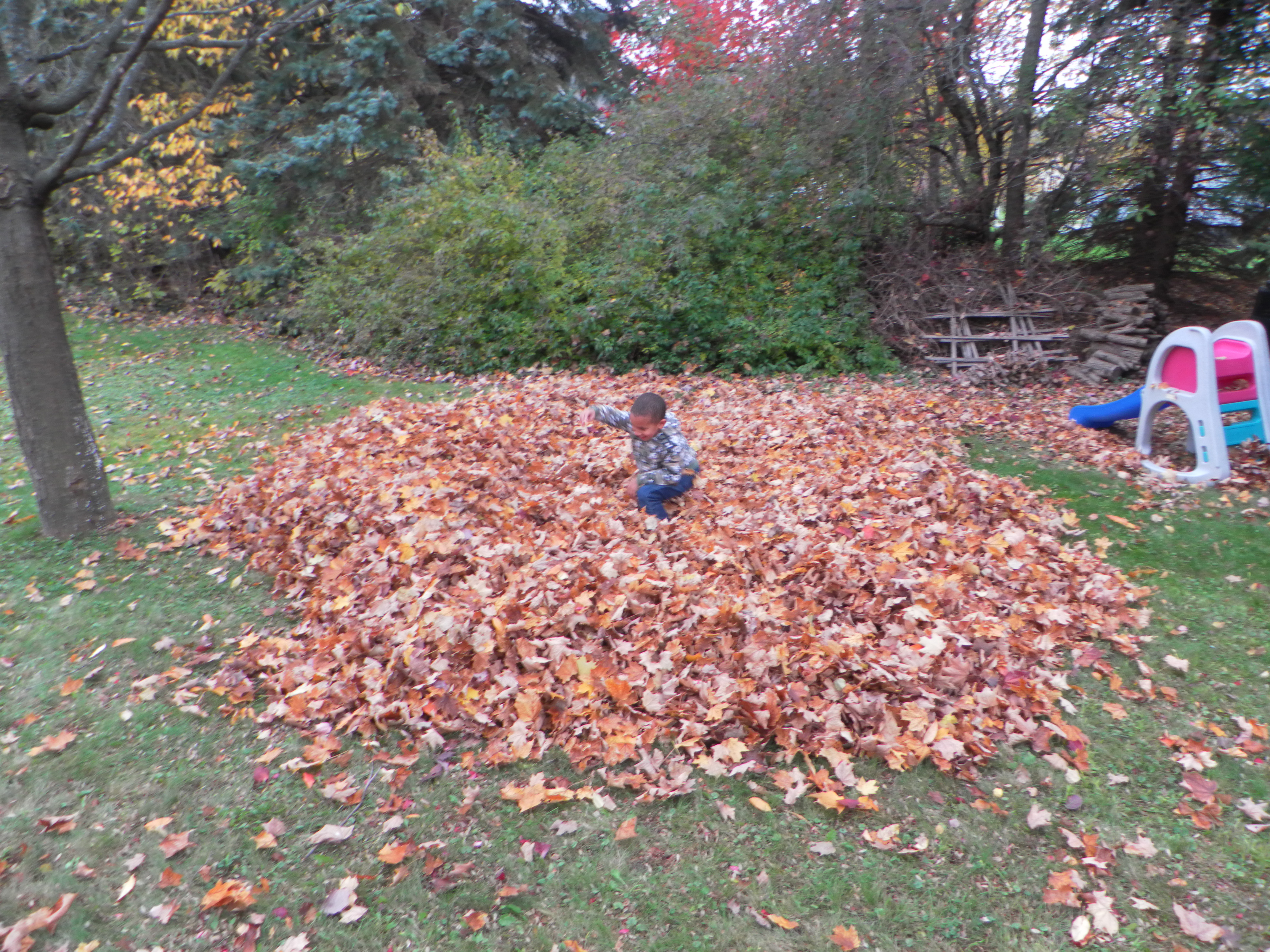
He even earned a short break for the obligatory leap into the pile.

rewards of hard work

I just hope this doesn’t make him think that after his first day of training at McDonald’s they’ll let him jump into a pile of hamburgers.

But the days grow short this time of year, and there was a large pile of leaves to vacuum and bag. He wanted to take training on this process too, but the machine was a little tall and heavy for him to hold upright. It was clear that his workday was over when he began throwing armfuls of leaves at me and shouting, “Confetti!”

Leaf fort

Makes you wonder how many children get bagged up and carted away with the leaves every year.

In the end, he learned a little bit, and I learned a lot. I have to practice being more patient with my volunteer helpers. As to whether I would be better off trying to train a first grader, well, I guess we’ll find that out next year.

I’m the Einstein of chicken strips

One day, when our older son was barely three, I decided to make chocolate chip cookies. He was in the other room playing as I mixed up the batter. He must have smelled them when they were about half way through baking. He came into the kitchen and peered through the glass in the oven door. “Chocolate [chip] cookies!” he exclaimed. “Daddy, you’re a genius!”

Back then he pronounced genius “genjus.” He used to call me a “genjus” once in a while, when I did something really smart, like making cookies. I’m not sure when, exactly, he began pronouncing genius correctly. He kept getting smarter and smarter, which meant my intellectual pedestal became proportionally diminished.

Einstein avoids chicken

Sure, he was good with simple stuff, like time travel, but could he handle the confounding problem of chicken strips? (Image: Ferdinand Schmutzer)

By the time the boy began saying genius the right way, I rarely heard it used in reference to me anymore. He understood that a person could learn new things every day. This being the case, of course Daddy had learned a lot of things during his many days. That didn’t make him a genius; it just made him old.

During the past two years, the boy has spent his time developing his own genius, which is right and proper. He knows nearly everything now, which must be a good thing. He’ll know even more tomorrow, his vast knowledge knocking another block out of the height of Daddy’s pedestal. The once colossal Daddy gets more life-sized every day, which is necessary, but also a little sad to shrinking giants.

morsels of enlightenment

The semi-sweet building blocks of my early genius.

The other night we were at a restaurant. The boy ordered chicken strips, which is another way of saying he decided against the grilled cheese sandwich. As usual, he asked me to cut up his strips for him.

“Can’t you cut up your own chicken?” I asked. “You’re a big boy now.”

“No. You can cut it,” he replied.

I cut up half of his chicken and then moved on to my steak. After watching me cut off a few pieces, he said, “Daddy, I want to help you cut your steak.”

“You can’t even cut your own chicken,” I told him. “You have to be able to do that before you can cut somebody else’s steak.”

A few minutes later, he had finished the strips I’d cut for him. He picked up his fork and knife and attempted cutting up the rest. After dragging his food across the plate with his knife, he asked me for help.

“Try switching hands with your knife and fork,” I said.

“Why?”

“You have more strength and control in your right hand. That’s the hand you should hold your knife in.”

He switched the utensils and cut through the chicken with ease. His eyes lit up. “Daddy, you’re right! You are so right! You’re a genius!”

For one day, my pedestal didn’t shrink. It may even have inched higher. I treasure that day; I don’t know when I’ll see another like it.