At home with Don Quixote

About six months ago, I undertook a foolish endeavor. I began reading Don Quixote. I don’t say this was foolish because I believe Don Quixote is an unworthy piece of literature. It was foolish because no person with multiple, young children has any business opening up any book of 900+ pages with the expectation of getting to the end while still remembering the beginning.

Nonetheless, for a few months, I made good progress for a man in my condition. That is to say, I was able to read about 10 pages most nights, in the interval between the children going to bed and falling asleep myself. On nights when I enjoyed particular vim and vigor, I might put up to 12 pages behind me.

Quixote

He rides his lonely road, searching for someone who’ll read him, or at least someone willing to pay full price.

I kept up this breakneck pace until New Baby was born. At that point, I was nearly 600 pages in.

Don Quixote (the first 600 pages of it anyway) is the story of man so swept up in reading romance novels about knights-errant that he slips into the delusion of himself being one of those ancient heroes. He sets off in search of adventures and causes mischief wherever he wanders, believing he is capable of mammoth feats and that it is his duty to display his prowess to the world. Whenever reality seeps in to disrupt the narrative he has devised within his head, he explains away the discrepancy with the excuse that evil wizards have enchanted him and used their spells to belittle his grandiose visions into ordinary, everyday things.

New Baby is two months old now, and I am on page 614.

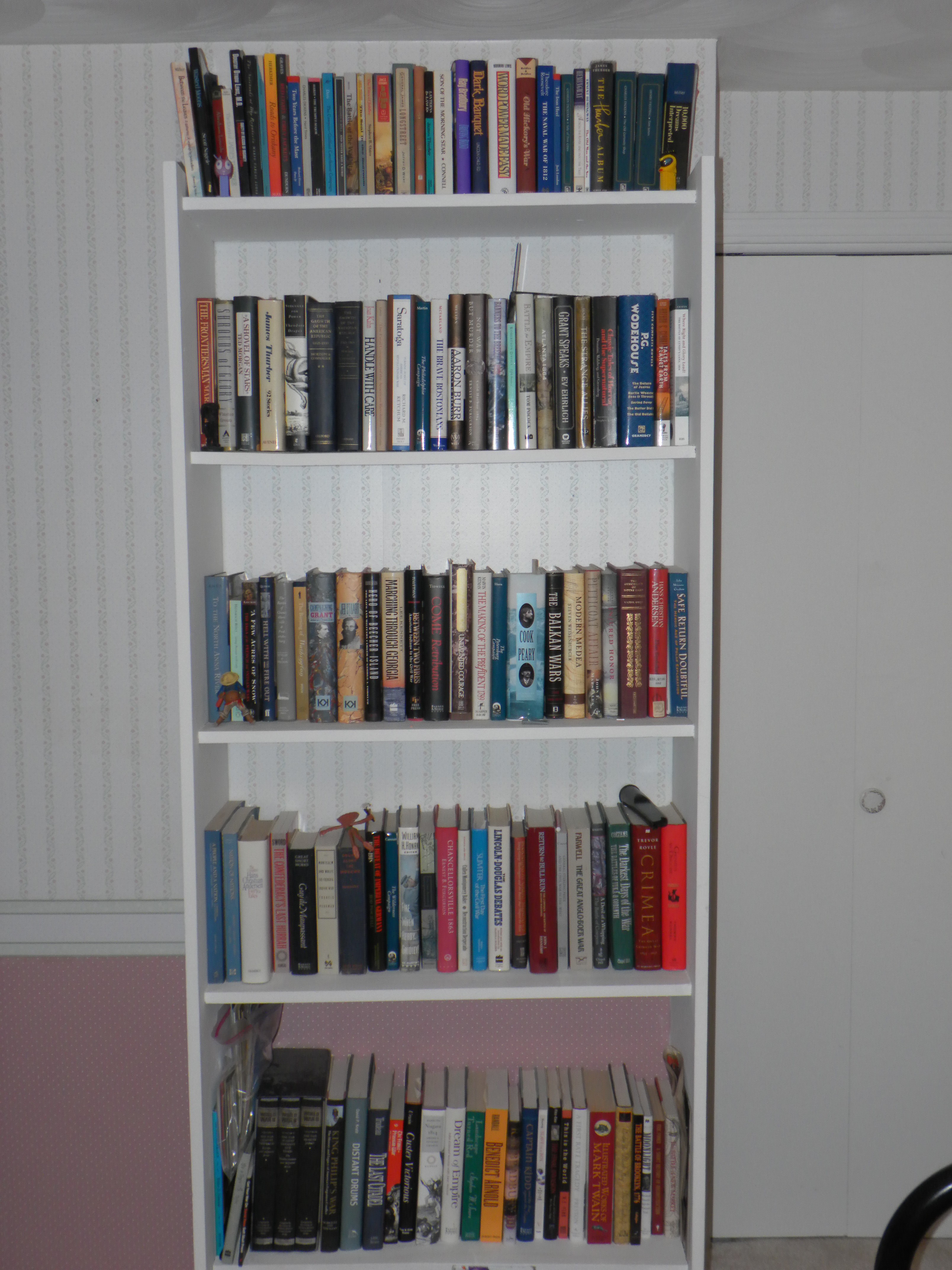
Oh, but I used to read! I used to be the Lancelot of reading, tearing through books and piling up their used bodies in book cases to the ceiling. I took on classics, even the torturous ones, with no fear, occasionally triumphing by finding one that turned out to be a classic. I was a warrior of words.
old days

A monument to those ancient days of spare time and disposable income.

You can watch TV while constantly changing the position of a crying baby in search of that one special pose that will settle him down. You can even play Farmville while rotating him. But it gets hard to read while juggling the kid from arm to arm. I’m catching up on all the TV programs I missed during my reading years. Thank goodness for reruns.

Meanwhile, Don Quixote stares down at me from the shelf. Once in a while, I notice this and I stare back at him. Every time, he looks more familiar, this man who deludes himself into thinking he can accomplish goals that are far beyond him. This man in the mirror.

My excuse is that I am enchanted. But my wizards are not evil. They are playful little goblins who vex my grand plans with a steady stream of wonderful, precious, ordinary, everyday things.

highway

Two modern-day enchanters out for a drive.


A smile for yesterday

Every night, I read the big boy a bedtime story. This tradition dates back to the time even before there was a little brother, an era that seems ancient. It’s not so much the story that matters as it is Daddy sitting on his bed reading aloud to him.

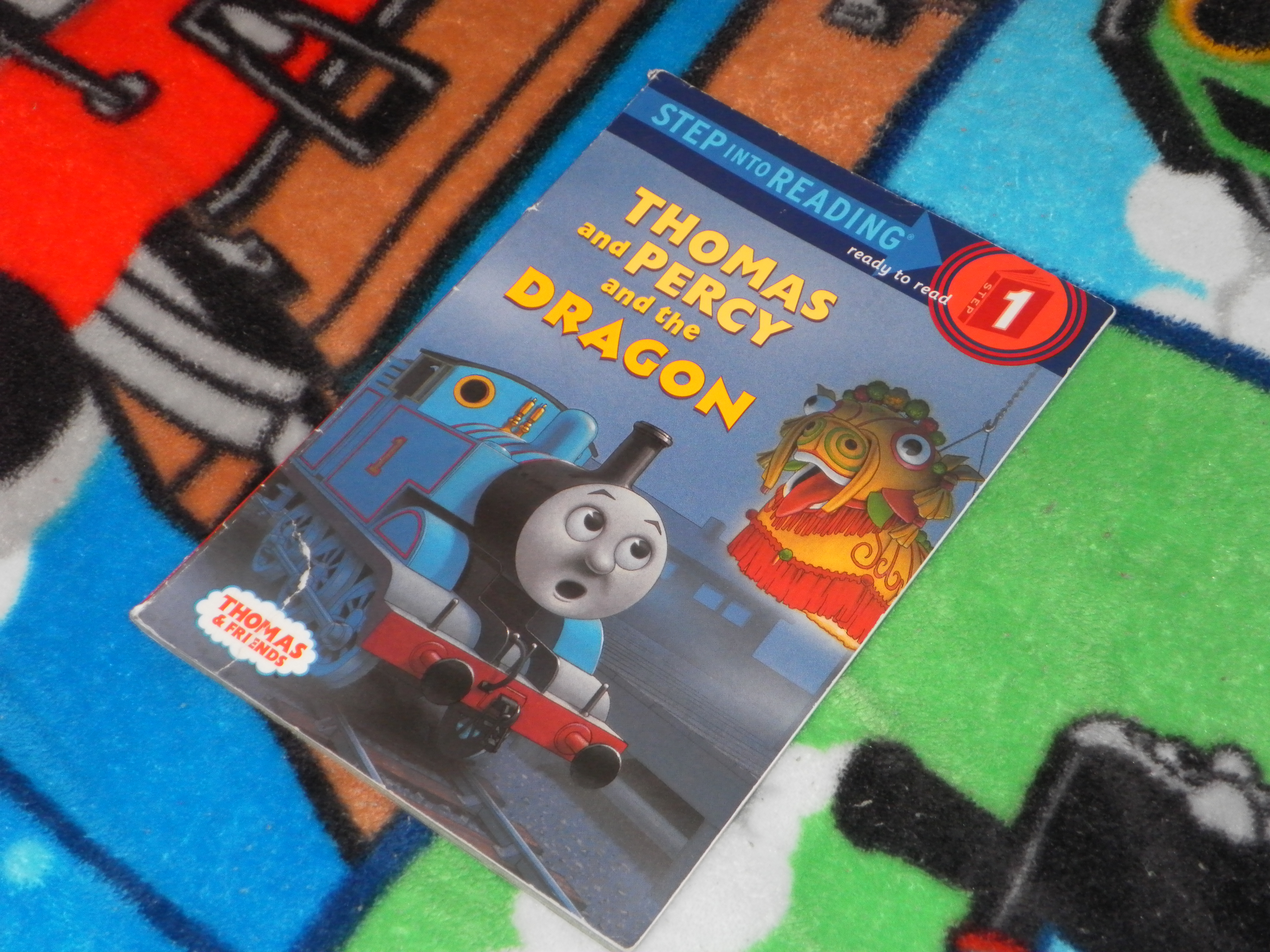
Back in the day, he liked a particular Thomas the Tank Engine book called, Thomas and Percy and the Dragon. It’s a Beginning Readers book of about 20 pages that is not flattering to Percy’s reputation, but then Percy does have his issues.

I read this book nearly every night, to the point where I had the dozen words on every page memorized. In a misguided effort to illustrate that we were perhaps overusing this book, I began reciting the story to the boy while looking at everything in his bedroom except the book.

nighttime reading

Daddy is so well read – he can quote the classics from memory.

I turned the pages on cue and recited the appropriate text while staring into the boy’s face. This effort to prod him toward fresh literature completely backfired. Thomas & Friends were doing comedy now, and he loved it. “Look at the page!” he would demand. I would sneak a peek at the book and quickly turn my gaze back at him, eliciting a stream of giggles.

One day, someone gave us a big, hardcover book about animals. I started reading this at bedtime. There was lots of information to digest, so we fell to the rate of one page per night. Sometime between the hyenas and the sharks, his little brother was born.

When we finally finished with the animals, someone gave us a big book of facts. Some of the concepts were over his head, and I’m sure he never wondered why Secretariat was such a fast horse (he had a freakishly oversized heart), but it was our thing.

I hesitated to continue some nights. I wasn’t sure he needed to know about Shakespeare yet. I hadn’t learned to run screaming from that name until ninth grade. Probably he was too young to foresee the terrible psychological scars The Bard will inflict upon his teenage years, so he didn’t flinch.

Eventually, his little brother joined our story time. The little boy doesn’t care about racehorses or playwrights. He wants only to grab the book or wrestle somebody. He’s a distraction from our routine, but he’s also part of our world moving forward, as it should and must.

It took nearly two years to read through those two books full of amazing and soon-forgotten facts. Two nights ago, we closed the back cover.

Last night, at bedtime, the little boy was too busy arguing with his mother to join us. The big boy was waiting on his bed. Sitting beside him was that old, flimsy paperback, Thomas and Percy and the Dragon. He didn’t say anything. He didn’t have to.

I sat down and opened the book to the first page. I turned my face to the boy and began reciting.

He grinned as big as yesterday.

How Daddy’s reading comprehension skills died a slow death

Parents of multiple children can’t help but compare and contrast their offspring. I like to notice the ways my two boys are alike, because noting their differences often leads to the temptation to wish one could be more like the other, and if I’m going to pressure them to follow another child’s model, I want more well-behaved examples to point at.

There is a world of difference between the habits of a one-year-old and those of a four-year-old. Despite the age difference, there is one activity in which my boys take common delight.

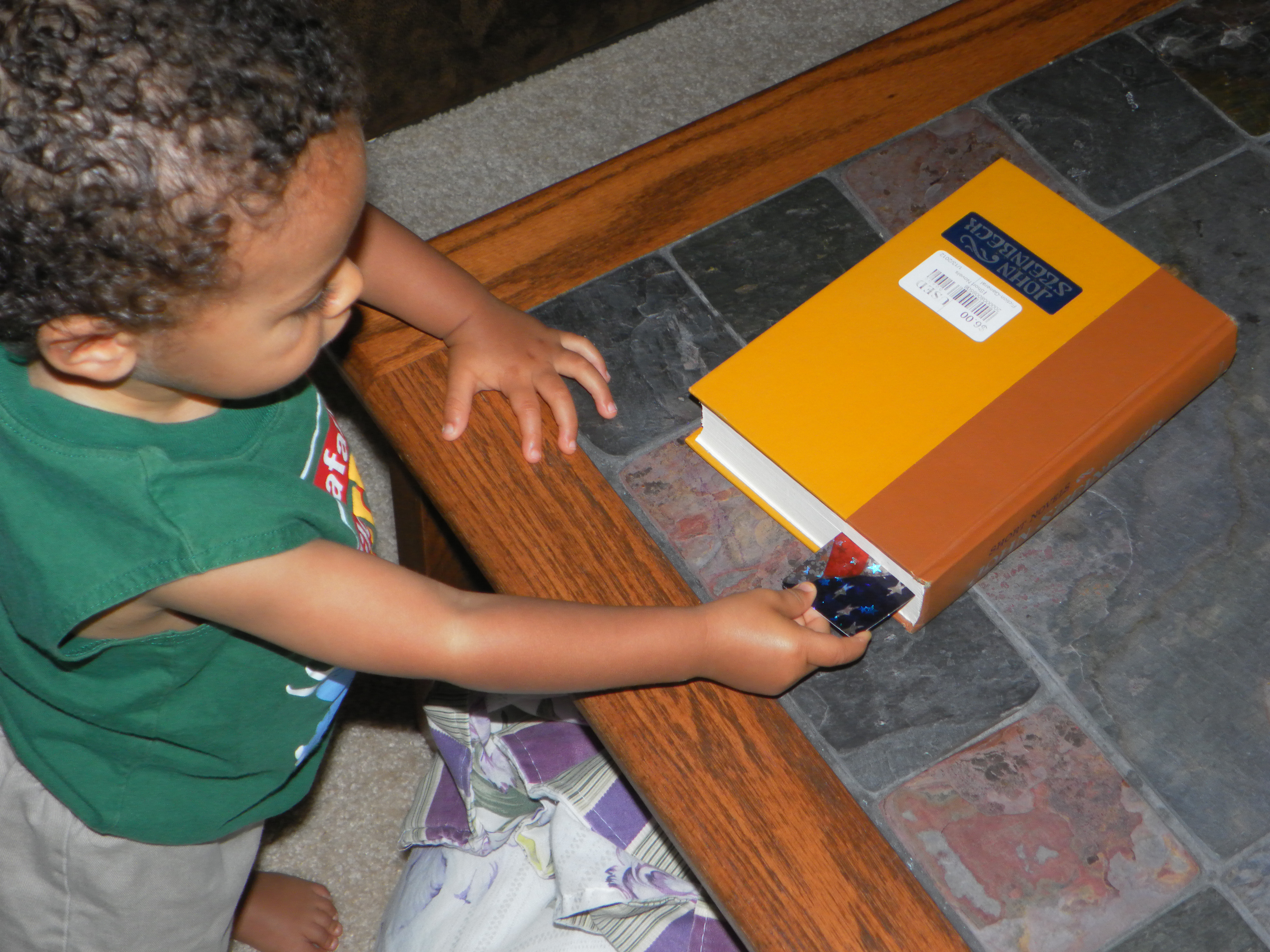
Pulling out the bookmark

Colorful tabs were just made for pullin’.

Apparently, children of all ages find endless joy in pulling the bookmark out of the book their father is reading and replacing it between randomly selected pages in the book.

I am, or rather, I was, an avid reader. I used to tear through history books like there was nobody tugging on my arm or crying in my ear. I used to devour the classics like a man who need not condemn anybody to bed at an unjustly early hour, and then hear fifteen different appeals of the sentence as the night wears on.

One summer, I devoted a couple of months to reading Shelby Foote’s Civil War trilogy. If I tried to tackle those thousands of pages today, it would take me longer to read The Civil War than it took Lincoln’s reluctant generals to fight it. I would be a sorry historian to declare that The Civil War lasted eight years. But there were lots of extended breaks.

Civil War set

For childless readers only . . . unless you want to end up as just another casualty.

The irony is that before I had children, I didn’t rely so heavily upon bookmarks as I do now. Back then, I read so often that I could easily remember my place without a flag directing me where to resume. Now, I might go weeks between reading sessions. I need bookmarks not only to remind me what page I was on, but also which book I was reading.

There must be something about a little nub of paper or Mylar, or even a strand of lint, sticking out of a book that hypnotizes a child with the desire to pull it out. It does not matter how plain the bookmark appears, it still portrays itself as a magical tab that must be pulled. I might as well install buttons on my books and expect little boys not to push them.

In the end, a bookmark is a boring plaything. The boys rediscover this as soon as it is free of the book. Little brother might toss his disappointment to the four winds or hide it somewhere within the book, as the mood strikes him. Big brother has been yelled at enough that he covers his tracks by replacing the marker between pages, any pages.

Thus, I find myself wondering why some books are so repetitive, while others seem to leave huge gaps in the narrative. I’ve read a few books over the past several years in which the sequence of events was downright bizarre. Some men my age have mid-life crises. Not me. I’m just going through my post-modern phase.

Scorn is fundamental

Our four-year-old is learning how to read. He is also learning how to not read. Take him to the toy department of a store and he can read surprisingly well. The words on the boxes all spring to life with vast meaning. Sit him down with a book at home and letters no longer make pronounceable sounds; words are cryptic hieroglyphs on the page.

At first blush his selective comprehension might seem like laziness. And it probably is, to some degree. But it also represents an understanding of the economic value of knowledge. When there is something he wants, he suddenly has knowledge to offer. When knowing offers nothing but tedium, he naturally knows nothing.

His strategy of using reading as currency is obvious. The other day, he quickly read the word Batman on the cable guide because he likes that show. He has become quite a fan of the old 1960s TV version (and for anyone who thinks Adam West is not a great actor, you try to say some of the lines he had to say with a straight face).

Another time, the boy also easily read the sentence, “Do you want chips and cheese?” when his mother wrote a note for him. He really wanted chips and cheese, which momentarily made him a super-reader. With a full belly, he became illiterate once more.

He has yet to embrace the concept of delayed gratification: make your parents happy and proud now, and you are more likely to receive some as-yet-unnamed reward in the future. Consequently, we are left with the task of trying to make reading, for its own sake, seem less toilsome.

We have a collection of magnetic letters stuck to our refrigerator. He uses these to spell out words. His baby brother likes to play with the letters too, but his favorite game is to push them underneath the fridge.

One day, the big boy was using the magnetic letters to spell out his full name. He was lacking a letter, so we spent our time trying to retrieve some of them from underneath the appliance. We finally found the letter he needed, but there were still more letters underneath that we couldn’t reach. He wanted all the letters back.

He had seen me push the fridge away from the wall once before so he grabbed hold and tried to push that monster out of the way. Of course, it didn’t budge. “Help me move this,” he insisted of me.

I had nearly destroyed its wall plug the last time I’d moved it. “No. I’m not moving the fridge again,” I told him.

He put his hands on his hips and gave me a look of disgust. “I thought you were trying to be helpful,” he growled.

The jury is still out on reading, and delayed gratification is yet to come, but it appears as though I’ve done a bang-up job of teaching him scorn.

Reading is fun!

I really need to pull another N out from under this fridge before the boy hits middle school and this message takes a wrong turn.