The stubborn contrarian doesn’t fall far from the tree

We had our spring parent conference with the boy’s kindergarten teacher last week. The good news is that the boy is doing well academically. As I often tell him, he’s too smart for his own good.

On the citizenship front, he’s not quite the hotshot he is academically. He’s getting better at focusing on his work, but he still has too much of his parents in him to be the most conscientious pupil. Like his mom, he’s a social butterfly, getting lost in chit-chat when he should be working quietly. He is too much like his dad when it comes to being a stubborn contrarian who knows it’s enough to be right – they don’t have to know why you’re right.

Even with the burden of his chatty, mulish genetics, the teacher likes having him in her class, so we ended the conference feeling good. But the most enlightening things were yet to come.

Outside the classroom, the kids’ projects were on display. For St. Patrick’s Day, each child had cut out a pot of gold, with coins labeled as things that were more precious than gold to them. As we walked down the line of these, the recurring words were, Mommy, Daddy, Grandma, and the like. It was sweet to see how the children valued their families. At our boy’s pot of gold, we squinted to make out the names on the coins. Don, Mikce, Leo, R-something – who were these people? They weren’t family members. They weren’t even kids in his class.

The teacher was still with us. Noting our confusion, she explained. “That’s Donatello, Michelangelo, Leonardo, and Raphael. The Teenaged Mutant Ninja Turtles.”

More precious than turtles?

It’s not that Mommy and Daddy aren’t precious; they’re just a little trite for this pot.

The way I’m going to spin this is that the boy doesn’t value cartoon turtles more than his parents; he just didn’t want to do the same thing all the other kids were doing. That’s plausible, isn’t it?

Next, we looked at a book called If I Were President. Each child did a page on which they wrote a phrase to complete the sentence, “If I were President, I would . . .” and drew an accompanying picture.

The book was full of compassion. “Help the world,” was the common theme, with variations toward “Make the whole world safe,” or “Help poor people.” The pictures were of the Earth or of a group of presumably poor people.

On my son’s page were drawn fighter jets and soldiers. It said the following: “If I were President, I would control the Air Force.”
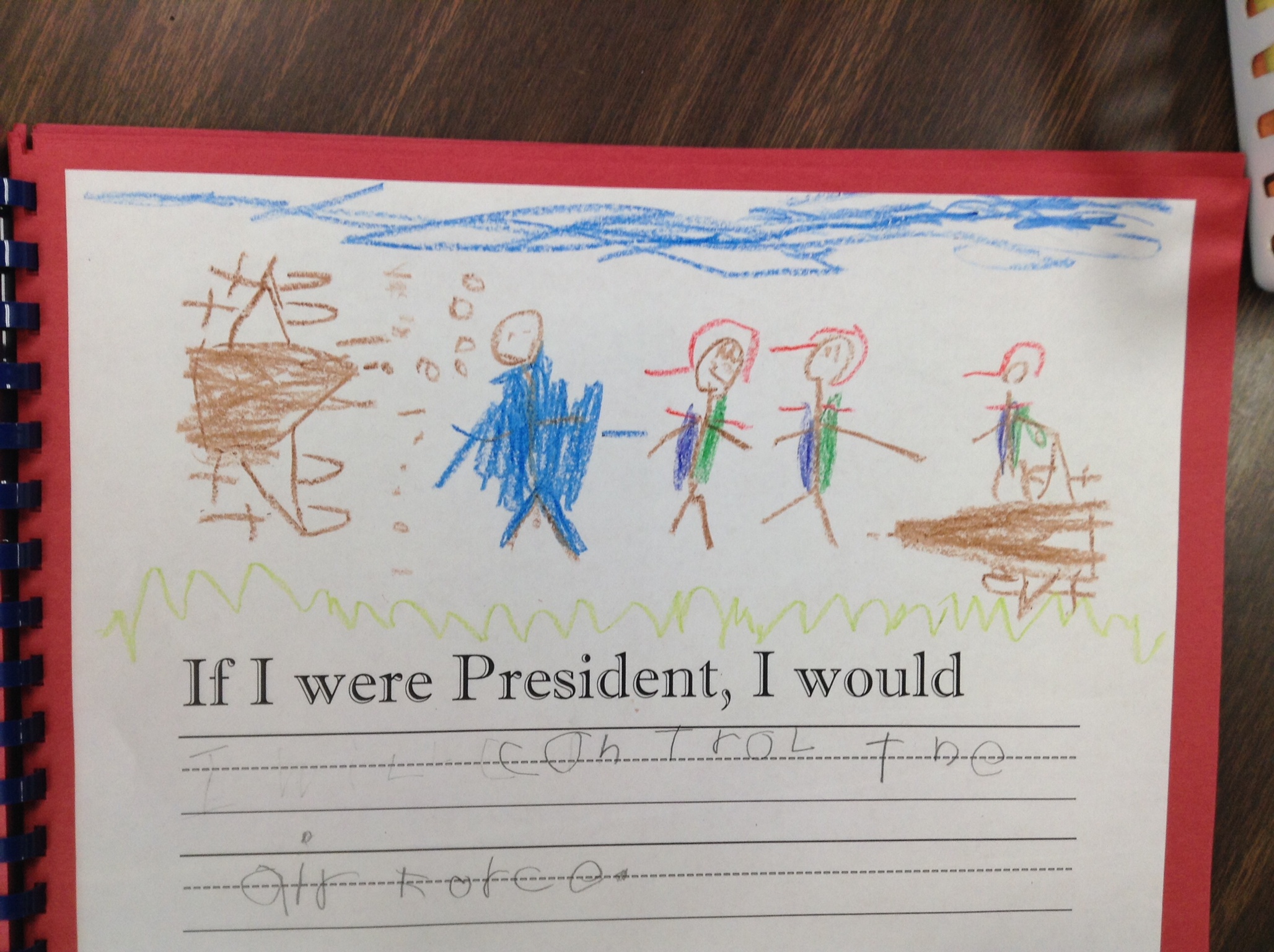
My son (you may call him, Mr. President) is the big, blue guy. He is commanding the troops to put on their saucepans and scramble their brown jets to go save the world.

My son (you may call him Mr. President) is the big, blue guy. He is commanding the troops to put on their saucepans and scramble their brown jets to go save the world.

As I see it, he’s not limited by the naïve idealism of his classmates. If you want to protect the world, you need to formulate a specific plan for doing so, and that plan had better entail adequate air power.

This boy has as much compassion as any five-year-old, but he understands that caring goes a lot farther at Mach 3. I’m sure Don, Leo, and those other guys who are collectively my son’s favorite people would agree with me.

Daddy’s just a big faker

Daddies aren’t supposed to get sick. That must be a rule among little kids because they never believe that Daddy feels like crap and needs to be left alone for a while.

It’s funny how little respect my five-year-old has for my illnesses considering how much attention he demands on his own sick days. When he’s sick, the house is his palace and the other people who live there are his servants. Before the sundry whims which may require action from Mommy and Daddy, there are certain base-line needs that should be met without him having to ask. He needs the entire couch commandeered for his reclining wants, and the TV tuned to cartoons for the duration of his infirmity. Beyond this, he needs a ready attendant to keep the blanket covering his feet should it slip when he changes position. And juice. There must always be juice at hand.

Dangerously exposed feet of an ailing boy

“Um, does somebody want to get on this?”

When I am sick, I mostly need the people in my house to leave me alone. I can get my own juice and fluff my own pillows; I just don’t want people climbing all over me or demanding that I supply juice to maintain them in the pink of health. I want to be left to myself. Apparently, this is a burdensome request.

If I am home from work when my son gets home from school, it likely means I’m ill. To him, it means play time starts early. He greets me with his favorite question, “Daddy, what can we play?” When I tell him I’m too sick to play, it’s a disappointment to him. But he’s a resilient lad, and he sloughs off the disappointment with everything else I’ve told him, so that within five minutes, he sees the world fresh and asks with renewed enthusiasm, “Daddy, what can we play?”

He is not the only one who easily forgets why I am at home at this unusual time. My wife does not think I make a very good patient either. She says I don’t complain enough when I’m sick; therefore I appear to be little more than a slacker playing hooky from work. If I moaned and groaned a bit more, she would perhaps be reminded that I do not need to be whipped up out my laziness with a steady course of housework.

Keep your snot at home

Besides, your family has chores for you to do. (Image: Ontario Medical Association)

There is always laundry to be done, and since I am neither comatose nor moaning, as a truly ill person would be, I might as well use this down time to lend a hand to operational needs of the household. She has this look she gives when the dryer finishes its cycle that says, “If you didn’t want to work today, you should have gone into the office.”

Stay home, do laundry

“Are you guys home sick from work too?”

I was taught to suffer quietly, so I can only blame my parents. If they had raised a squeakier wheel, maybe that wheel could get a sufficient break from playing games and folding towels to get a little rest when it was sick.

Where thumbs go to die

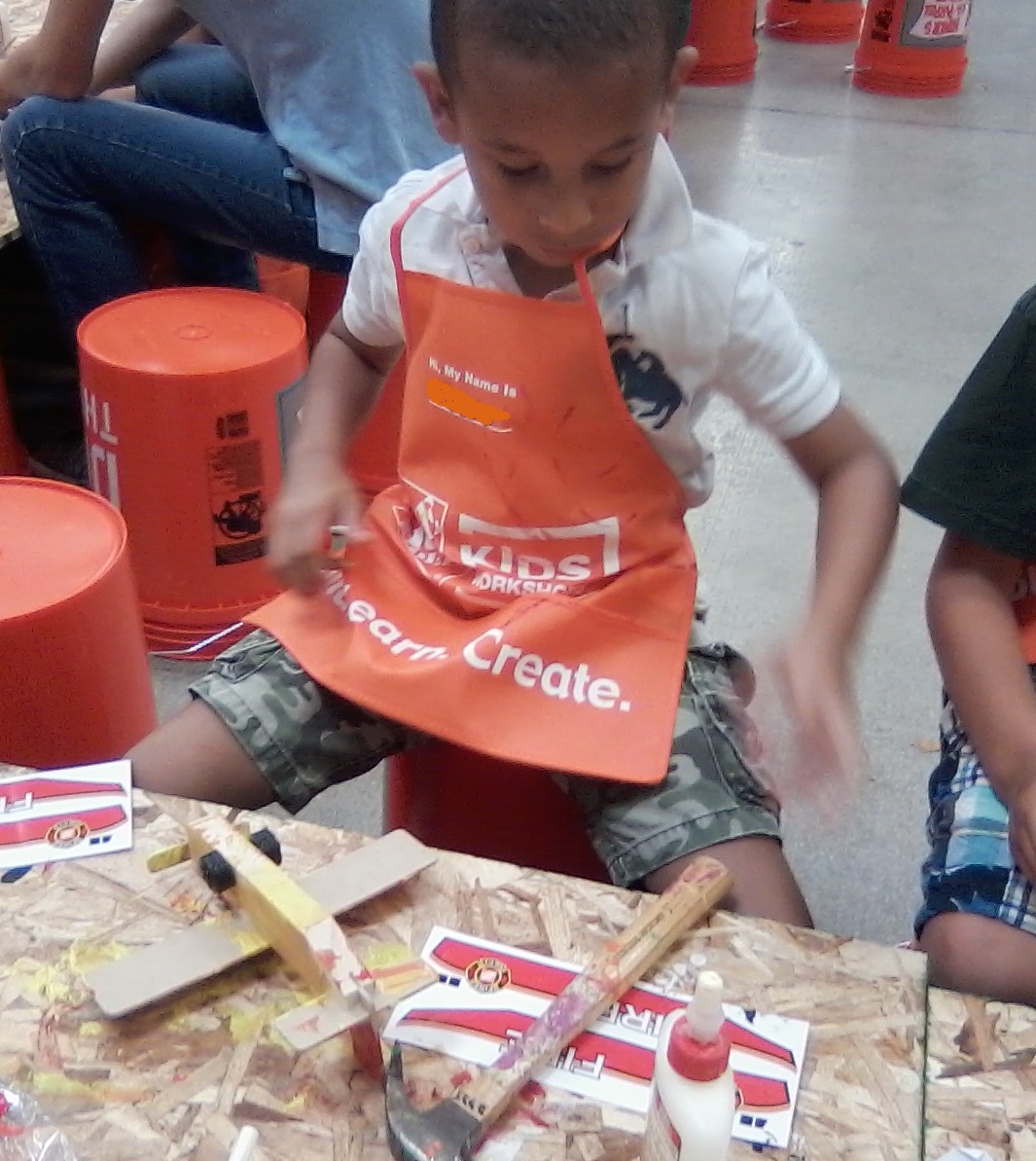
Every first Saturday of the month, we pack up our complimentary, kiddie aprons and head off to the Home Depot kids’ workshop to build something.

This event provides a great opportunity for kids to learn how to use tools and for parents to go insane.

Okay, that’s hyperbole. Many parents at the workshop don’t go insane. Mostly, it’s only me. And even I’m okay, if we can bring as many parents as kids.

The problem arises when my wife can’t go, and I’m in charge of two little master builders with hammers. The projects always require hammers.

My boys are aged five and one. Five-year-olds are awkward with hammers. One-year-olds feel right at home with hammers, which is the more terrifying relationship.

hammer time

Let’s hammer some decals onto this airplane!

The projects are easy, and I can manage going back and forth between the boys. Right up until the kits require me to use one of those quarter-inch (6mm) wire nails. It’s hard to start such a nail, on account of it not reaching up past my fingers as I hold it in place. Also, I have to look around the corners of my seeing-things-far-away glasses to spy this little, close-up item hidden somewhere between my thumb and index finger.

This is when things, except my blood pressure, slow down. I’m helping the big boy pound a nail, using only my sense of touch, while the little boy builds his list of other things that can be hit with a hammer. Since my eyes are useless to the project at the moment, they are reassigned to standing guard over my kneecaps.

I’ve finally got my nail in the right spot with my thumb positioned to absorb no more than 60% of the tap, when: BANG!, the little boy brings down his hammer with both arms onto the plywood bench we’re hunched over. The piece I’m working on jumps, and it’s back to square one.

I eventually get the big boy’s nails started for him. He’s pounding away on them, and anything else within a six-inch radius. Time to help the little boy with his nails, which I have to hammer while walking, because his hammer was the only thing keeping him interested. Now that I have it, he’s going shopping, and I’m chasing him down – with a hammer in my hand. Nothing to see here.

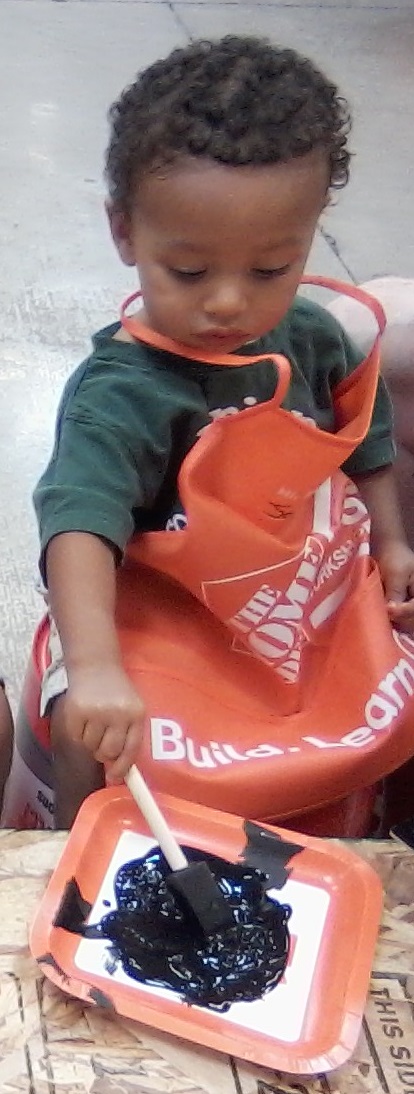
Somehow, we get both boys’ projects assembled. That means it’s time to double down on adventure with . . . PAINT! I wear a Home Depot kiddie apron with my name on it, just like the boys. The lady in charge laughs at me every time I squeeze the neck strap over my head, but I’ve learned my lesson.

Paint!

Who wants to get painted first?

We get our money’s worth out of that paint. We paint clothes, the workbench, nearby portions of Home Depot, and sometimes we even get a little color splashed onto our projects. The latter is always a bonus, because then we can take wet paint with us in the car.

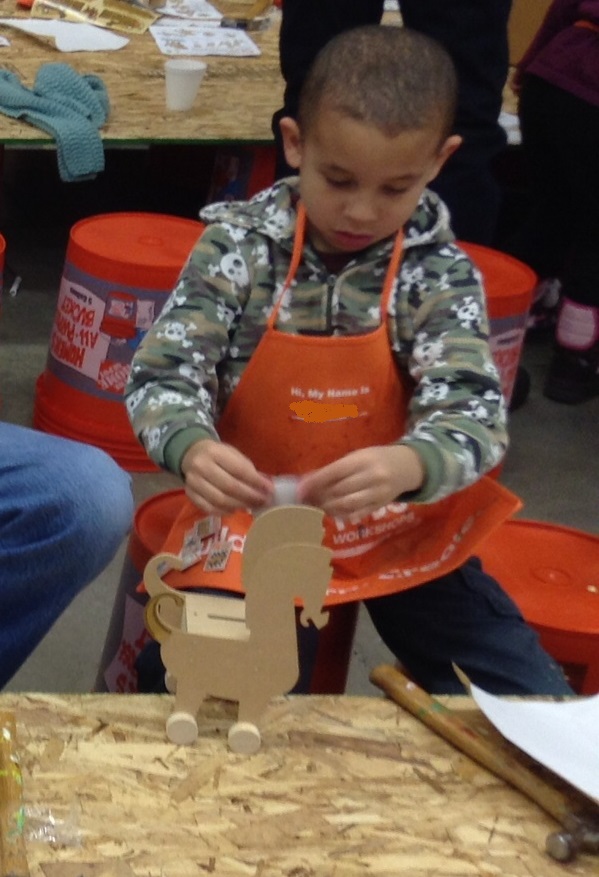
When we’re done, the boys get pins for their aprons to signify completion of the project. I don’t get a pin, but each time I walk out of there with two thumbs, I’m happy.

trojan horse

Stickers instead of paint? This could be a major breakthrough in stain prevention.

Secrets of the universe traded for pocket change and snacks

I’ve mentioned our one-year-old’s penchant for using the words Mommy and Daddy interchangeably. He’s getting better at differentiating the proper usage of each, but he still backslides once in a while and uses a universal Daddy to cover the nomenclature of both parents.

It feels as though this child is adopting the English language slower than his brother did, though he seems, in general, to be a quicker mimic and a bit more advanced with hand-eye coordination. He certainly has a stronger throwing arm, and is not afraid to use it, even at point-blank range.

His reluctance to use our words does not mean that he is the silent type. To the contrary, he is quite verbose in his own language, which he speaks most eloquently, and with passion. Last night, we were writing with crayons. He would make a mark on the paper and then tell me the story of what it meant. He was animated in the telling, using his voice, hands, and facial expressions to relay the nuances of his tales. When his eyes grew wide, I knew it was the serious part; when he showed me his scared face, I knew to be frightened.

He enjoyed telling me what he knew, all in his own language. All he needed from me was an occasional acknowledgement, in any language, that I was interested. It occurred to me that this might be his last chance to tell me these things – the secrets that only babies know about life and the universe. Soon, he will speak our language, making it necessary that he forget all the infant wisdom with which he was endowed. It is not good for adults to know too much about Creation.

Preaching to the chair

Extolling the true meaning of life . . . to a chair.

Now that he has unburdened his soul, I expect the slow transition to our language to quicken. He is already assimilating more of our words into his vocabulary, and in a most impressive way, methodically choosing the important words first.

Juice and No are already firmly within his lexicon. Recently, he added another a vital word. We encountered an arcade game one day. He became interested in the coin slot. I told him that was the place where you put the money, then set him on a chair so he could watch the demo. Soon, he climbed down, pulled me to the game, pointed at the coin slot, and said, “Money.” Apparently, the demo was not engaging enough, and if Daddy isn’t good for a couple of quarters, what is he good for?

Days later, he saw an image of spare change on the computer. His eyes widened. He pointed and exclaimed, “Money!” If this is not proof enough of his systematic adoption of words based upon their usefulness, it should be noted that he added the very important word Cheetos to his repertoire only moments after his first taste.

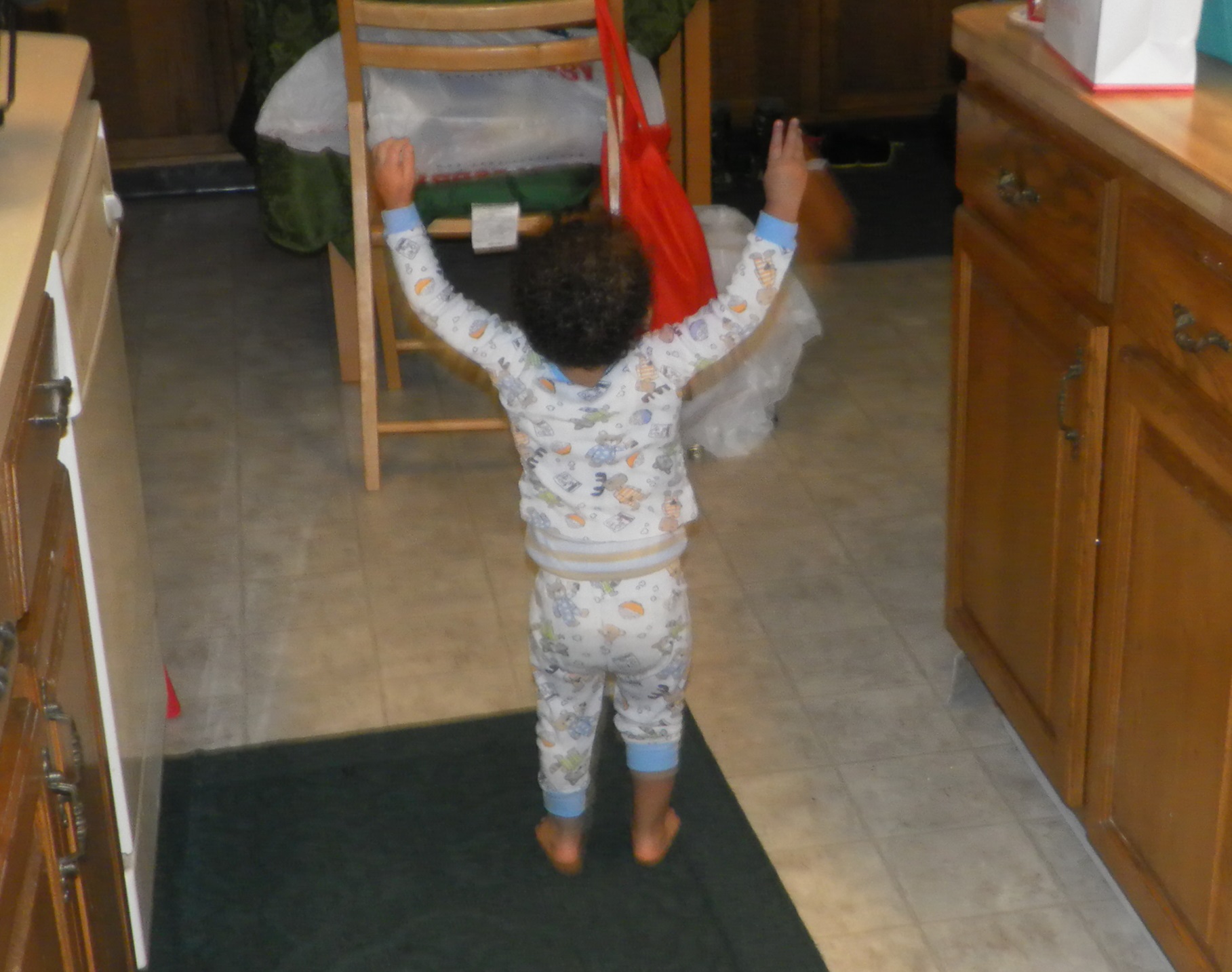
Looking for Cheetos

If there is juice, money, or Cheetos on top of that counter, he’s in business.

Now that he knows how to indicate Money and Cheetos, he is at work on perfecting one of the cornerstone words of toddlerhood: Mine!