Can you crawl to the kitchen and get me some juice?

Some things are more enjoyable when done with one’s children. Being sick is not one of them. You can hardly enjoy being sick at all when your kids are sick too. It just about ruins the whole experience.

Four-year-olds forget their manners altogether when they are sick. They don’t want to sleep in their own beds, and they will make sleeping in yours next to impossible for you if you let them insert themselves there. And you will let them insert themselves, because in your weakened state you are prone to bouts of empathy, and they can sense this.

On our first night of family illness, I let my son sleep in the bed with me. His mother, who was slightly less ill, and exceedingly more wise, than his father, opted to sleep on the couch. She made a speedy recovery.

A sick four-year-old in your bed is a sprinkler system for germs. Even though my son covers his mouth during waking hours, he made no bones about coughing directly into my face in the bed. Rolling over saved my face, but it did nothing to prevent his charming little sneeze droplets from alighting upon the back of my neck. I also discovered that, even in the throes of illness, I can be remarkably nimble when it comes to dodging  puke.

Sick children need their juice. They need it now and they need it where they are. Sick parents might have very wobbly legs, but that is no excuse for not crossing the room to slide a boy’s cup of juice two inches closer to him so that he does not have to roll over to reach it.

Sick children have a great many needs, none of which will wait until Daddy is feeling just a little bit better. I feel fortunate that Mommy was able to tend to the sick infant’s needs without much help from me. This left me free to attempt to keep my legs under me until the preschooler had all of his needs met, or until he realized that I wasn’t trying to cough up a lung just to mock him.

father in bed

In olden times, when the father got sick, the children busied themselves knitting warm garments for him instead of tormenting him with their sundry juice requests.

He got better quicker than I did. This was a relief; all of his sick neediness was replaced by healthy neediness. There were lots of Christmas toys to be opened. Just getting the modern toy out of its box is a half-hour, labor-intensive process, requiring no less than three separate tools. Rescuing toys from their intricate webs of packaging is one of the primary reasons why dads exist. I was happy to help my son liberate his toys, from where I lay on the floor, even at the risk of falling asleep with scissors in my hand.

Both of the boys are well again. I am nearly so. For their sakes, I hope I get back to 100% very soon. It is an unfairness to them, having to jump and climb all over a chronic complainer who is forever whining about not feeling well enough to take a sharp knee in the gut.

What’s in a Christmas stocking?

Christmas is almost upon us and I’m feeling good about it. I’ve got my checklist pretty well marked up:

  • Reroute a couple of paychecks to Amazon.com to take care of the far-flung friends and relatives.
  • Sort through all the millions of toys my four-year-old has told me he wants, paring it down to the few that he will like well enough to make him forget the rest for a few days.
  • Pick out gifts for my wife to the best of my ability as a husband.
  • Practice looking contrite and saying “Sorry, Honey,” when my ability as a husband turns out to be typically husband-like.

The only things I haven’t quite gotten nailed down yet are stocking stuffers for the baby. Stocking stuffers for everybody else have been easy, but I’m having trouble finding little treats for infants. This probably shouldn’t worry me. After all, the child is not yet aware of a thing called Christmas, let alone that it should feature a stocking filled with goodies. A day of teething upon the packaging of his brother’s toys would be an unexpected windfall to him. He wouldn’t miss his stocking at all.

But I would. Stockings are an important Christmas tradition to me. When I was a kid, the only thing my siblings and I were allowed to open when we got up at, oh, say about 2 a.m., on Christmas morning were our stockings. My mother was an inspired stocking filler. The little delights she put in there got us through the hours until she and my father got up.

Then, there were cows to milk; presents had to wait because the cows’ utters wouldn’t. Then there was church. Those of us with enough foresight to choose to be on the Polish side of family that year might have gone to Christmas Eve Mass the day before. We got to play with the goodies from our stockings while we waited for the Germans to come back from church, because our Lutherans didn’t have a Christmas Eve service. We little ones were up for about eight hours before we got to open presents.

stocking hanging on tree

Baby’s first stocking. No, I don’t know the name of any blue-nosed reindeer, but I think he is soon to become a favorite of ours.

One year, when my older brothers played a practical joke by switching out my stocking stuffers for one raw onion, I retreated to a dark corner in the kitchen and cried like it was the end of the world. That was 40 years ago, but I remember it very well. Santa didn’t love me anymore, and it hurt. Even worse, I knew some boys in the next room who deserved an onion far more than I did, so where was the justice?

Even if my little guy doesn’t know about Christmas, or who Santa is, I want him to have a stocking full of happy things on Christmas morning. They may be little things, soon lost or forgotten, but I want to do my best to tell him that the people in his life, who are symbolized by Santa, love him dearly, and always will.

Letter to Santa

A letter to Santa, dictated by the big boy on behalf of his little brother. Since this note falls under Santa-client privilege, names have been redacted.

The elf couldn’t make it to the shelf this year; he’s serving a life sentence in the closet

This Elf on the Shelf is becoming quite a widespread Christmas tradition it seems. There’s nothing wrong with that; not all traditions have to be old. I wish the best to all the elves on shelves and those who abide by them.

We have an Elf on the Shelf too, but our elf isn’t on the shelf, and never has been. Our elf has spent his entire three-year sojourn with us securely stuffed into his box, beneath a pile of other heavy boxes. Our elf is sealed in his cardboard tomb, where all puppets susceptible to springing to life at any moment belong.

Our elf was given to us by some kind people who hoped that we would enjoy the tradition as much as their family did. We knew nothing of the tradition, but when we learned that this nosey little troll would be watching all of our comings and goings from his seemingly innocent perch on the mantel, my wife and I shook our heads at each other.

We both imagined a scene like this:

WIFE: I see you set the elf on top of the book case last night.

ME: I didn’t touch any elf.

WIFE: Oh, I guess the boy must have left him there.

ME: The boy can’t reach the top of the book case.

Cue scary music. . .

Elf on shelf marketing

At significant risk to my own safety, I dug the box out of the closet to provide illustration to those who may be unfamiliar with this nefarious plot Christmas tradition.

If there is one thing Hollywood has proven to us, it is that magic little dolls always turn out to be evil. They chase you around and stab you with sharp things until you toss them into the oven for one hour at 450 degrees. And even then, you’ve got a hot mess of evil spirit taking up all your baking space next time you need to roast a turkey.

Of course, we could not tell the generous givers that their gift elf would never see the light of day in our house; that would be rude. So we thanked them like the polite people we are on the surface and proceeded to pile heavy objects onto the lid of that little devil’s coffin.

Elf with breathing hole

If he were never intended to spring to life, why did his creators make sure there was a breathing hole in his holding cell?

Maybe it’s just me. Does anyone else think it’s kind of creepy having a doll follow your children around the house, spying on them? When I was a kid, Santa didn’t need quisling helpers, ratting out children at every turn. Santa knew if you were bad or good. He just knew. That’s why I’m suspicious. I have my doubts that these so-called elves have any connection to Santa at all.

And even if Santa is getting up there in years, and does need help monitoring my naughty children, he’s got me. I’m forever threatening to tattle to Santa the boy’s every transgression. And I’m only 40% evil, at most. That doll could pull a knife on my family at any minute, but the worst I’d ever do to them is make them eat vegetables.

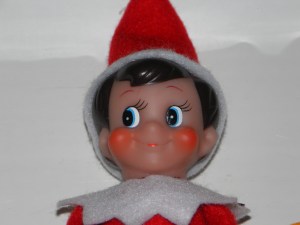
Elf face

Look deeply into his eyes. He knows you’ve been bad, very bad indeed. And now you must be punished.

Well, to each their own. If you enjoy your Elf on the Shelf, more power to you. And if you wake to find him in a strange place, it must be because someone in your family put him there. It must be.

Those Germans sound like they’re telling a really good story

My son likes me to read to him. Though I would rather have him start carrying more of the burden of the reading, I generally don’t mind his requests. Sometimes, he doesn’t even listen to the story. He just likes hearing the sound of my voice.

If I needed any more proof of this, it came the other day when I read a good chunk of a book to him in German. The boy does not understand German. Moreover, a solid C- average through two semesters of German 1 notwithstanding, I neither speak nor read German.

The story of how I came to read to my son in a language that neither of us understand is a long one. I will shorten it as much as possible.

My father spoke German like an authentic Swabian, which is to say fluently, but perhaps with a bit of a southern drawl. I’m sure this came in handy for him, growing up in a mostly German-speaking household. When I was a child, he would occasionally travel to visit some of the Swabians his parents left behind when they decided that all the artillery noise from neighboring France that kept them up at nights was too much for their peaceful natures.

German Swabia

Swabia (highlighted): Southern hospitality – German style. (Map: Clair Samoht)

My father would bring home from Germany the most wonderful storybooks I’d ever seen. They were full of brightly-colored animal characters, performing heroic deeds in fantastic settings. The heroism of their deeds I deduced from the pictorial narrative, since the text of these German books was, not coincidentally, all German. In spite of, or perhaps because of, their foreignness, I loved those books.

I grew up, and the books vanished.

Before our first son was born, my wife located copies of these books online. She gave me a set for my birthday. Even she made me read them aloud to her, because although we don’t know what the words mean, she is in love with my German pronunciation.  She thinks I sound like the Germanest German who ever clicked his heels together, and for some odd reason, she finds this attractive. After the children have gone to bed, I sometimes hear her whisper into my ear, “Sprechen to me, baby!” But that’s a story for a different blog.

Anyway, my son found these books on the shelf and was immediately taken with the artwork. He can tell by the pictures that these are good stories. Of course, he wants me to read them to him. At first, I protested that they were in German, but that feeble argument did nothing to dissuade him.

Consequently, I occasionally find myself sitting next to the boy, reading to him words I don’t understand and am pronouncing like I think the German generals in old WWII movies would. To make matters more ridiculous, the text is written in an old fashioned script, from which I could probably not make out English words. I can’t stop to try to decipher all those 30-letter words without affecting the flow of the narrative, so I just read the first syllable and tag onto it something that sounds like an order to move two panzer divisions to Normandy.

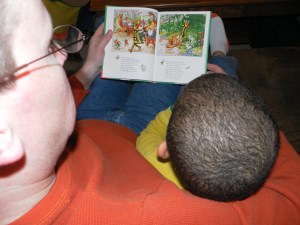
Reading German books

This is what it looks like when we read one of our German books.

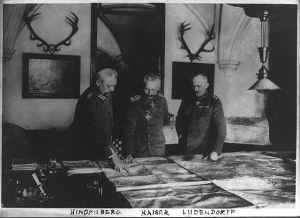
German generals looking at map

This is what it sounds like when we read one of our German books, though this is actually an image from WWI, not WWII, and these individuals are not movie actors.

The boy just listens, or not, patiently enjoying the great pictures. He doesn’t interrupt me at all until we get to the end of the story. When we get to the end, he asks me if I’m done. He is completely satisfied with the story, except for one little thing. “What was that about?” he asks.