It’s a long story

Lately, whenever I ask my son a question like, “How did the [busted item of the day] get broken?” he heaves a big sigh and replies, “It’s a long story.”

He does not attempt to relate that long story, because it is clear that a father with such a short attention span would not be interested in the burdensome details.

“It’s a long story,” is not at all an introduction to an informative tale. Rather, it is the boy’s way of telling me that a lot of unnecessary information will not fix [busted item of the day]. It is his counsel to not cry over spilled milk and just get on with the business of living life. What’s done is done.

I could not figure out where the boy picked up such an evasive strategy, until I recalled a conversation we had at a restaurant a while ago.

Out of the blue, and just as I was about to shovel the first forkful into my mouth, the boy asked me, “When I was a baby, how did I get into Mommy’s belly?”

Why do they always pounce when I’m weak from hunger?

Put on the spot, my panicked mind bounced between two options. “You see, son, when a man loves a woman . . .” was the option from which my mind ran screaming.

“It’s a long story,” was the defense mechanism for which my mind leapt. It worked, or so I thought at the time.

Before the boy could renew his assault, a man wearing an Air Force uniform was seated nearby. My son, who is going through a period of fascination with all things military, forgot about the origins of his species. “Is that man in the Army?” he asked.

I explained that he was in the Air Force, which was like the Army, but with jets. My son soaked it all in. “Why don’t you go in the Army, Daddy?” he asked.

“I’m not so good at following orders,” I replied.

“You could be the boss of the Army. Then you could give all the orders.”

“But I’m too old. They wouldn’t even take me.”

“Well, you wouldn’t have to be in the battle,” he assured me, as if the Army has a row of rocking chairs ringing the combat area for its aged recruits.
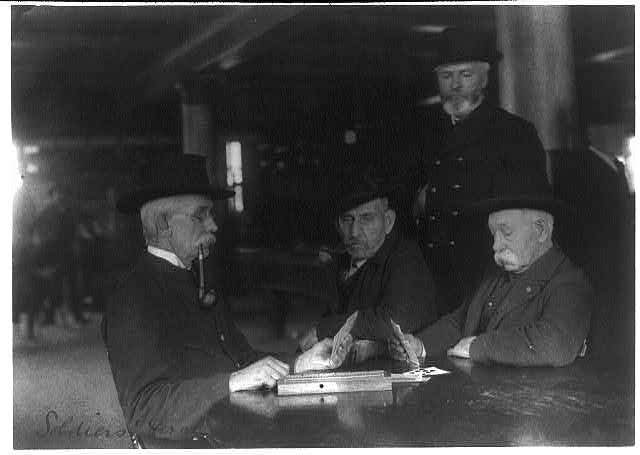
Old soldiers

Maybe I could join up with this outfit of old soldiers. We’d play cards, listen to the battle on the wireless, and, time permitting, argue about where babies come from.

We then went on to discuss related topics. The subject of where babies come from was forgotten. I congratulated myself for dodging a bullet, for the time being anyway.

Well, maybe he forgot about the topic of the conversation, but he did not forget about the device Daddy used to steer the conversation elsewhere. He remembered that all too well. Now I have a house full of broken stuff and a child full of long stories that are too cumbersome for Daddy’s simple mind.

You reap what you sow.

And that baby question will come up again anyway. How will I handle it next time? Well, that’s a long story.
We’re not laughing at your tears; we’re laughing with them

When a child hurts himself and starts to cry, there are numerous ways his parents might react: alarm, fear, laughter.

It may not be the proudest moment of parenthood, but if you have never been inspired to uncontrollable laughter by your child’s mishaps, then you haven’t been a parent very long or your pants are on fire.

The truth is that children sometimes hurt themselves in comical ways. What makes it worse (or better, if you enjoy a good laugh) is that the sounds leading up to the actual crying are like a well-known symphony resounding in the parents’ ears. When that sound track begins to play, a parent has two responsibilities:

  1. Check for blood.
  2. If there is no blood, try to conduct yourself in a manner that appears sympathetic.

The first responsibility is easy to fulfill. The second, not so much. It depends upon the circumstances. Sometimes children hurt themselves in mundane ways that are not at all hilarious. It’s easy to be a good parent when you’re bored. But when the kid goes slapstick, be prepared to have your parenting chops tested.

Last week, my preschool son found a spider on the kitchen floor. As the self-appointed neighborhood watch chief, when it comes to tiny pests in the house, he immediately contacted the authorities. I (the authorities) relocated the spider outdoors.

My son, harkening to the classic axiom of infestations: where there is one, there are bound to be others, decided that he’d better check the kitchen for other spiders. He got my flashlight and was soon crawling around inspecting the nooks and crannies of the room.

We have an island in the middle of our kitchen. My wife and I were standing on one end, and my son quickly disappeared from view as he crawled around the other. We could hear him rooting about on the floor as he entered an area populated by a few wooden chairs.

He must have been too focused upon his work, and his comments to himself about the likelihood of spiders being found here or there, to notice that he wasn’t crawling out in the open anymore. We could see nothing, but we heard the telltale opening of the Overture of Torment:

THUMP!

Then that long inhaled breath that is broken up into three equal parts in the instant between the pain and the wailing:

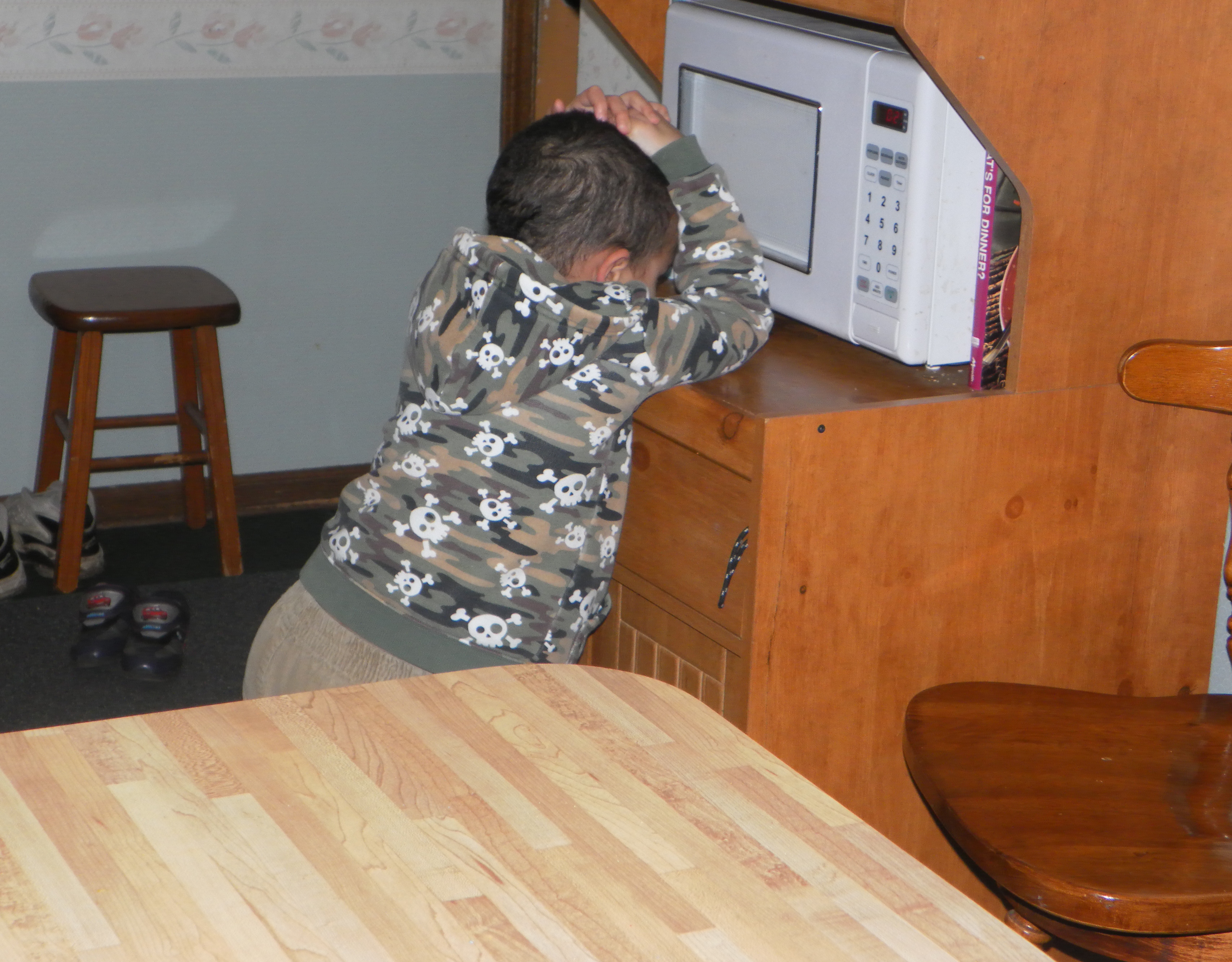
crying to the microwave

In this over-acted dramatization of the recent tragedy, the boy makes an editorial comment by turning to the microwave for the sympathy that more fortunate children expect from their parents.

“Huuut, huuut, huuut.”

Then, with enough air drawn into his lungs to support it, the wailing itself:

“Aaaaaahhhhhhhh, aaahhnnt, aaaahhhhhaaaaa . . .”

He stood up, both hands holding the top of his head as if pressing that fixture firmly down on his neck until the glue dried. Tears ran down his cheeks as he looked to us for the sympathy so common to our parental natures.

There was no blood, so we looked away, a moment before our bodies began to shake with laughter.

We couldn’t look at him; we certainly couldn’t look at each other. We hid our faces.

My wife found the strength to ask, “What happened?”

“I . . . bumped . . . my . . . head,” he choked out, almost audibly.

I put my head down on the counter and covered my eyes. All I could think about were the spiders who were taking advantage of this tragedy to make good their escape.

The very next day, he was searching for something around the corner in the TV cabinet when we heard the exact same song:

THUMP!

“Huuut, huuut, huuut.”

“Aaaaaahhhhhhhh, aaahhnnt, aaaahhhhhaaaaa . . .”

I can’t hide my mirth on such a regular basis. Once the blood check was over, I let it out. He was angry at first, but after I sat down with him and gave him a big hug, his crying subsided. “Why are you laughing?” he asked.

“I was thinking about yesterday. Remember? You were looking for spiders, but you found a chair instead.”

“Yeah.” He started to laugh too.

They say it’s the best medicine.

Scorn is fundamental

Our four-year-old is learning how to read. He is also learning how to not read. Take him to the toy department of a store and he can read surprisingly well. The words on the boxes all spring to life with vast meaning. Sit him down with a book at home and letters no longer make pronounceable sounds; words are cryptic hieroglyphs on the page.

At first blush his selective comprehension might seem like laziness. And it probably is, to some degree. But it also represents an understanding of the economic value of knowledge. When there is something he wants, he suddenly has knowledge to offer. When knowing offers nothing but tedium, he naturally knows nothing.

His strategy of using reading as currency is obvious. The other day, he quickly read the word Batman on the cable guide because he likes that show. He has become quite a fan of the old 1960s TV version (and for anyone who thinks Adam West is not a great actor, you try to say some of the lines he had to say with a straight face).

Another time, the boy also easily read the sentence, “Do you want chips and cheese?” when his mother wrote a note for him. He really wanted chips and cheese, which momentarily made him a super-reader. With a full belly, he became illiterate once more.

He has yet to embrace the concept of delayed gratification: make your parents happy and proud now, and you are more likely to receive some as-yet-unnamed reward in the future. Consequently, we are left with the task of trying to make reading, for its own sake, seem less toilsome.

We have a collection of magnetic letters stuck to our refrigerator. He uses these to spell out words. His baby brother likes to play with the letters too, but his favorite game is to push them underneath the fridge.

One day, the big boy was using the magnetic letters to spell out his full name. He was lacking a letter, so we spent our time trying to retrieve some of them from underneath the appliance. We finally found the letter he needed, but there were still more letters underneath that we couldn’t reach. He wanted all the letters back.

He had seen me push the fridge away from the wall once before so he grabbed hold and tried to push that monster out of the way. Of course, it didn’t budge. “Help me move this,” he insisted of me.

I had nearly destroyed its wall plug the last time I’d moved it. “No. I’m not moving the fridge again,” I told him.

He put his hands on his hips and gave me a look of disgust. “I thought you were trying to be helpful,” he growled.

The jury is still out on reading, and delayed gratification is yet to come, but it appears as though I’ve done a bang-up job of teaching him scorn.

Reading is fun!

I really need to pull another N out from under this fridge before the boy hits middle school and this message takes a wrong turn.

I can tell you are a Superstar from your healthy snacks

This is a big week in our son’s life. He is Superstar of the Week at his preschool. This is a major honor that can only be achieved through hard work, diligence, and having your name drawn out of a hat. All of the children have a turn, but this does not diminish the honor. When it’s your week, you are the only one who is Superstar of the Week.

The boy’s parents are not Superstars when it comes to thoroughly reading the information sheets he brings home from school. Instead, we rely upon him to keep us informed. This is ironic, as he seems to believe that his parents do more than skim the paperwork for the gist of it. He doesn’t like to waste our time supplying redundant details.

This resulted in a Sunday night trip to the store for materials, when we finally figured out that Superstars usually make a poster of family pictures to display during their week. The evening was a frantic blur of scissors and glue. Daddy ran security to keep the baby away from the project, on the construction of which, he so badly wanted to help.

I was the at-home parent on Monday of Superstar Week. When my son got up in the morning he asked if he needed a bath. Since his mother hadn’t left orders to give him a bath, I told him he didn’t need to take one.

“Yes, I do,”  he replied. I froze in place. Before I could demand of this alien imposter what he had done with my real son, he explained. “I can’t be dirty if I’m gonna be the Superstar.” So, Superstars take baths voluntarily? This is the most important thing to know about the Superstar of the Week. I went back and checked; it wasn’t mentioned in the handout.

The Superstar is privileged to bring to school a healthy snack to share on Friday. We will have to ask for some advice on this matter. When I was a kid, healthy and snack never appeared in the same sentence. If anybody had ever dreamt of such a combination, it would only have been to remind the provider to steer clear of the lead chips this time.

During my childhood, we ate wholesome snacks. These were foods that gave us the energy and the blood pressure to stand up for the American Way. Ho-Hos and whole milk defeated communism. Could carrot strips and V-8 juice have accomplished that?

Sugar and salt, the cornerstones of my youthful nutrition pyramid, seem to be out of favor today. Maybe my wife knows of a magical food item that fits into that narrow intersection of healthy and delicious to preschool children. If not, we’ll do what we usually do: bring it up in casual conversation with some up-to-date preschool parents and steal their ideas without letting them know how clueless we are.

Being Superstar of the Week brings glory, but also grave responsibility. You have to be clean, and you have to nudge your parents into the modern age. It’s not all fun and games, you know.

walking to school

Heading off to the first day of school in the fall. Who would have guessed that the experience would turn him into a Superstar?