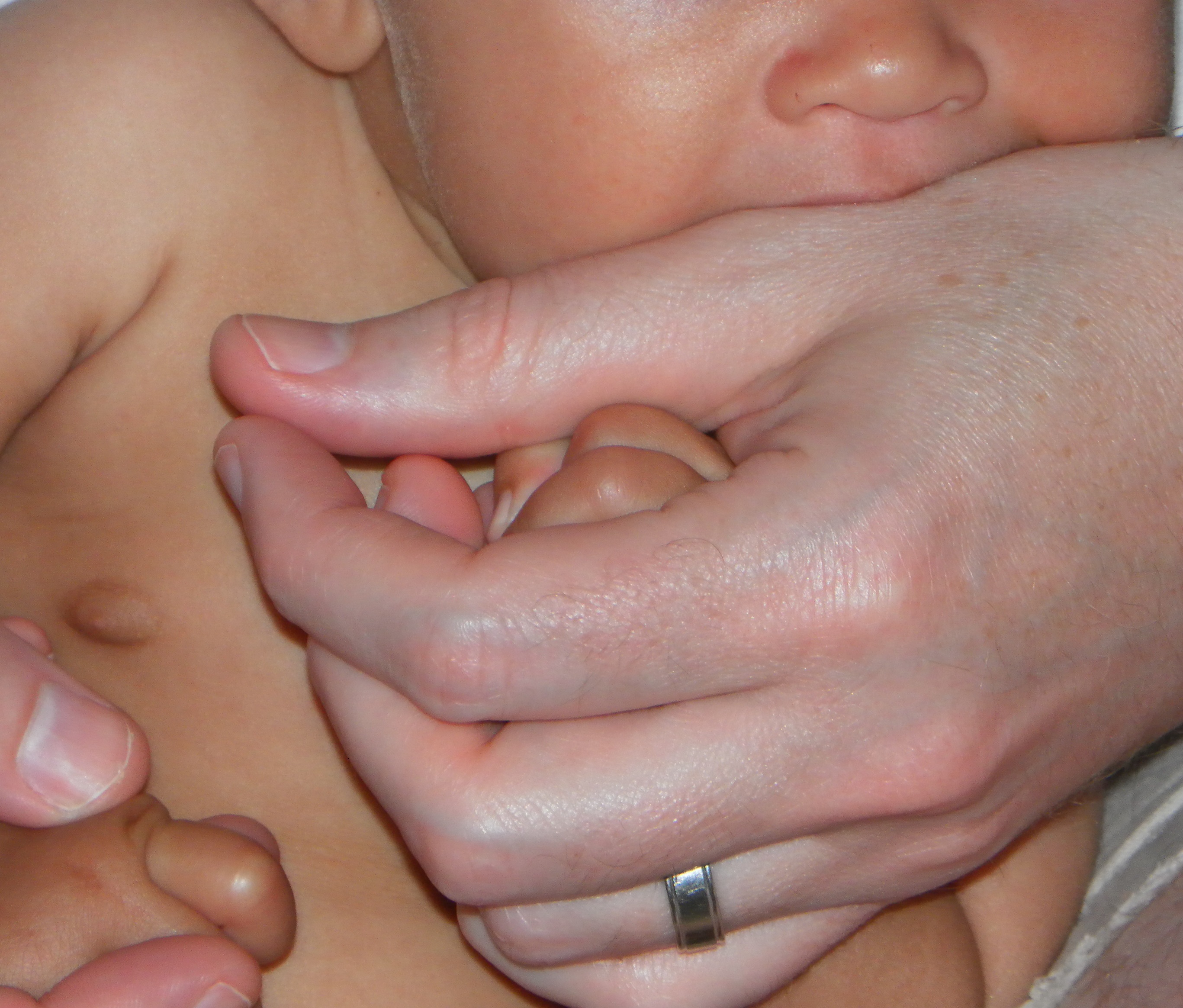
A Land Shark is born: baby’s first tooth

The baby is cutting his first tooth. To be more exact, the baby is cutting everything he can get into his mouth with his first tooth. It’s funny how popular culture phrases it as though something destructive is happening to the tooth itself when, in fact, it is the tooth that is tearing up the world as we know it.

I’ll concede that the sensation of that first little nub coming in may be inspiring the baby to bite down on things for pain relief. It would be helpful to know how much trouble this developing tooth is causing him, but we are largely in the dark. The baby can’t tell us because he doesn’t speak English, although I could swear I’ve heard him sigh, “Oh, yeah!” a couple of times, right after he’s belted a grand slam into the upper deck of his diaper.

If teething is indeed causing him pain, he is doing a good job of sharing the joy. That little diamond-tipped blade he has poking out of his lower gum is hell on naked flesh. The fact that it lies hidden behind a baby-soft pair of lips makes it doubly dangerous.

This young man has always enjoyed rolling a parent’s fingers between his gums, but the advent of the tooth has turned him into an adorable little piranha.  It’s as if the tooth has taken charge of him, commanding him to snap at any fleshy target in its insatiable lust for blood.
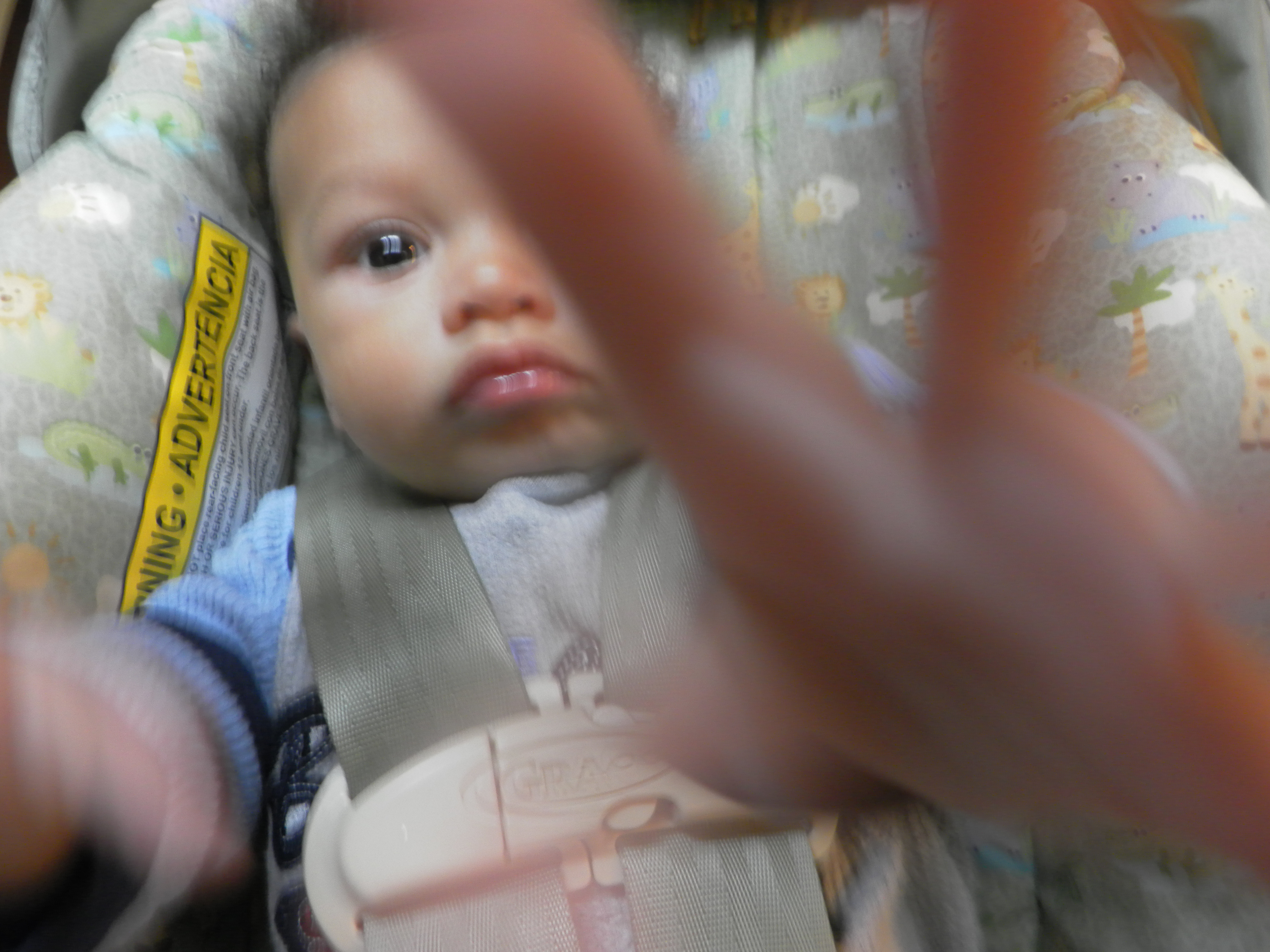
baby peace sign

“The tooth asks that you respect his right to privacy. No pictures, please.”

Fingers should always tread lightly around a teething baby’s mouth, but this boy bites shoulders now. Of course, it’s not his fault; it’s that demon tooth that rules him. That sociopathic shard of enamel smiles at you from within that happy little mouth, lulling you, endearing itself to you through your gullible weakness for developmental milestones. It sucks you in, toys with you, until you are so deceived that you actually feel betrayed when the shark bites.
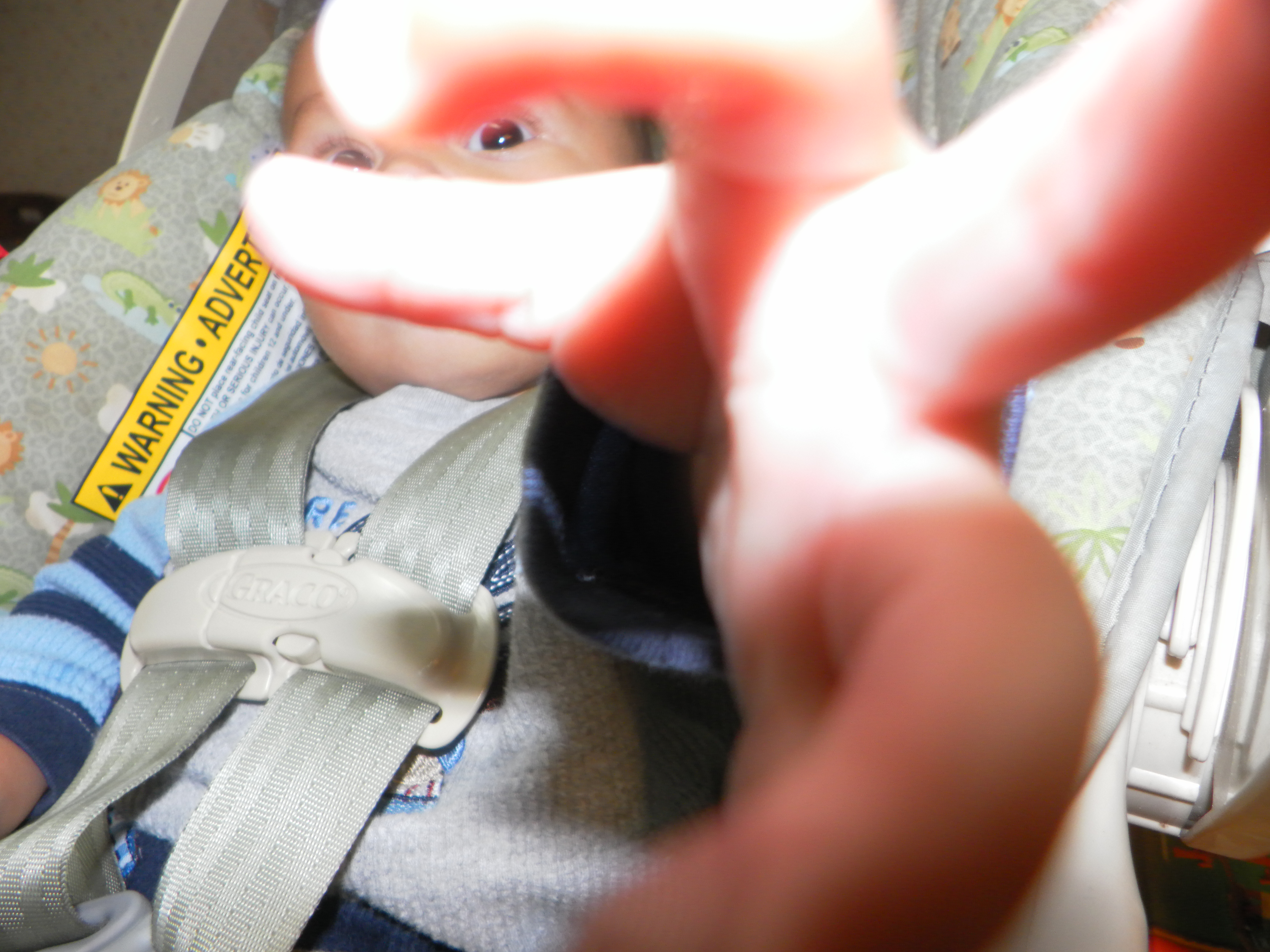
baby grabbing at camera

“Okay, that’s it! I said no pictures of the tooth. Give me that camera.”

From my recollections of the first child’s teething time, it seems that there is an unspoken understanding between baby’s teeth and mother when it comes to breastfeeding. Smart babies know not to bite the boob that feeds them. That’s one spigot that no youngster should do anything to turn off at such a tender age. It could lead to the gnashing of teeth, as soon as he gets another tooth to gnash against the first one.

Meanwhile, the baby is always looking for something or someone to try his new tooth on. I feel like I should be pushing raw steak at him with a long stick. Does anybody know where I can get a pair of rawhide gloves and shoulder pads?
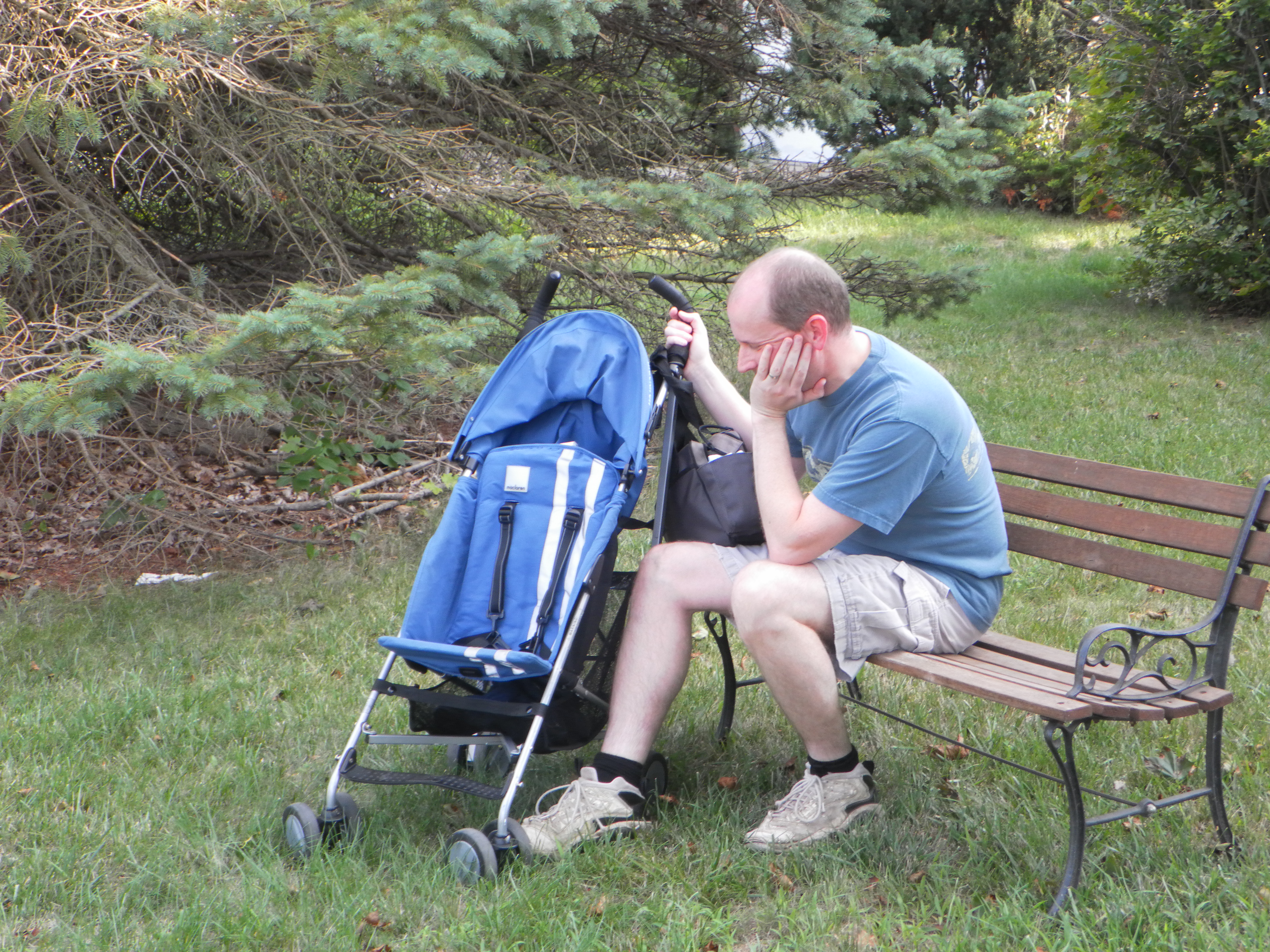
Who’s the weirdo with the stroller?

I am a periodic sufferer of a condition. Since I can find no official name for this complaint, I am going to name it myself. My problem is called Empty Stroller Syndrome.

Empty Stroller Syndrome (ESS) occurs almost exclusively in fathers of young children. It manifests itself in well-populated areas, including public transportation. A bout of ESS is generally brought on when the mother takes the child from the stroller to some location disassociated from the father, who is left with an empty stroller and no child in sight.

It is important to note that if you are out in public with an empty baby stroller, but have no children in your life, you are not suffering from ESS. You are suffering from being one weird dude.

Empty Stroller Syndrome: the silent stigmatizer.

ESS is an often misunderstood condition due to the fact that, to the unfamiliar observer, the sufferer closely resembles the weird dude aforementioned. Lacking a nearby baby, there is no recognized protocol for differentiating the ESS sufferer from the weird dude.

It dawned upon me that I suffered from ESS while I was riding the metro train in Washington, D.C. With two small children, we have many accessories to carry with us on outings. These many necessities were secreted in and about our stroller, with heavy baggage hanging from each handle.

Every time we boarded the train, my wife took the baby out of the stroller and held him on her lap. When we could sit together, this presented quite a natural scene. But on the D.C. subway, parties often need to disperse, transforming me into a solitary man with his heavily weighted stroller.

Judging from the looks I received from fellow passengers, some sympathetic men recognized, or at least hoped they recognized, an all too familiar case of ESS. Other passengers merely wondered silently about that weird dude who used a baby stroller as a pushcart for his sundry, joyless bundles.

Without the baby in place, the stroller was unbalanced. At every change in momentum, it was liable to tip over backward. Not wanting to risk injuring others, I guarded it closely. This made me look less the innocent victim of a crowded transport system, and more the weird dude whose precious, precious collections of plastic spoons and acorns must be jealously protected from a covetous world.

The shame of ESS. In the past it was difficult to build awareness because fathers were so shamed by their condition that they would not allow themselves to be photographed with their empty strollers.

In most cases, it doesn’t matter to me what strangers think. But I’ve put a lot of work into this fathering business, and I’d rather not be thought of as some kind of unhinged stroller pervert. I have the children to prove that there is a perfectly reasonable pathology behind my distant, glassy stare. They are elsewhere on the train, with their mother, the one competent to be the guardian of cargo more important than empty strollers.

I tried to ease the suspicions of my close companions by turning and yelling things to my family that hinted at more than a passing acquaintance between them and myself. I gave up this tactic when it became clear that the crowd did not relish a loud conversation about the probability of there being a poopy diaper somewhere among them. For those who could not see the family to whom I was speaking, this talk only added to my mystique.

Alas, there was nothing to do but quietly endure my flare-up of Empty Stroller Syndrome. In the distance, I could hear people clucking over the baby. Nobody ever gushes about how adorable my empty stroller is. In silence, they avoid making eye contact with me.

Milk it while it’s still cute, kid

In considering the traits the baby is displaying at three months old, I wonder which of them he will carry with him as he grows into a young man. I’m fairly certain that he won’t continue to view every naked moment as an opportunity to pee on whatever or whomever is within range. That could get very socially awkward, and if it doesn’t, I don’t think I want him hanging out with that crowd.

Of all the cute things a baby does, how many of them would still be cute if he did them later in life? The boundaries of cute shift over time, and there are some things that won’t be so cute down the line. That being said, he can cut out the indiscriminate peeing any time now, as that was never cute, in spite of his misguided notions.

This would not be cute in an adult

Our baby loves chewing on hands. I understand babies wanting to suckle on fingers, but he’s moved past digits. He loves to sink his gums into some juicy thumb butt. A little shank of thumb is his favorite, but he’s not above savoring a bit of knuckle or wrist when the mood strikes him. I don’t have meaty hands, but what meat I do have is, apparently, quite delicious.

These are even better dipped in melted butter.

Maybe he would chew on my ankles if I held him with my feet. Perhaps he’d chew on whatever was available, excepting, of course, my gristly, spiny shoulders. But I think he prefers hand meat, because when my hands are not available, he munches his own. His thumb is just not enough. I’m going to start wearing gloves when the teeth come.

This won’t do much for his social life

When he’s happy and engaged, the baby coos adorably. It is one of the most endearing things about him. Yet, the cooing is not going to be so cute when he’s 17. I hope he doesn’t approach the girl he wants to take to Prom and just start giving her the “ooooo, ooooo, ooooo,” treatment. Sure, it’s cute now – it’s so cute that it’s all he needs to say. But that 17-year-old girl is going to want to know when he’s picking her up, and she’s probably not going to have her hair done by ooooo o’clock.

“I’m here to take your daughter to indiscriminately dive-bomb people in the park . . . uh . . . I mean . . . Prom.” (Photo: Gary Kramer/U.S. Fisheries and Wildlife Service)

By the time he is 17, he’s going to need to be more articulate than a pigeon. Of course, I’m sure he will be, under normal circumstances. I just hope he doesn’t panic and resort to babbling random bird noises every time he comes near a pretty girl. My fear is not unfounded; there is some precedent for this kind of behavior in his nuclear family.

Babies change so quickly that I could be writing about different traits in a week. I just hope all of those future traits are contented ones . . . and none of them lead to cannibalism.

It’s a loose interpretation

You can’t be around a baby for any length of time without wondering if the baby’s cries have a specific meaning. If there is a language of babyhood, it would be gold to parents to understand it.

“Why can’t you people understand me? I’m crying in the plainest language possible!” (via Wikipedia)

At some point in every young life, a divide is crossed, between baby consciousness and the consciousness we carry for the rest of our lives. There is a strict no-reentry policy within the arena of baby consciousness. Once you leave, you’re out for good, so try not to leave anything you need inside the fence.

Our baby cries a lot when Daddy is in charge of him. Naturally, I am keen to know the cause of his displeasure. Since my wife, the cat, and I are all too old to still have a foot planted inside the baby consciousness compound, I pinned my hopes to my three-year-old son. Maybe he still remembers some of the lingo.

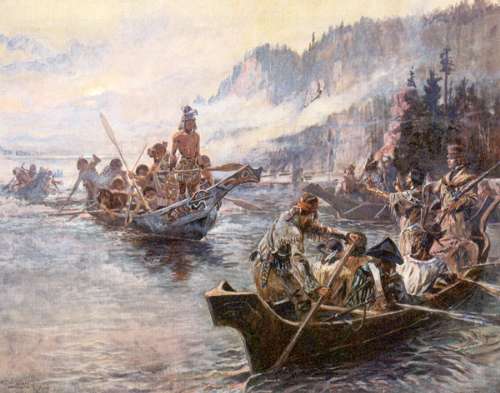
For a while, every time the baby cried, I pushed the three-year-old at him. “What’s he saying?” I asked, as if I were Lewis or Clark, the boy were Sacagawea, and the baby were some random Shoshone we ran across on the trail west.

My son couldn’t translate a single wail. This shouldn’t have surprised me; the boy can’t identify the problem half the time when he, himself, is crying. Besides that, he clearly no longer understands Babyish. And why should he? As he has often pointed out, there are no two things on earth more different than a baby and a big boy.

Having given into his prideful instinct to culturally distance himself from the baby, the boy has discovered that he has burned a bridge that might have been useful to him. Only too late did he realize the influence held over communication by the interpreter.

The boy has backtracked, now pretending that he does indeed understand the baby’s tearful messages. “He wants some milk,” the boy once explained of the baby’s cry. “And he wants you to get me some ice cream.”

“He says they’re debating whether to kill you all or let you go in peace. Also, he would like you to go get me a cupcake and some fruit punch.” (Artist: Charles Marion Russell)

This fraudulent translation would be transparent under any circumstances. Yet, I think the boy attributes my disbelief to the fact that he has already disavowed any knowledge of baby-speak. I can see him thinking that he would get away with it, if only he had pretended to understand the baby from the start.

Still, there’s no harm in trying. When the baby begins wailing, the boy will interpose himself and his useful services. “He says he wants to be with Mommy so you can build a track for my train on the floor.”

And if I have a good reason not to do what the baby asked: “It’s too late to get out the train set. It’s almost bed time.”

Well, the baby covered that, too. “He said he’d be so happy if you let me stay up late tonight.”

I can tell the boy is mentally kicking himself for giving me reason to doubt the faithfulness of his translations — he’s kicking himself all the way upstairs to bed.