When in doubt, sound it out – or just take a wild guess

My son is starting to be able to put the sounds letters make together to form words. This is a joyous, proud, and maddening time for his parents. It is hard to hold a single emotion from one moment to the next when our budding little reader is playing with the intellectual Flubber commonly referred to as sounding it out.

We are certain the boy is a genius when he correctly reads a word we thought beyond his knowledge of the pot-hole-laced rules of English pronunciation. In the next instant, we become convinced that Kindergarten is nothing more than a pipe dream for this daft child who just sounded out the letters of a simple syllable, then blended them to form a word completely foreign to the sounds he just uttered.

In our hearts we know that he is neither genius nor daft. He’s a kid who is on solid academic footing when he is focused. He is also a kid who is four. Consequently, he is often tempted by disinterest in thinking a problem through when it is more convenient to take a wild guess and move on to playtime.

This laziness is as natural as it is maddening. Without it, parenting would probably get to be too easy; parents would go around bumping their swelled heads into each other as they waited a minute for their gifted children to become doctors specializing in the treatment of concussions.

My son and I were looking at a group of portraits of people he did not know. Beneath each, the person’s name was spelled out. My son wanted to know who they were, so I asked him to sound out one of the names. The one I chose was Mary.

He began, “Maa, aah, ra, ee.”

“Now put it all together,” I said.

“Mary,” he replied without hesitation.

“Good job!” I had thought that the Y at the end might give him some trouble, since Ys have been known to make various sounds in different situations. But he tore right through it, making me just a tiny bit proud. We moved on to the name Adam. I thought this one would be easy after Mary.

“Aah, da, aah, ma,” he read.

I was already counting this one as a win and trying to find the next name we would try. “What’s it say, when you put it together?” I asked, almost as an afterthought.

“Henry!”

That high-pitched noise bystanders heard next was made by the hot air of parental conceit rushing out of my head through my ear holes.

Adam and Eve Currier and Ives lithograph

Eve laments the time wasted in trying to sound out the hard-to-read and easily tempted Adam. If she had only followed her instincts and gone with Henry, things certainly would have turned out better. (Image: Currier & Ives)
Learning + play – learning = fun

I’m normally a very Do-It-Yourself oriented person. Before I consider paying somebody else for a service, I make every effort to do it myself. I have never needed surgery, but if I ever do, I will read all about it on the Internet to see if it is an operation I can knock out over the bathroom sink before I fork over a dollar to a “trained” surgeon.

As I pay a preschool big wads of money, in hopes that they can teach my son to read, or at least get him close, I wonder where my awesome self-reliance went. It is deflating to my rugged individualist ego to throw in the towel on this issue; nonetheless, the towel is wadded into a ball and my arm is cocked into pitching position.

I should be able to teach my own flesh and blood to read. To begin with, I can read myself, which is half the battle. I should be able to find the time, patience, and discipline to get him reading. It turns out, those things comprise the much larger half of the battle.

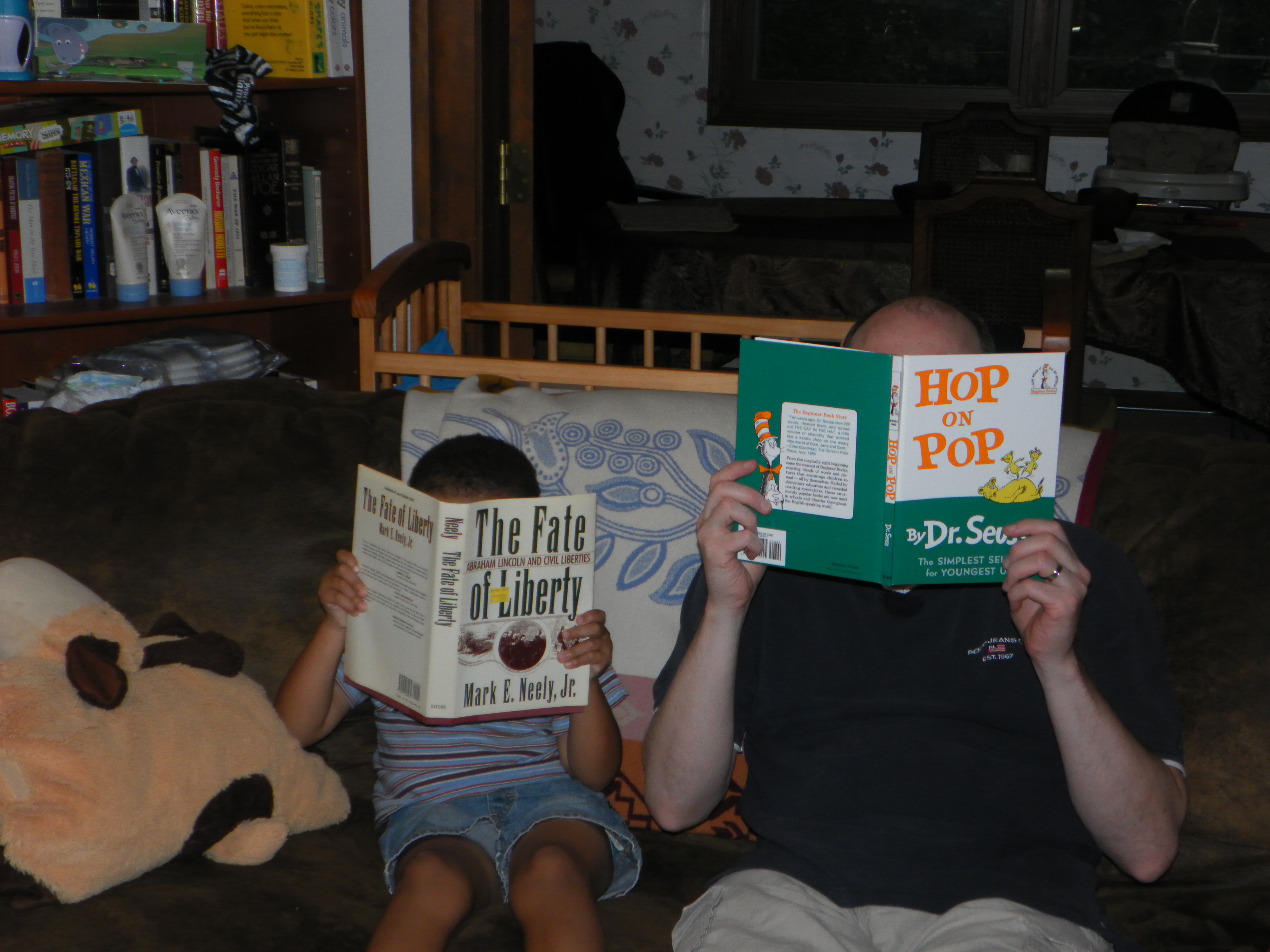
We need to train another reader to help me get through these books. The backlog has spread to shelves all over the house. This work is seriously cutting into my play time.

There are a surprising number of halves to this battle, most of them unconsidered during those callow days when I entertained glorious dreams of educating some future, theoretical child at my knee. Discovering all these extraneous halves has led me to the disappointing conclusion that I probably should not be the boy’s mathematics tutor either.

A considerable half of the battle is the one wherein the boy considers it a waste of his time to learn to do something that his parents can easily do for him. We have two experienced readers in the family,  leaving us with a spare, in case the one reading the bedtime story conks out. Surely, that is enough for any household. A child who learns to do things for himself opens himself up to the burden of unwanted responsibilities. Where does it end? Soon, they’ll be troubling him to tie his own shoes.

It may be an obvious half of the battle that the boy would rather play than work on academics. Learning is work, and so is teaching, which is perhaps part of the reason why we commonly pay people to do it. After the 100th time Daddy implores his distracted pupil to “sound it out,” it dawns upon him that he has already gone through the learning-to-read process once in his life. It was a slog then, and it’s a slog now. There’s no good reason to go through this drudgery twice in one lifetime. As the boy has pointed out, everybody could be using this time to play.

Reading is fundamental. I learned that from all the commercials I saw on TV as a kid.

This battle has at least 14 too many halves for Daddy. Mommy is much better at sticking to it, as well as getting the boy to stick to it. Mommy has laid a good foundation, but even Mommy’s diligence has its limits. It may be worth the money to have someone, whose credentials go beyond the mere ability to read, take a hand in the process. If nothing else, it is sure to take some of the guilt out of play time.