Einstein didn’t have to poop on the potty!

Buster is adept at many skills for a two-year-old. He holds a pencil like a pro and draws abstract art as if preparing for his gallery opening. He makes up his own songs to serenade his Mommy at bedtime. He knows his way around an iPad better than I do and makes that little guy leap over the stampeding bulls in his favorite game with dexterity to make my head spin.
Helping with the baby

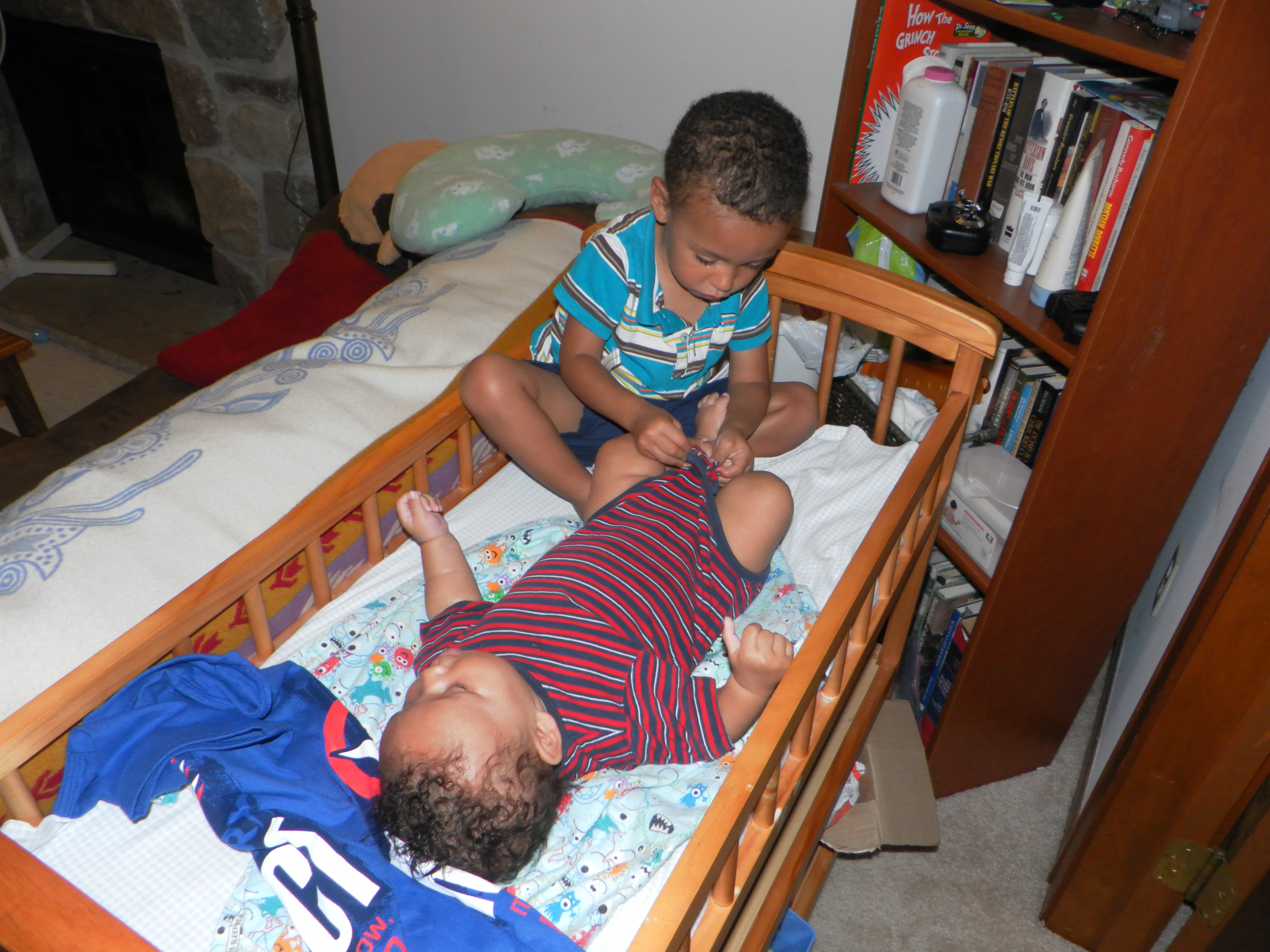
Teaching Daddy how to manage those tricky snaps on the baby’s Onesie.

Yet there are some toddler skills that Buster is not ahead of the curve on. It would be one thing if he didn’t have the capacity to do certain things, but he does. It’s more of a defiance issue, although even that doesn’t truly capture the spirit of it. It’s defiance mixed with indifference.

Buster thinks he’s pretty smart. I don’t know if he styles himself a genius, but his affinity for playing jokes can only lead to the conclusion that he believes he’s pretty clever. And a clever boy shouldn’t be asked to learn things he sees little use for in the rest of his life.

Just as an older child might ask about the long-term utility of Algebra, I hear, in Buster’s spirited remonstrations, the philosophical query: “When will I ever use big boy underpants in real life?” Such garments hold no candle to the convenience of the diaper.

“Einstein didn’t have to poop on the potty!” He doesn’t know anything about Einstein, and he doesn’t say this literally, but I can see in his eyes the formation of an idealized, toddler image of genius. His aggravated eyes tell me that the child genius would never waste his time on something so trivial.
Theory of potty relativity

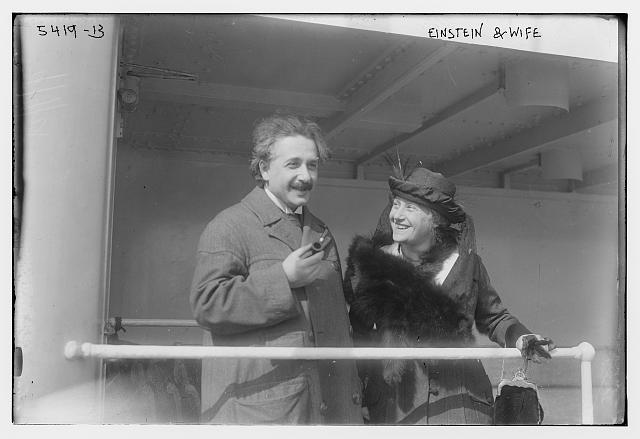
“Everything is relative, my dear. Poop wherever you like!”

“Galileo didn’t pronounce K, F, or S sounds!” I bet he did, though this is not really about Galileo. It’s about a toddler whose opinion of his own world view dismisses the need to do inconvenient things.

Pope Urban's bad boy

Galileo Galilei: also too clever for his own good. The inquisition was not amused by his jokes.

It’s easy to replace the unnecessary consonants in words with the ever useful D and T. Mommy and Daddy understand the words formed by these substitutions, and since they are the only people he will ever need ask for a bowl of Lipton Noodle Doup, there’s no point in wasting effort on the unnecessary.

Buster can make the S sound. I know, because I’ve hounded him into doing it. He just doesn’t see the need. It is, after all, marginally more difficult for his tongue than making the D sound, so why bother?

Because Daddy is a trouble maker. One day, daddy wouldn’t make him any doup until he made the S sound.

“If you want soup, say ssssssss,” Daddy demanded.

Buster held out as long as he could, but he really wanted that soup.

Finally, he relented. “Sssssss,” he said.

“Now, say sssssoup,” the heartless Daddy persisted.

Buster sighed. “Ssssss . . . doup.”

That was close enough. Buster got his soup. And the last laugh.

Clever boy.

Reading is fun, except for all those words

I was helping my 1st grade son with his homework. This isn’t the perfect bonding exercise, as he does not like doing his homework and I do not enjoy watching him not like doing his homework. It leads to impatience in my voice, which he likes almost as little as he likes doing his homework.

Earlier this year, as I was dragging him out of bed for school, he told me, “I don’t like learning. It’s not really fun for me.” Dragging him out of bed in the morning is not really fun for his parents, but I suppose that’s an issue for another day.

Part of his homework that night was a questionnaire from his reading teacher. I guess she wanted to get a feel for each child’s attitude about reading before getting too far into the year. My son is a pretty good reader, when he has to be. And when he doesn’t have to be, he’s playing with LEGOs.

When it comes to reading practice, he’s lazy. I could compare him to a mule or other reluctant worker, but that’s not quite strong enough. The only simile that fully captures it is: he’s as lazy as a six-year-old.

The first question on the homework was: “Reading is _________”

The boy thought about it for a second, then filled in the word fun.

I raised an eyebrow. “Really? You don’t act like reading is fun.”

“Reading is kind of boring. But I think this is what the teacher wants me to say,” he explained.

It would be hypocritical of me to make him change his answer, since much of my own school career was based upon political expediency.

What books?

He loves going to the library. They have fun toys and games there, and you can even borrow Sponge Bob videos.

He answered a few more questions about his favorite subjects to read before he got to the question: “The best thing about reading is _________”

He didn’t have to think about it at all. He quickly went to work answering the pictures.

This didn’t sound much like a reading is fun kid, but maybe you can like to read and still like the pictures even a tiny bit more than the text. I let it go.

The next question was: “The worst thing about reading is _________”

He didn’t miss a beat. “The words,” he said, quicker than he could touch his pencil to the paper.

I had to slow him down this time. If you are going to start off playing this game of hiding your opinions behind the expected preferred opinions, then you ought not directly contradict yourself by letting your true feelings out later.

I should have let him look foolish with his incongruous answers, but I was in no mood to be dragged down with him.

We discussed it and decided the hard words made a better answer.

So it boils down to this: reading is fun, especially when accompanied by numerous illustrations, but the enjoyment can be diminished by an overabundance of difficult passages.

That sounds like a perfectly reasonable opinion, doesn’t’ it?


Let’s play 20 (thousand) questions

If you are the father of a new baby boy and you are feeling a little left out because junior only seems to have eyes for Mommy and her rolling hills of milk and honey, take heart. Your day will come. Your day will come with a suffocating vengeance. Junior will cover you with love, elbows, knees, and incessant questions before you know what hit you.

Boys start climbing up and down Daddy as toddlers. This isn’t so bad. Toddlers aren’t very heavy. Yes, they have sharp corners, but there is usually not enough force behind the pointy parts to cause Daddy any serious internal damage. More importantly, toddlers don’t ask a steady stream of questions just to hear themselves talk. They may talk a steady stream of gibberish at you, but all you have to do is smile and nod to keep them happy.

a horse of course

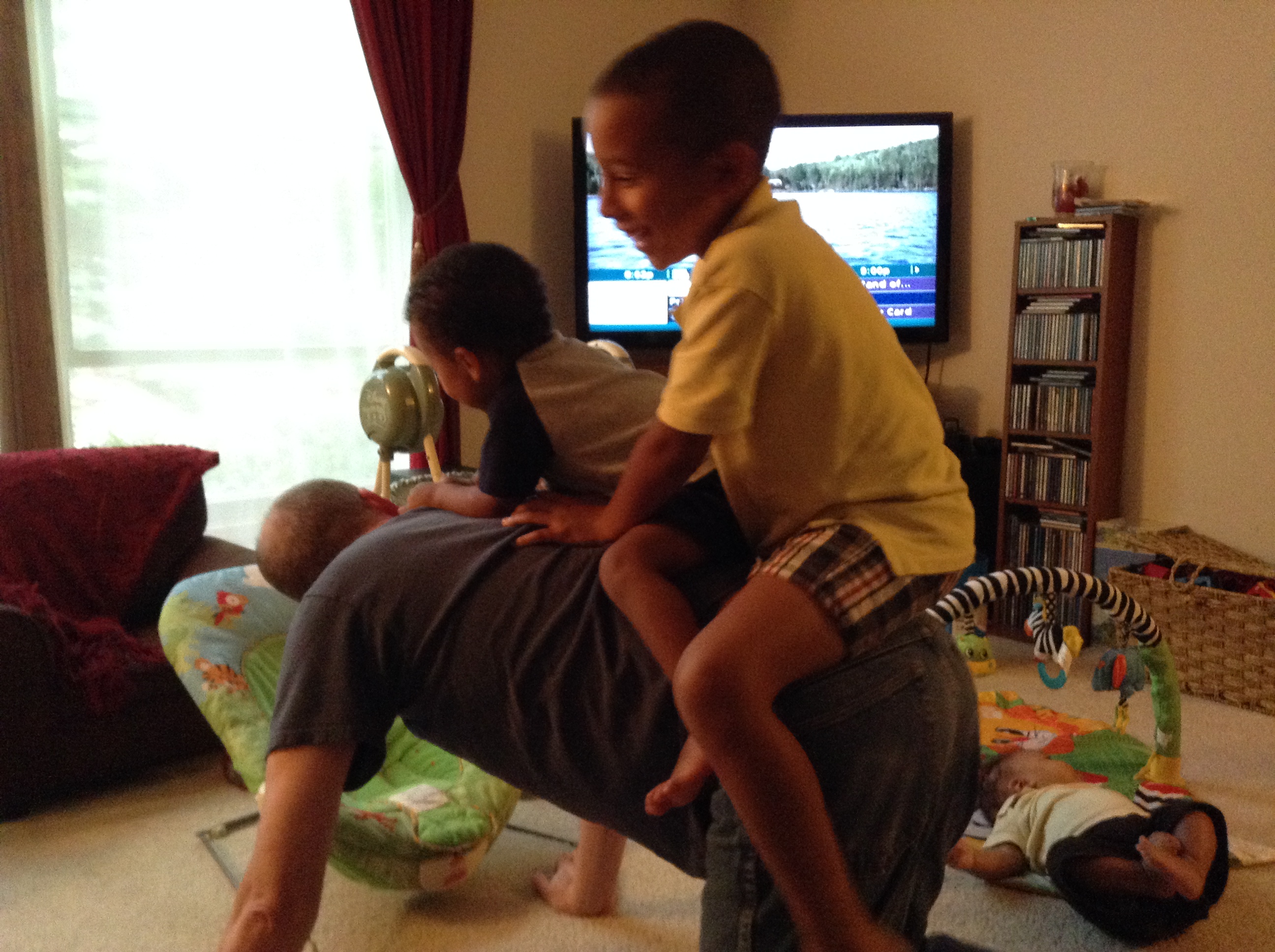
They’ll ride you like an army mule.

Five-year-olds are a different story. They can get to be heavy. We’re talking a serious bag of rock salt here. Their love for Daddy can be a painful one. Worse, five-year-olds are full of Daddy questions. These are not to be ignored, even if the answers are right in front of their faces.

I’m not talking about the occasional, meaningful question – the one that lets a boy put together the pieces of his world to help it make sense. I’m talking about the “narrate the world to me as it passes so I don’t have to pay attention to anything on my own” questions.

Our five-year-old likes to watch history documentaries, especially those dealing with the World Wars. I like watching them too, so this isn’t a problem – until his mouth starts running. For the life of me, I can’t get the boy to understand that if he would just shut his pie hole and listen to the program, most of his questions would be answered before he asked them.

Moreover, his endless questions make it difficult for me to hear the TV, meaning I have more trouble answering his questions. That is, when his question is something more complex than the ubiquitous, “Are those Germans?” That one I can usually handle without the narrator’s help.

I’ve missed out on a myriad of fascinating tidbits of history answering the “Are those Germans?” question. But the boy occasionally asks a thoughtful question. It’s just too bad he can’t write these down to ask after the program.

WWI German artillery

Yes. They’re Germans. Now can we remain quiet and listen to the program for 10 seconds?

In an awkward oversimplification, I have categorized Nazis as the “bad Germans” for him. This leads him to the very reasonable question: “What happened to all the good Germans.” I only wish I were smart enough to answer that. This boy has a strong sense of right and wrong, and great pride in his German heritage. It pains me that I can’t reconcile these things for him. Even his good questions give me fits.

The good news is that I only have to hem and haw over the deep questions I can’t answer for a few seconds before we fall into our old, comfortable give and take:

“Are those Germans?”

“No. They’re Italians.”

“Oh. How about those? Are they Germans?”

“Nope. Greeks.”

Meanwhile, the unheard narrator drones on with his superfluous facts, far less important than labeling everyone in every picture.

Secrets of the universe traded for pocket change and snacks

I’ve mentioned our one-year-old’s penchant for using the words Mommy and Daddy interchangeably. He’s getting better at differentiating the proper usage of each, but he still backslides once in a while and uses a universal Daddy to cover the nomenclature of both parents.

It feels as though this child is adopting the English language slower than his brother did, though he seems, in general, to be a quicker mimic and a bit more advanced with hand-eye coordination. He certainly has a stronger throwing arm, and is not afraid to use it, even at point-blank range.

His reluctance to use our words does not mean that he is the silent type. To the contrary, he is quite verbose in his own language, which he speaks most eloquently, and with passion. Last night, we were writing with crayons. He would make a mark on the paper and then tell me the story of what it meant. He was animated in the telling, using his voice, hands, and facial expressions to relay the nuances of his tales. When his eyes grew wide, I knew it was the serious part; when he showed me his scared face, I knew to be frightened.

He enjoyed telling me what he knew, all in his own language. All he needed from me was an occasional acknowledgement, in any language, that I was interested. It occurred to me that this might be his last chance to tell me these things – the secrets that only babies know about life and the universe. Soon, he will speak our language, making it necessary that he forget all the infant wisdom with which he was endowed. It is not good for adults to know too much about Creation.

Preaching to the chair

Extolling the true meaning of life . . . to a chair.

Now that he has unburdened his soul, I expect the slow transition to our language to quicken. He is already assimilating more of our words into his vocabulary, and in a most impressive way, methodically choosing the important words first.

Juice and No are already firmly within his lexicon. Recently, he added another a vital word. We encountered an arcade game one day. He became interested in the coin slot. I told him that was the place where you put the money, then set him on a chair so he could watch the demo. Soon, he climbed down, pulled me to the game, pointed at the coin slot, and said, “Money.” Apparently, the demo was not engaging enough, and if Daddy isn’t good for a couple of quarters, what is he good for?

Days later, he saw an image of spare change on the computer. His eyes widened. He pointed and exclaimed, “Money!” If this is not proof enough of his systematic adoption of words based upon their usefulness, it should be noted that he added the very important word Cheetos to his repertoire only moments after his first taste.

Looking for Cheetos

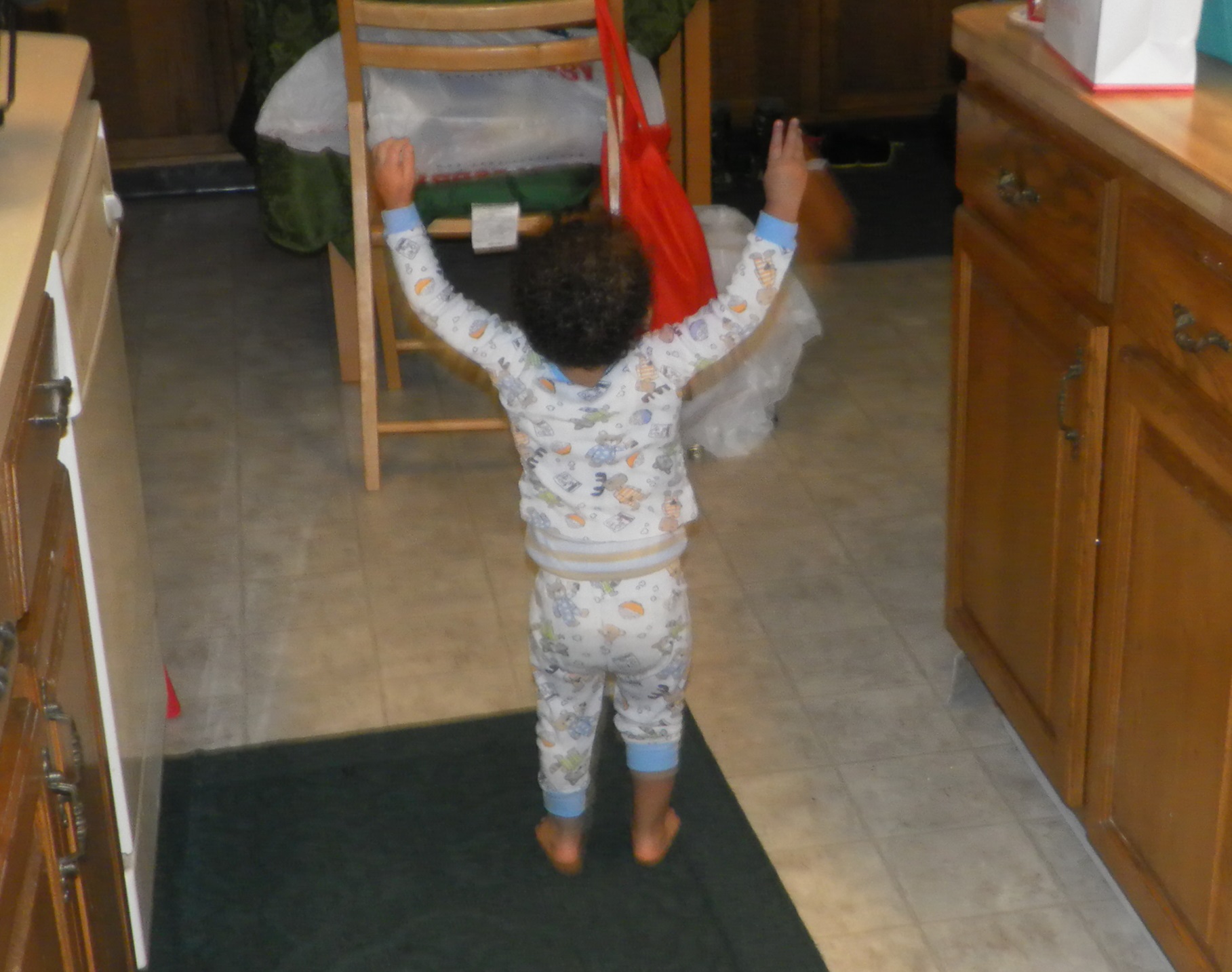
If there is juice, money, or Cheetos on top of that counter, he’s in business.

Now that he knows how to indicate Money and Cheetos, he is at work on perfecting one of the cornerstone words of toddlerhood: Mine!