You are my sunshine, but not necessarily my only sunshine

“You are my sunshine,

my only sunshine (along with your brother, who is also my sunshine).

You (in concert with your brother) make me happy

when skies are gray . . .”

Since we’ve had our second child, we have been careful about the words to the little songs of endearment we sing to the baby. Not wanting to inspire jealousy by leaving the older sibling out, we do all we can to fit our high regard for everybody into the song.

This requires us to think on our feet, because few songs of endearment are intended to address multiple individuals. Imagine Roberta Flack singing, The First Time Ever I Saw Your Several Faces or Sinatra crooning that classic, It Had to be You. . . and That Other Guy Over There. It is probably for the best that most love songs focus upon a single individual, but this means that parents who need to spread the love around may have to cut and paste.

There is nothing so sweet and melodic as parents singing sweet nothings to their babies, except when the melody is held suspended by the insertion of clarifying, parenthetical phrases. These phrases must be added whenever Big Brother is within earshot. At his age, he gets fewer songs of his own. Therefore, he must be included as an addendum to his baby brother’s lullabies. This leads to verses like the one at the top.

We are lucky that our preschooler exhibits hardly any jealousy toward his baby brother. The big boy likes having a little brother. Our only worry about his attitude toward the baby is that he sometimes wants to hug his little brother too vigorously. He doesn’t quite understand how fragile a baby is. When he becomes most zealous to show affection for the baby, we stand guard, ready to prevent the reenactment of a scene from Of Mice and Men.

We are careful not to fritter away our good fortune. My wife often reminds me to avoid telling Big Brother that I can’t pay him immediate attention because I am tending to Little Brother. This could cause resentment. Instead, I have to make up excuses that sound something like, “I can’t play trains with you right now because I have to get all of the milk out of this bottle through this tiny hole. Luckily, your little brother is really good at this sort of thing. With his help, I’ll be done and ready to play with you by nightfall.”

My kids may grow up singing the wrong lyrics to many decades’ worth of popular (and unpopular) songs, and believing that babies take bottles to help rid their parents of troublesome milk surpluses, but I won’t laugh at them. As long as they like and respect each other, I’ll tolerate their crazy notions. To my boys, I will make every allowance for such misconceptions, because, as Debby Boone was fond of singing, “Y’all light up my life.”
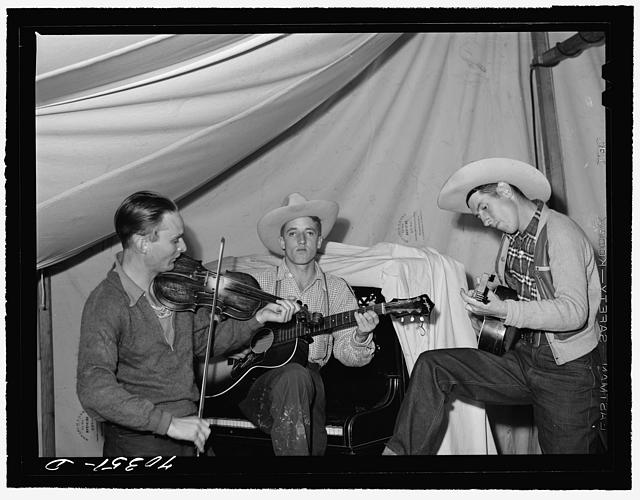
Cowboy band

“But the Yellow Rose of Texas (and the Blue Marigold of West Virginia, and also the Purple Violet of Eastern Maryland) is the only gal for me.” (Photo: Russell Lee/U.S. Farm Security Administration)

 

Our friend, Mr. Lincoln

About a year ago, someone gave us a book about Abraham Lincoln. The book is for a much older child, but I read some of it to my son anyway. Since then, every time we see Lincoln’s image somewhere, the boy shouts, “Look! It’s Mr. Lincoln!”

My son never refers to the man as Abe Lincoln or President Lincoln. It’s always Mr. Lincoln, which has that perfect blend of the familiar and the respectful that I find so endearing. I now also refer to the 16th president as Mr. Lincoln.

Lincoln life mask in Smithsonian

The Lincoln life mask at the Smithsonian. Even though we both thought it was a little creepy, the boy stopped racing through the museum long enough for us to take a good look.

My son doesn’t really know who Mr. Lincoln was. He doesn’t fully understand the role of the presidents yet. As far as he knows, Mommy is the only Chief Executive in the world and Daddy is her office intern. Mr. Lincoln is famous mostly because his image keeps popping up in various places from time to time, much like Mickey Mouse.

In spite of his ignorance of Mr. Lincoln’s place in the world, my son has developed an affinity for the man. This became evident on our recent trip to Washington, D.C. when we spent an afternoon visiting Ford’s Theater.

We were early for our tour at Ford’s, so we went to the nearby wax museum. Every president was represented in wax. “Creepy,” my son pronounced them, and not just because they were politicians. We began taking pictures of ourselves with the figures, but the boy would have none of it. He wouldn’t be in the same frame with any of them. Washington, Madison, Jackson, Pierce, they were all just scary zombies. I don’t blame him about Pierce; I wouldn’t have my picture taken with Franklin Pierce either.

The only wax figure the boy would consent to take a picture with was the statue of Mr. Lincoln. He wasn’t especially comfortable with the idea, but he agreed to it. He knew Mr. Lincoln was a good guy, the kind of guy that would never hurt a little kid.

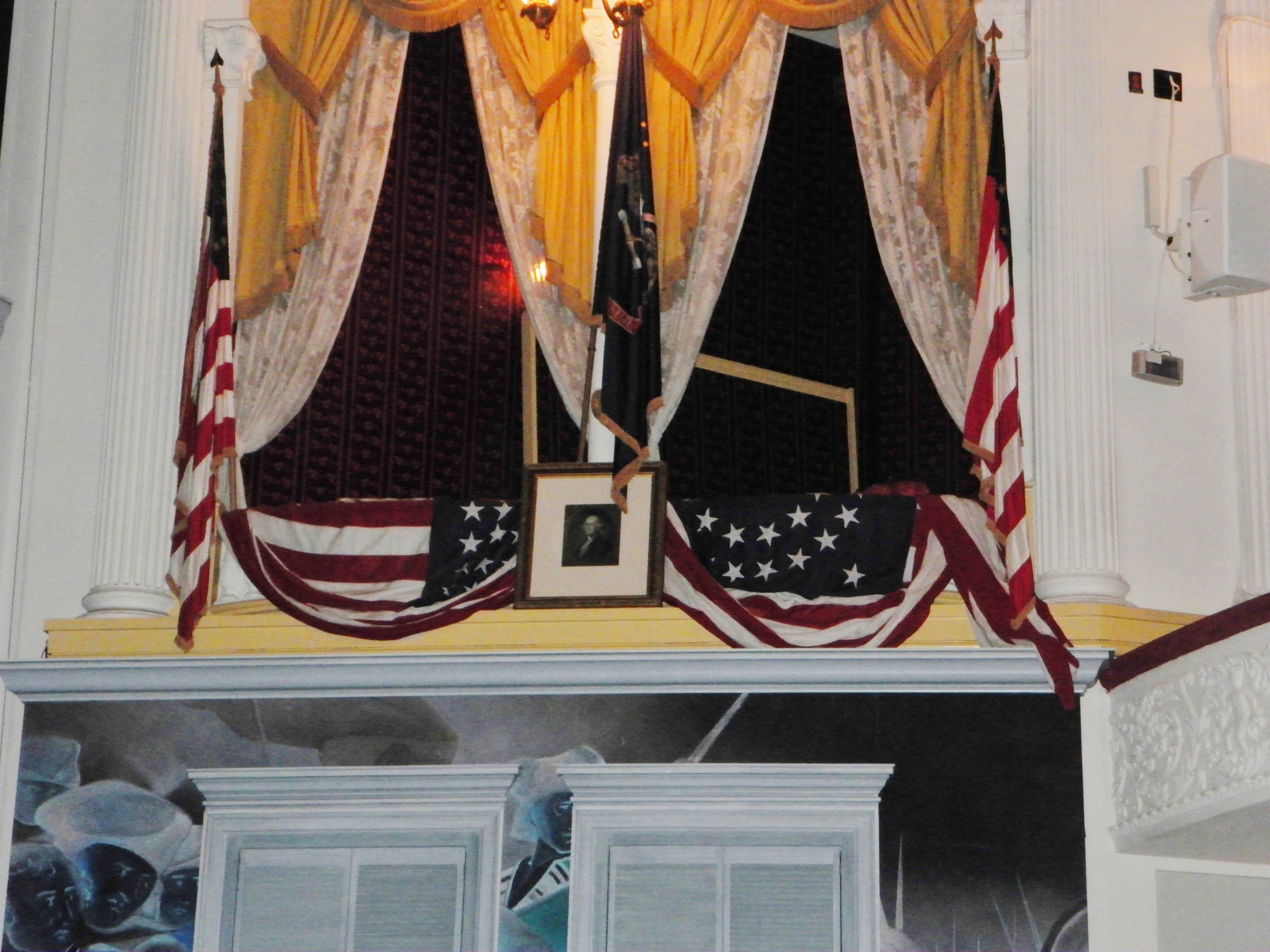
Presidential Box at Ford's Theater

The Presidential Box at Ford’s Theater. Because of all the references to this room, my son calls Ford’s the “Box Museum.” Although it’s not the kind of place you might expect to appeal to children, my son has already asked if we could go to the Box Museum again.

At Ford’s Theater, I explained to the boy that this was the place where Mr. Lincoln was shot. The shooting was, I believe, news to him. It took a while for it to sink in. We saw a sculpture of John Wilkes Booth in a room with photographs of all the conspirators. My son pointed to the picture of George Atzerodt and asked, “Is that the man who shot Mr. Lincoln?”

I guided him to the correct photograph. “This is the man who shot Mr. Lincoln. His name was John Wilkes Booth.” The boy studied the picture in silence.

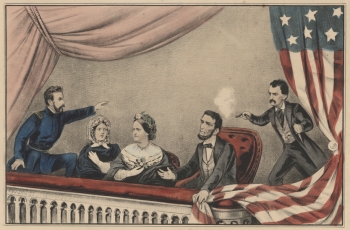
The derringer Booth used was in a sealed case. Behind it was an illustration of the moment of assassination.  As my boy looked at the picture he became agitated. “I wish I had that gun,” he said, “I’d shoot that guy.” He pointed at Booth in the illustration.

My first impulse was to tell him he was a few days too late, but I held my tongue. This was serious. Somebody had shot Mr. Lincoln. Mr. Lincoln, that nebulous man who somehow only existed in pictures and in wax, was familiar. He was a friend. The boy wanted to save him, even though, deep down, he realized that he couldn’t. He knew he was too late and it made him sad.

Currier & Ives lithograph of Lincoln assassination

A sad moment in history, and in the afternoon of one little boy.

Three-year-old children can’t always explain how their emotions are affected. We went upstairs to the theater to hear a 30-minute talk about the assassination. My son sat through the entire presentation without making a peep or kicking the back of the seat in front of him. He didn’t stand up and he didn’t ask me how long we had sit here. His behavior was as unusual as it was exemplary.

My son sat quietly; I dare say he sat respectfully. I don’t think he did this for me, nor for his mother. I don’t even think he did this for the speaker. I think he did this for his friend, Mr. Lincoln.

Who’s the weirdo with the stroller?

I am a periodic sufferer of a condition. Since I can find no official name for this complaint, I am going to name it myself. My problem is called Empty Stroller Syndrome.

Empty Stroller Syndrome (ESS) occurs almost exclusively in fathers of young children. It manifests itself in well-populated areas, including public transportation. A bout of ESS is generally brought on when the mother takes the child from the stroller to some location disassociated from the father, who is left with an empty stroller and no child in sight.

It is important to note that if you are out in public with an empty baby stroller, but have no children in your life, you are not suffering from ESS. You are suffering from being one weird dude.

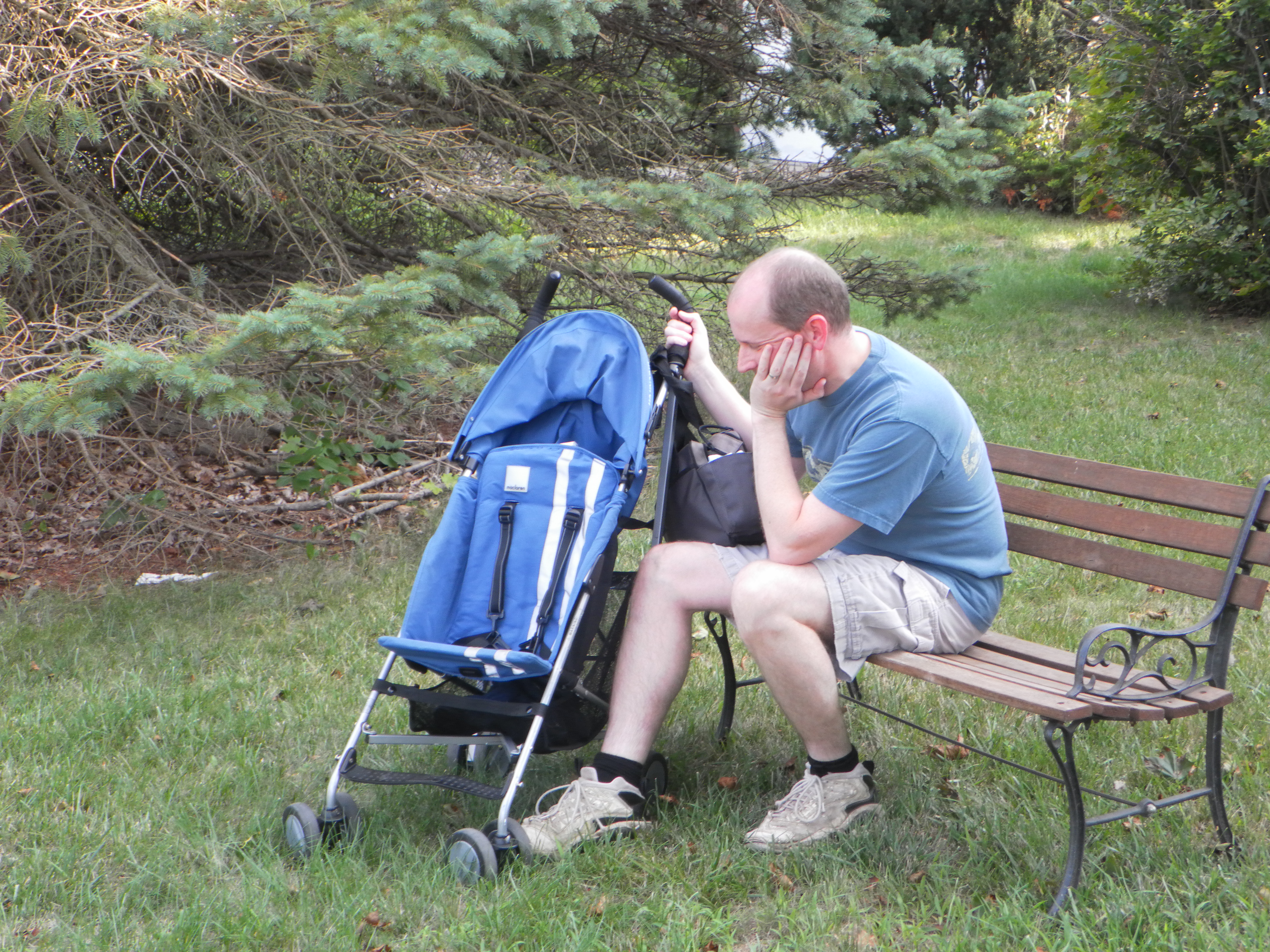
Empty Stroller Syndrome: the silent stigmatizer.

ESS is an often misunderstood condition due to the fact that, to the unfamiliar observer, the sufferer closely resembles the weird dude aforementioned. Lacking a nearby baby, there is no recognized protocol for differentiating the ESS sufferer from the weird dude.

It dawned upon me that I suffered from ESS while I was riding the metro train in Washington, D.C. With two small children, we have many accessories to carry with us on outings. These many necessities were secreted in and about our stroller, with heavy baggage hanging from each handle.

Every time we boarded the train, my wife took the baby out of the stroller and held him on her lap. When we could sit together, this presented quite a natural scene. But on the D.C. subway, parties often need to disperse, transforming me into a solitary man with his heavily weighted stroller.

Judging from the looks I received from fellow passengers, some sympathetic men recognized, or at least hoped they recognized, an all too familiar case of ESS. Other passengers merely wondered silently about that weird dude who used a baby stroller as a pushcart for his sundry, joyless bundles.

Without the baby in place, the stroller was unbalanced. At every change in momentum, it was liable to tip over backward. Not wanting to risk injuring others, I guarded it closely. This made me look less the innocent victim of a crowded transport system, and more the weird dude whose precious, precious collections of plastic spoons and acorns must be jealously protected from a covetous world.

The shame of ESS. In the past it was difficult to build awareness because fathers were so shamed by their condition that they would not allow themselves to be photographed with their empty strollers.

In most cases, it doesn’t matter to me what strangers think. But I’ve put a lot of work into this fathering business, and I’d rather not be thought of as some kind of unhinged stroller pervert. I have the children to prove that there is a perfectly reasonable pathology behind my distant, glassy stare. They are elsewhere on the train, with their mother, the one competent to be the guardian of cargo more important than empty strollers.

I tried to ease the suspicions of my close companions by turning and yelling things to my family that hinted at more than a passing acquaintance between them and myself. I gave up this tactic when it became clear that the crowd did not relish a loud conversation about the probability of there being a poopy diaper somewhere among them. For those who could not see the family to whom I was speaking, this talk only added to my mystique.

Alas, there was nothing to do but quietly endure my flare-up of Empty Stroller Syndrome. In the distance, I could hear people clucking over the baby. Nobody ever gushes about how adorable my empty stroller is. In silence, they avoid making eye contact with me.

History, trains, dinosaurs, trains, airplanes, and mostly trains

My three-year-old son likes our local historical museum quite a lot, but it is nothing that can prepare a boy for a visit to the various museums of the Smithsonian in Washington, D.C. Nor is it anything that can prepare the dad of a three-year-old boy for the adventure of taking his son to those behemoths.

Archie Bunker’s chair and assorted other cultural artifacts. To a three-year-old, this is one big blah, blah, blah exhibit.

The Smithsonian American History Museum is famous for its many exhibits that hold no appeal to the three-year-old boy. Many of the displays include a panel of text, describing the item and its importance to our culture. I read the first line of several of these descriptions before I was dragged around the corner to see if there were any toys or displays with buttons to push hiding there. I wish the museum would find writers who could explain an exhibit in five words or less. That would be a great boon to every tourist parent.

The saving grace of the American History Museum was the area with the locomotive engines. To a little boy, the world is composed of trains, trucks, and diggers, but mostly trains. While the rest of the museum was a blur of verbose descriptions, fattened with wasteful prepositions, conjunctions, and articles to vex the skidding parent, the train area was a wonderland that needed no words. There were huge hulks with wheels and metal on tracks; who needs a placard to tell them that is the most glorious combination on Earth? Nobody endeavored to drag Daddy away from the trains.

This is the meaning of life.

The Natural History Museum holds dinosaur skeletons. My son enjoyed the dinosaurs, if you only count the first two we saw. After that, they lost their charm. He quickly formed the conclusion that their most prominent characteristics were that they were big and they were dead. Judging by these criteria, the skeletons all turned out to be pretty much the same.

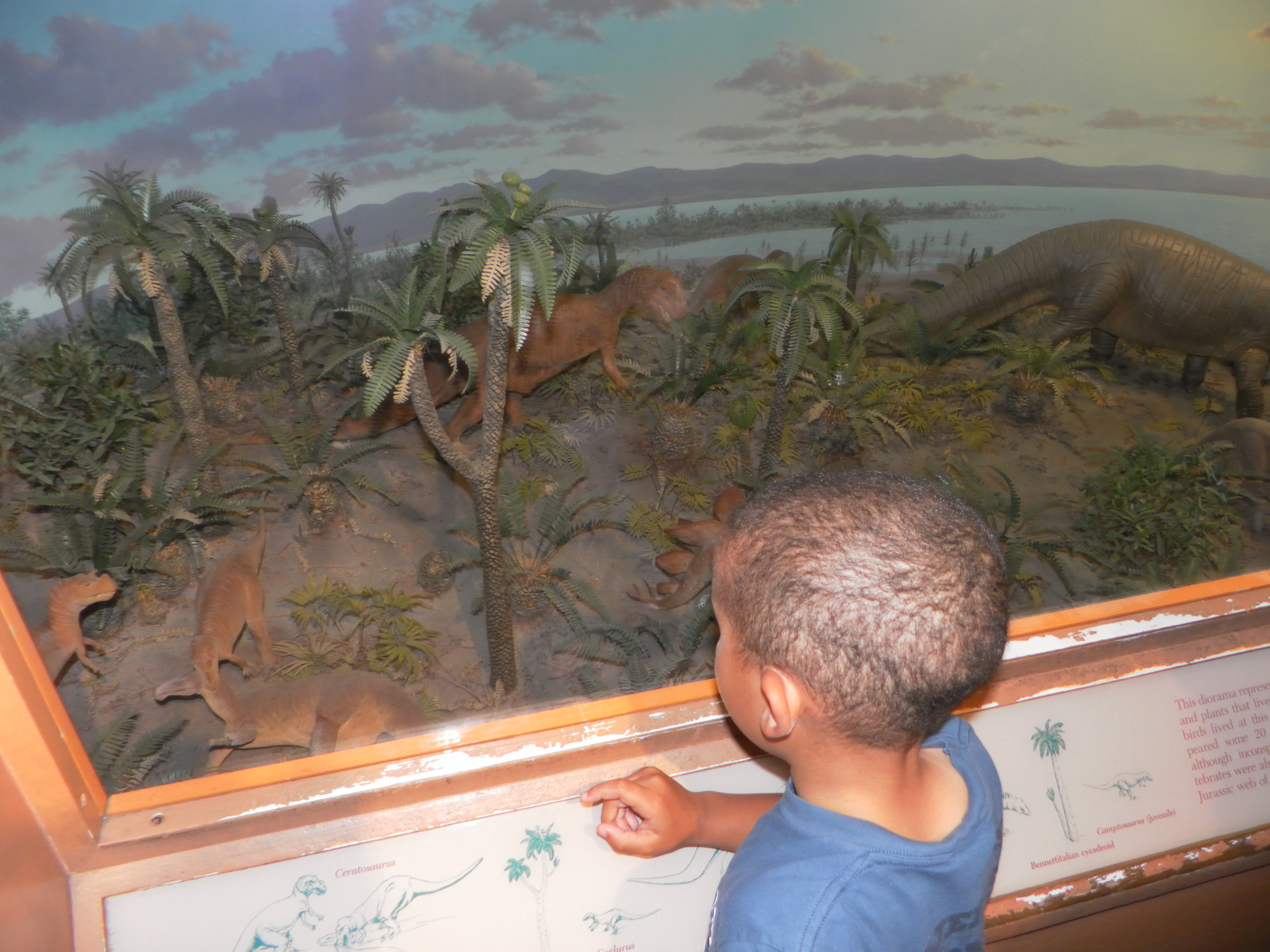
Dinosaur-on-dinosaur violence was an issue that was left unaddressed for too long by the dinosaurs. This display depicts a sad chapter in the demise of dinosaur culture.

It was the human remains that interested him the most. He wanted to know what happened to that guy, whereas the demise of each of the dinosaurs was less intriguing. Based on the many dioramas of various dinosaurs attacking one another, I think he just assumed that they ate each other up until the final tyrannosaurus died of loneliness.

He was also fascinated, and creeped out, by a time-lapse image of a woman posing as a colonial era matron. I might have inadvertently led him to believe that she was a witch, but that wasn’t completely my fault. They buried this colonial lady in a lead coffin; so what did they expect ignorant fathers of future generations would blurt out when they didn’t have time to read the entire description? “I bet she was a witch,” is exactly what our forefathers should have expected me to say. Of course, I meant that she must have been falsely accused of being a witch, but I doubt my boy inferred the distinction. He held my hand as he stared at her changing image, cautioning me not to get too close.

Playing with a nondescript, toy airplane while countless real aircraft sit unappreciated in their quiet, historic nooks.

In the Air and Space Museum, my son went straight for the places where he could push a button or move a lever. He might not have known what the lever did, or why he should take such unbounded pleasure in pulling it, but who cared? It was enough to know that it was a lever, and levers are meant to be pulled with glee by the hands of little bodies. I watched a lot of really fantastic lever-pulling and button-pushing in that museum. Somebody told me there were vintage aircraft in the building as well, but I must have missed that part.

Each day, we rode the metro back to our hotel, and that was the very best part of all. The many museums we visited were a wonderful excuse to ride the train back and forth. But even if they weren’t there, we would have had to ride the train into town every day to watch the grass grow on the mall.