If you are the father of a new baby boy and you are feeling a little left out because junior only seems to have eyes for Mommy and her rolling hills of milk and honey, take heart. Your day will come. Your day will come with a suffocating vengeance. Junior will cover you with love, elbows, knees, and incessant questions before you know what hit you.
Boys start climbing up and down Daddy as toddlers. This isn’t so bad. Toddlers aren’t very heavy. Yes, they have sharp corners, but there is usually not enough force behind the pointy parts to cause Daddy any serious internal damage. More importantly, toddlers don’t ask a steady stream of questions just to hear themselves talk. They may talk a steady stream of gibberish at you, but all you have to do is smile and nod to keep them happy.
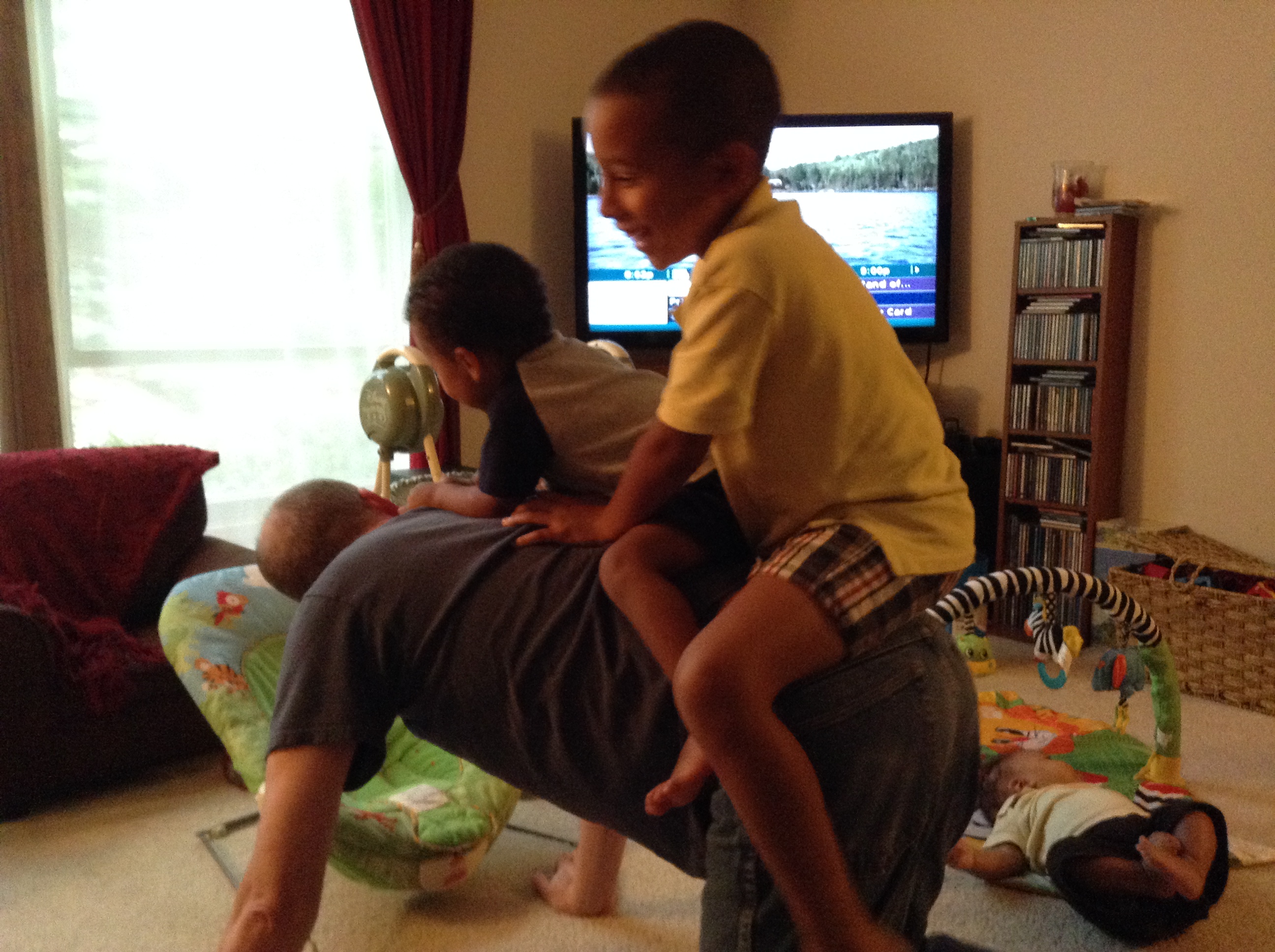
They’ll ride you like an army mule.
Five-year-olds are a different story. They can get to be heavy. We’re talking a serious bag of rock salt here. Their love for Daddy can be a painful one. Worse, five-year-olds are full of Daddy questions. These are not to be ignored, even if the answers are right in front of their faces.
I’m not talking about the occasional, meaningful question – the one that lets a boy put together the pieces of his world to help it make sense. I’m talking about the “narrate the world to me as it passes so I don’t have to pay attention to anything on my own” questions.
Our five-year-old likes to watch history documentaries, especially those dealing with the World Wars. I like watching them too, so this isn’t a problem – until his mouth starts running. For the life of me, I can’t get the boy to understand that if he would just shut his pie hole and listen to the program, most of his questions would be answered before he asked them.
Moreover, his endless questions make it difficult for me to hear the TV, meaning I have more trouble answering his questions. That is, when his question is something more complex than the ubiquitous, “Are those Germans?” That one I can usually handle without the narrator’s help.
I’ve missed out on a myriad of fascinating tidbits of history answering the “Are those Germans?” question. But the boy occasionally asks a thoughtful question. It’s just too bad he can’t write these down to ask after the program.

Yes. They’re Germans. Now can we remain quiet and listen to the program for 10 seconds?
In an awkward oversimplification, I have categorized Nazis as the “bad Germans” for him. This leads him to the very reasonable question: “What happened to all the good Germans.” I only wish I were smart enough to answer that. This boy has a strong sense of right and wrong, and great pride in his German heritage. It pains me that I can’t reconcile these things for him. Even his good questions give me fits.
The good news is that I only have to hem and haw over the deep questions I can’t answer for a few seconds before we fall into our old, comfortable give and take:
“Are those Germans?”
“No. They’re Italians.”
“Oh. How about those? Are they Germans?”
“Nope. Greeks.”
Meanwhile, the unheard narrator drones on with his superfluous facts, far less important than labeling everyone in every picture.






 Snoozing on the Sofa