Killing me softly

If you have teen or pre-teen children and you don’t realize they are plotting to kill you in a myriad subtle ways, you’d better get wise. Society won’t forgive you for leaving those poor, helpless, homicidal maniacs orphaned when you might have done something to prevent it.

One of the ways my children are trying to kill me is through diabolically altering the volumes of their voices so that I hear everything I don’t want to hear and nothing I do want to hear from their mouths.

The things I don’t want to hear are many and pervasive: the screams that rattle my skull from boys chasing each other around the house; the high-decibel appeals for parental intervention as they take turns hitting each other in fully justified counterstrikes; the shrieks of tormenting laughter from two kids who have teamed up into allied mockery against the third, and the wailing, whining cries for justice from the outnumbered victim.

And all of this is before they have friends over.

You would think these children would never struggle to make themselves heard.

This is the paradox; they often speak too softly, though not as often as they scream too loudly.

I possess a supernatural power to make my kids inaudibly quiet, and all I have to do is ask them a question.

“What do you want from the drive-through?”

 “*Whisper, whisper, whisper*, “and a vanilla shake.” (They make sure I hear about the shake; a $6 add-on will hasten Dad’s demise nicely.)

“Is your homework done?”

“*Mumble, mumble, mumble*”

“Did you brush your teeth yet?”

  *Shrug*

“Is your homework done?”

Even in the prime of my youth, I struggled to hear conversations when there was background noise. This is how I unknowingly agreed to random things in crowded college bars by smiling and nodding in response to unintelligible conversation. My children know this about me.

Over the many years since the prime of my youth, my eardrums have aged substantially. My children know this too.

This is how the plan to get me. They drive up my blood pressure with their screaming and yelling. Then, they amplify my hypertension to a crescendo by giving answers I have no hope of hearing when I ask a question.

They have made a sharp skill of looking away, or sneaking behind me, when they offer their mild answers to my questions.

If you are not careful, children will practice speaking to you from a different room, which is a skill I’m sure they learn from wives.

I plan to avenge my own death by not dying at all, not right away anyhow. Instead, I will continue to lose my mind. They will have important questions to ask me soon:

“Can I borrow the car?”

“Can you co-sign for me?”

“Why do you keep running away from the nursing home?”

“Have you made out a will?”

I will answer all these questions with a clear voice and a distant, glassy stare: “I want a vanilla shake!”
My promotion to 5th grade in 1977 must have been a clerical error

“Dad, how do I do this?”

I get this question every time there is a big 4th grade or 6th grade project due.

I thought I had completed both of these grades back in the 1970s. I never suspected I would be made to repeat them, and certainly not after this many years.

Big Brother, now a 10th grader, doesn’t ask my help on schoolwork anymore. Once he got to high school and settled into being a teenager, the notion struck him that he was smarter than me. This notion does not only pertain to scholarly pursuits, but also, and more importantly, to the scope of freedoms and privileges a young man should be allowed while making the most of his parents’ hospitality.

If Buster and Big Man believe they are smarter than I am, they keep dark about it. They realize the unseemliness of asking the big dumb guy to do your homework for you. For now, they let me believe I’m smarter than a 4th or 6th grader. I suppose they’ll let me know how things really stand after they don’t need me anymore.

I don’t mind helping them here and there with a difficult math problem or vocabulary word. It’s the big projects that are trouble. They are both daunted, nearly to the point of paralysis, by big school projects. They hide from the project for five and half weeks, hoping it will fade out of existence in the last three days.

At some point within the last three days, they realize it is still there. This is when the problem gets referred to Dad.

Most of their projects require the reading of a book. They may, or may not, have read the first 20 pages in the previous 39 days.

Dad’s first task is to hound them to read the book, or at least enough of it to know the main character’s name and to be able to make a wild guess as to what the major conflict could be.

That’s the easy part.

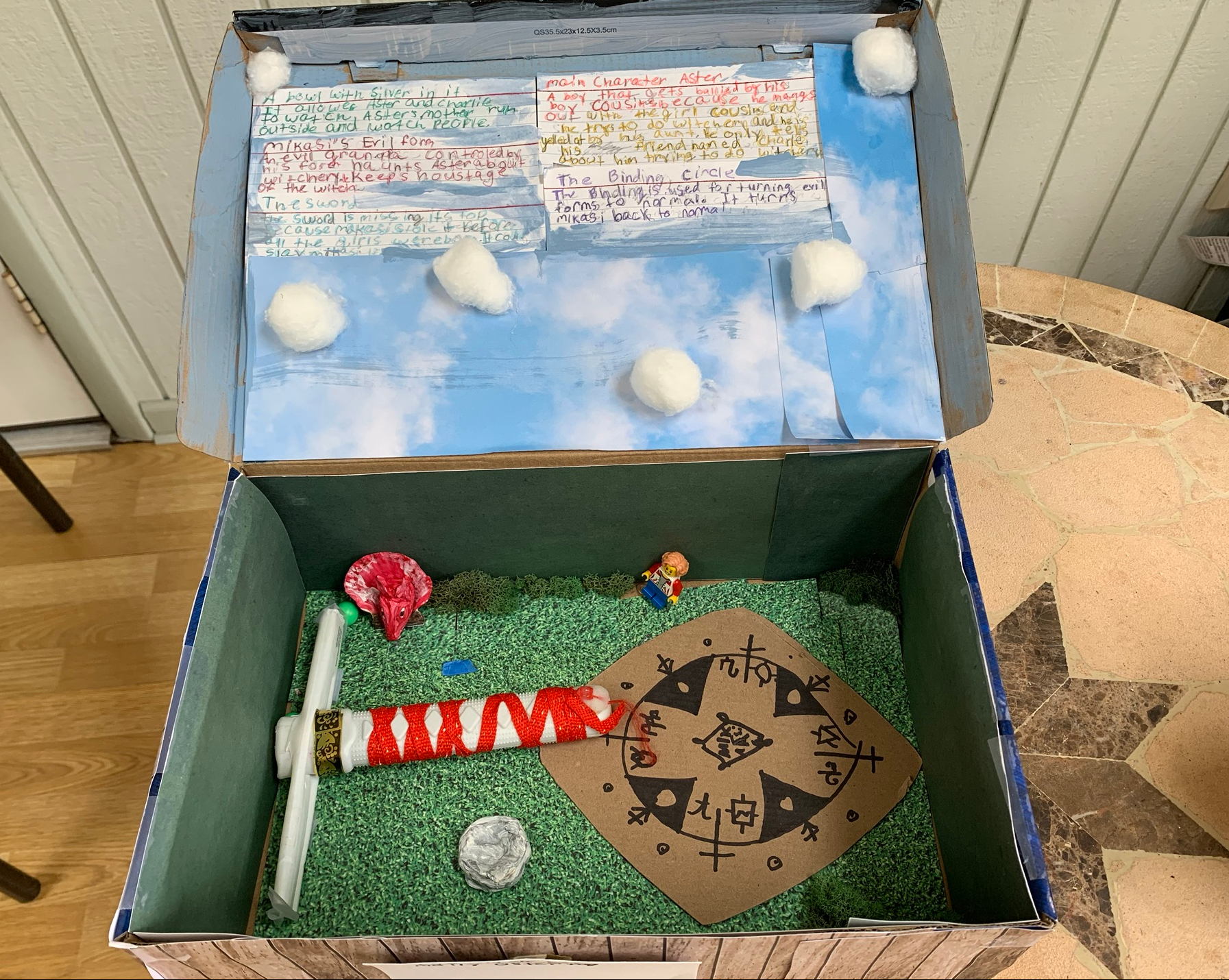
Today’s teachers aren’t satisfied with students reading a book and showing their comprehension of its themes. They want pupils to be able to do arts and crafts about it.

Buster, Big Man, and I are all creative in our own ways, but rarely does that creativity spill into the realm of arts and crafts. I read a lot of books, yet I can’t recall a time when I’d finished a novel and been inspired to fashion a paper doll in homage to the protagonist.

Perhaps I am out of touch with modern times, because it seems that every book must inspire some diorama or figurine. After stumbling through the book, this is where my boys fall flat. They fall flat on top of me, the man who waits, with his bag of popsicle sticks and Elmer’s glue, to memorialize in sculpture every book his reluctant children are forced to read.

I would be a more active blogger, but with Buster so close to junior high, I must devote my time to perfecting Play-Doh replicas of Romeo and Juliet.

Cranky old men aren’t what they used to be

Big Man is in 4th grade, which is weird because, in my memory, he started Kindergarten yesterday.

After school, I strain to contain my impatience with the car line so I can drive him the five minutes to home.

On rare afternoons, we find ourselves driving behind a bus from his school that passes within 30 yards of our house. Whenever this happens, I threaten to put Big Man on that bus the next day.

This is an idle threat, as the amount of paperwork it takes to get a kid onto a school bus these days is another thing beyond my patience.

I don’t know if Big Man takes the threat seriously, but he feels he must provide resistance to it, just in case I do harbor such a crazy idea as putting him on a school bus.

The idea is revolting to him. “No, I will not ride the bus!” he insists.

“You’ll love it!” I tell him. “Bus friends are the best friends!”

“No, they’re not,” he responds. “Bus friends are the worst friends!”

The last time we had this exchange, I asked him what was the big deal? It’s only a five-minute ride. “When is was in school, I had to ride a bus for an hour to school and an hour home again,” I told him. “And I had to do it from Kindergarten until I graduated high school.”

  In my day, we were grateful to have a school bus to ride.

He didn’t care about childhood troubles from the olden days, and he likely thought I was exaggerating anyway. In truth, I was exaggerating; the bus ride was probably only 55 minutes each way.

As I considered this, I realized I had given him the classic, old-man, life-was-much-harder-in-my-day gripe. Making myself a cliché was bad enough, but this was as wimpy an example of the old man gripe as has ever been griped.

I didn’t walk 10 miles, through three feet of snow, uphill both ways. I walked 20 feet from the bus door to the school entrance – on level pavement. Yes, the bus ride was a good 10 miles and more, and there was sometimes snow, and no doubt a few hills, but I was riding the bus for cripes sake!

One time the bus got stuck in a snowbank, but no one died. No one even got chilly. We were inside a heated bus. It was exciting, in a completely non-life-threatening way, to hear the bus driver softly swear as he spun the tires backward and forward until the equally comfortable replacement bus showed up.

And that was it. That was the pinnacle of my hard-luck childhood. I had to sit still for nearly two, non-consecutive hours per day. The horror!

I fear the future of a nation whose old men’s exaggerated stories of childhood hardship are so soft and squishy.

For this reason, and to avoid the administrative headaches involved, I don’t think I’ll try to put Big Man on the bus.

When in Greece, climb something

I’m not much of a traveler. Taking our family to Greece for 2.5 weeks was a big step for us, though my wife was the driving force behind the adventure.

I learned some things in Greece, most of them not very useful in my everyday life at home, but a few of them mildly interesting. Following are some observations made in Greece (your experience may differ.)

Greece is hot. Greece is exceedingly hot in summer. They told me this was an unusually hot summer, but seeing all the habits Greeks have developed over the centuries to avoid the summer heat, I’m thinking Greek summers are always going to be hotter than I can stand. Also, air conditioning is marginally effective when all the doors and windows are thrown wide open.

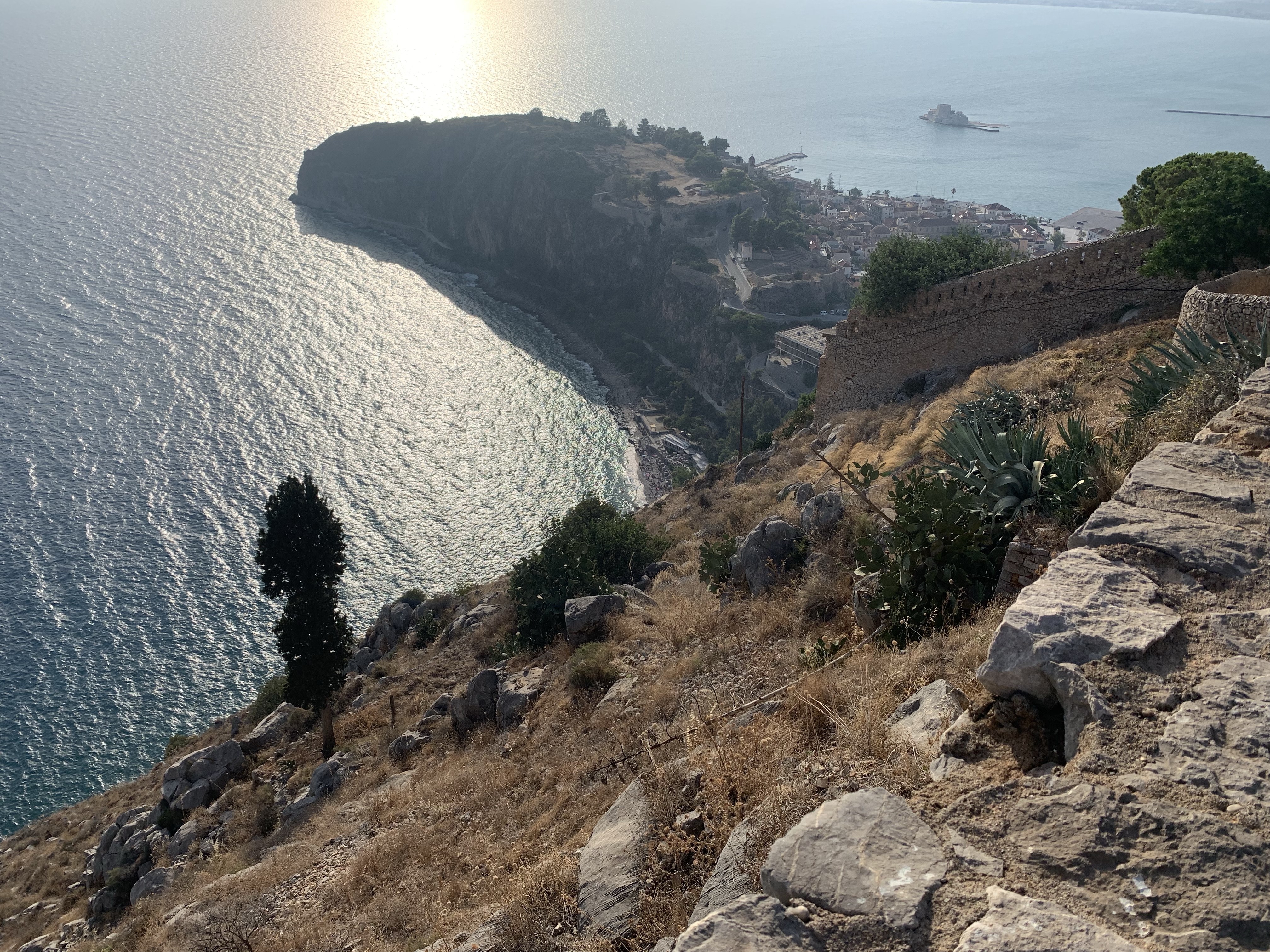
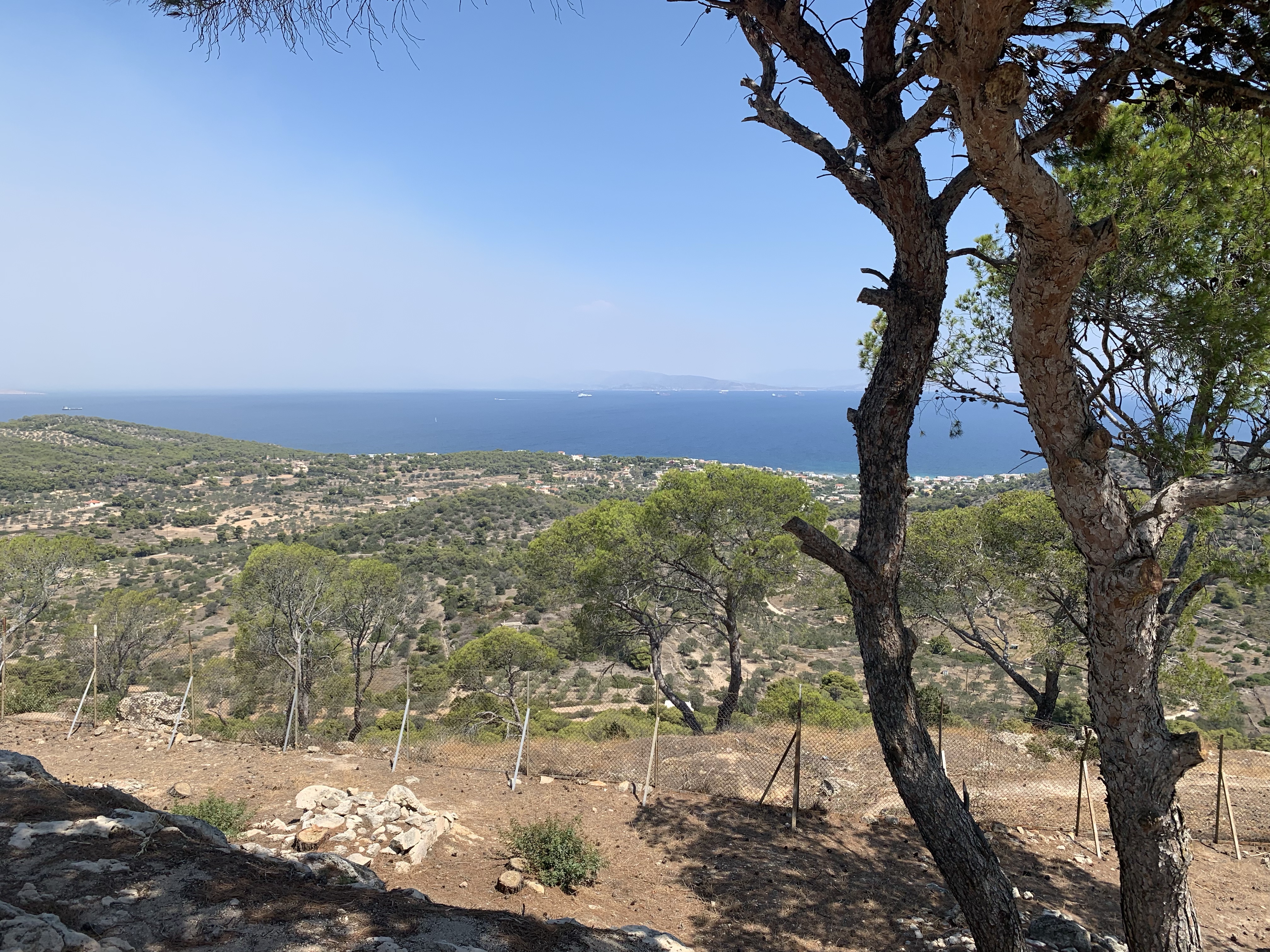
There are lots of hills in Greece. You can’t fail to notice this when you are walking in 100+ degrees Fahrenheit. Just about everything you want to see is on top of a big hill.

There are lots of neat things to see in Greece, amazing, ingenious, beautiful things. If you survive the walk up the hill, you can see them.

Ounce for ounce, bottled water is the best beverage investment you can make in Greece. It is inexpensive, which is good, because you will need gallons of it. Beer can be purchased anywhere, from a vending machine in the laundry mat to a kiosk on the beach. I found this form of liberty refreshing. What I found less refreshing was the beer. There are many varieties, from Greece and elsewhere in Europe. Almost universally, I found them to be the continental cousins of Bud Light. If you love Bud Light, you’ll find many beers to like in Greece. Otherwise, bottled water.

The kids could not find any lemonade that wasn’t carbonated (as the locals said, “with gas.”)

Athens is noisy. Traffic is a never-ending game of chicken: the one traffic cop I saw was smoking a cigarette; it would have seemed more humane if they had also offered him a blindfold. There are lots of stray cats. The pigeons don’t give the cats a second thought. Greek bus drivers have nerves of steel.

Island villages are more peaceful, but drivers will still park in the middle of the street to run to the ATM.

Beach can mean a place with sand, or a concrete deck with ladders down into the water.

Greek landscape is beautiful. Greek people are friendly.

I can’t tell if Greeks are whispering sweet nothings or screaming bloody murder at each other. The hand gestures and voice volumes look and sound exactly the same to me. Maybe that’s how they keep Americans from knowing their business.

Travel tip: You can avoid the hill climb by visiting the LEGO version in the museum.