What’s another syndrome among family?

New Baby is settling in at home. We’ve begun calling him New Baby because after two years we still are in the habit of referring to Buster as the baby. Until we come to terms with Buster’s boyhood, he is Old Baby and his little brother is New Baby.

It still seems surreal that Buster could have a little brother.

My wife worries that Buster will develop Middle Child Syndrome. For that reason, she always wanted to have four children. Now that she has to deal with the reality of three boys, she has switched gears. She’s leaning less toward birthing another child and more toward viewing a little psychotherapy for her middle child as a solid investment.

I’m not worried about the man in the middle. Buster already has Buster Syndrome. Maybe that other syndrome is just the antidote he needs. He could use a little soul-searching to slow him down and temper some of those ragged edges.

Buster's glasses

The ravages of Buster Syndrome.

So far, Buster has adapted admirably to his new position. He shows only tenderness to New Baby, channeling all of his aggressive tendencies toward his big brother. Needless to say, his big brother is fine with this. It leads to no fighting, whining, or tattle telling at all.

Whether Buster’s treatment of New Baby stems from pure kindness or the fact that he sees the writing on the wall is uncertain. New Baby is a beefcake. Buster is a little squirt. Unless he conjures up a growth spurt, Buster will be a big brother in name only within a few years. He is wise to plan for that day.

Until then, New Baby has sharp claws for self-defense. I don’t know what part of evolution demands that babies be born with long fingernails. He can’t hold his head up or make his limbs bend to his will, yet New Baby has razor talons. This somehow makes sense to Nature. In theory, his claws could be used to protect himself, if a predator caught his spastic hand and scraped his fingernails against itself. Otherwise, they only protect him from having a smooth face. Nature likes self-inflicted scratches I guess.

Not a bumbo fan

“Feel the wrath of my pinky claw!”

New Baby doesn’t have to wield his bird of prey claws against Buster, even if he could control them. Buster is committed to being a good big brother. As to being the middle child, I think Buster will have no problem carving out a comfortable space for himself. He will defend his things from the grabby hands of his little brother with vigor equal to that he used snatching them from the hands of this big brother. His zeal will be an example to all.

I don’t worry about any of the boys adjusting to their new roles. The one I worry about is the cat. He flirted with neurosis dodging only two boys. Now he faces a trio of hazards even as his reflexes decline. If anyone qualifies to blame their troubles on a situational syndrome it’s him.
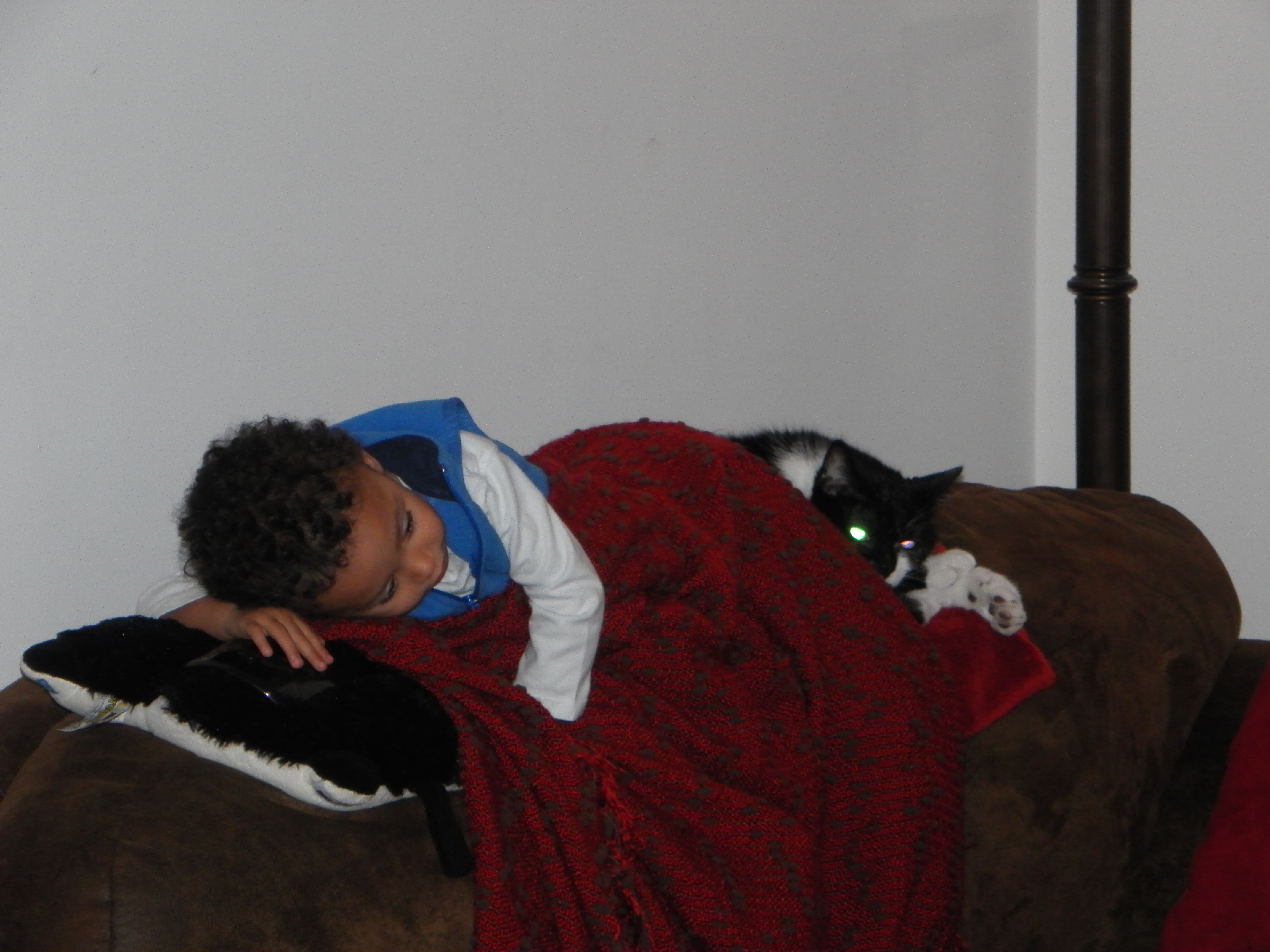
in the cat's bed

There is no place in this house for you to find solitude, Mr. Cat. It’s kind of like being a parent.
Buster’s birthday bash

It was right around April Fool’s Day when Buster walked into the room with one hand hiked up into his shirt sleeve. Holding out that arm, he practiced his most scared face and yelled in mock terror as he stared at the empty space at the end of his sleeve. He couldn’t stop giggles from filling the places between his terrified screams, because he was convinced the whole prank was hilarious.

It was hilarious, and a huge parent-fail that I didn’t get it on video.

It was his first joke as a two-year-old.

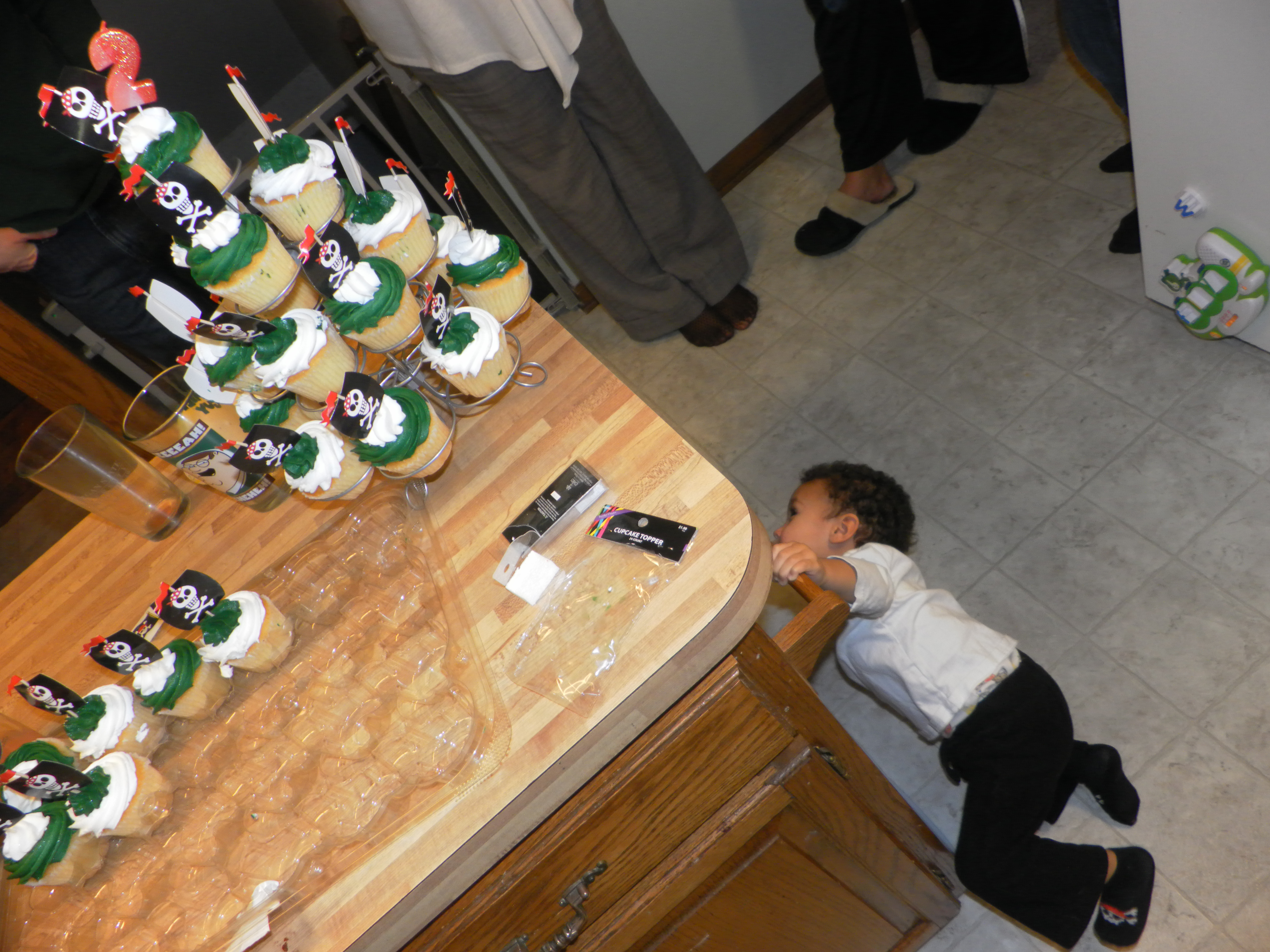
I bet Buster learned this joke at his birthday party. It was pirate-themed, and one of the props was a plastic hook that covered up the wearer’s hand. Likely, an older kid pretended to lose a hand in one of their many sword fights. Hooks may be comical, but empty space is funnier. That’s what Buster took away from it.

below the cupcakes

Checking the perimeter for cupcake-stealing pirates.

Buster always throws a good birthday bash – both times. I think this is because toddlers don’t have lots of expectations to get in the way of having fun with whatever direction the party takes. They don’t care who shows up as long as there are a few kids ready to play. They don’t stress over the menu, and they aren’t expecting presents, so anything they get is gravy. They don’t even care if somebody else blows out the candle on their cupcake, just as long as they get to eat the frosting and leave the cake part for Daddy.

All Buster really cared about at his party was having a house full of kids that he could chase around with a foam pirate sword. They didn’t have to be his own age either. The bigger the kids, the bigger the targets.

fighting pirates

A mighty sword – brought to you by the pitter-patter of little feet.

Buster likes playing with older kids. You don’t have to be careful with them. You can hit them as hard as you want. If they start crying because they got beat up by a two-year-old – well, let’s just say they should learn to not do that. It doesn’t paint them in the best light. And nobody’s going to yell at you for making a big kid cry. They might pretend to scold you, but they’re only doing it to mollify a big baby, or modern society, or somebody else not to be taken seriously. They don’t mean it.

But if a big kid hits you too hard, just turn on the water works and that kid’s done for the day. They should know better, but after you whacked them good a few times, they must have forgot. Big kids are funny that way.

pure gravy

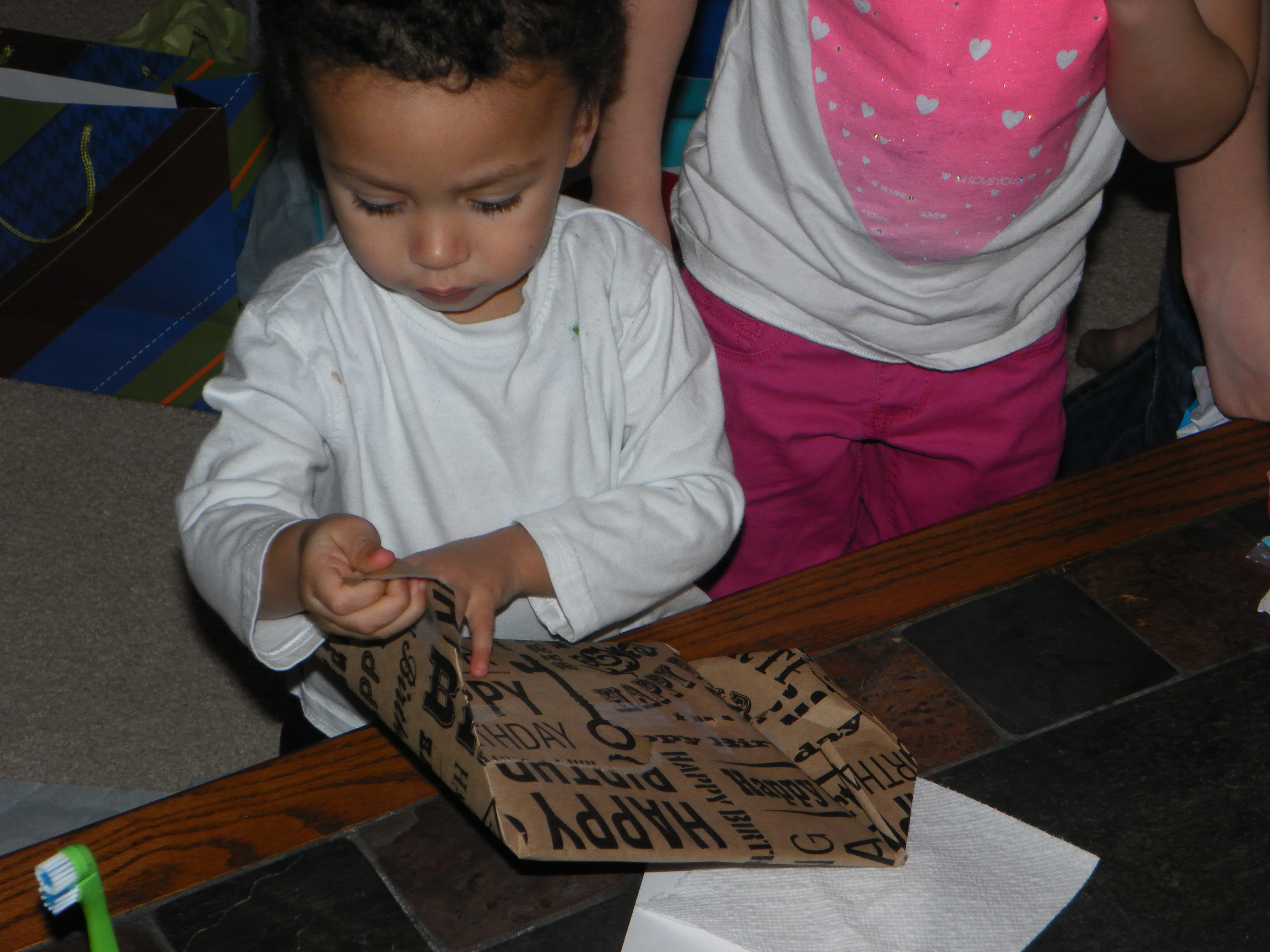
After cupcakes and sword fights, opening presents is pure gravy.

When he slept two hours late the next morning, we knew Buster had a good time at his party. He must have had one-too-many Kool-Aids.

Three days later, the pizza and cupcakes were gone, the decorations put away, everything back to usual. Except that Buster was still making pirate-themed jokes. Now that was one heck of a party.

Secrets of the universe traded for pocket change and snacks

I’ve mentioned our one-year-old’s penchant for using the words Mommy and Daddy interchangeably. He’s getting better at differentiating the proper usage of each, but he still backslides once in a while and uses a universal Daddy to cover the nomenclature of both parents.

It feels as though this child is adopting the English language slower than his brother did, though he seems, in general, to be a quicker mimic and a bit more advanced with hand-eye coordination. He certainly has a stronger throwing arm, and is not afraid to use it, even at point-blank range.

His reluctance to use our words does not mean that he is the silent type. To the contrary, he is quite verbose in his own language, which he speaks most eloquently, and with passion. Last night, we were writing with crayons. He would make a mark on the paper and then tell me the story of what it meant. He was animated in the telling, using his voice, hands, and facial expressions to relay the nuances of his tales. When his eyes grew wide, I knew it was the serious part; when he showed me his scared face, I knew to be frightened.

He enjoyed telling me what he knew, all in his own language. All he needed from me was an occasional acknowledgement, in any language, that I was interested. It occurred to me that this might be his last chance to tell me these things – the secrets that only babies know about life and the universe. Soon, he will speak our language, making it necessary that he forget all the infant wisdom with which he was endowed. It is not good for adults to know too much about Creation.

Preaching to the chair

Extolling the true meaning of life . . . to a chair.

Now that he has unburdened his soul, I expect the slow transition to our language to quicken. He is already assimilating more of our words into his vocabulary, and in a most impressive way, methodically choosing the important words first.

Juice and No are already firmly within his lexicon. Recently, he added another a vital word. We encountered an arcade game one day. He became interested in the coin slot. I told him that was the place where you put the money, then set him on a chair so he could watch the demo. Soon, he climbed down, pulled me to the game, pointed at the coin slot, and said, “Money.” Apparently, the demo was not engaging enough, and if Daddy isn’t good for a couple of quarters, what is he good for?

Days later, he saw an image of spare change on the computer. His eyes widened. He pointed and exclaimed, “Money!” If this is not proof enough of his systematic adoption of words based upon their usefulness, it should be noted that he added the very important word Cheetos to his repertoire only moments after his first taste.

Looking for Cheetos

If there is juice, money, or Cheetos on top of that counter, he’s in business.

Now that he knows how to indicate Money and Cheetos, he is at work on perfecting one of the cornerstone words of toddlerhood: Mine!

Life as an interchangeable part

Toddlers have a way with words. Their own way with their own words. They are some of the few people on Earth who say exactly what they mean. Pity we can’t understand any of it.

Our one-year-old has mastered his pronunciation of the words Mama and Dada. This was a happy milestone, until we realized that he was using them interchangeably when addressing his mother and me. I might have been Dada when I left for work in the morning and Mama by the time I got home again. Now, I sometimes forget to bring things home from work, but I’ve never yet left my Dada parts at the office.

Likewise, my wife can go from Mama to Dada without me perceiving a difference in her appearance, and I’m fairly well-informed regarding her anatomy. Buster might bump his knee and cry out for his mother’s loving arms with the plea, “Mama!” After the tears dry, he might tap her on the arm and point out to that very same Dada just exactly where he had hurt his leg.

We recalled Buster’s big brother going through a phase of development where he too threw these terms around without regard to gender, so we bided our time. Still, we took pains to point out which name goes with which parent whenever Buster seemed inclined to listen to our gibberish.

snowball school

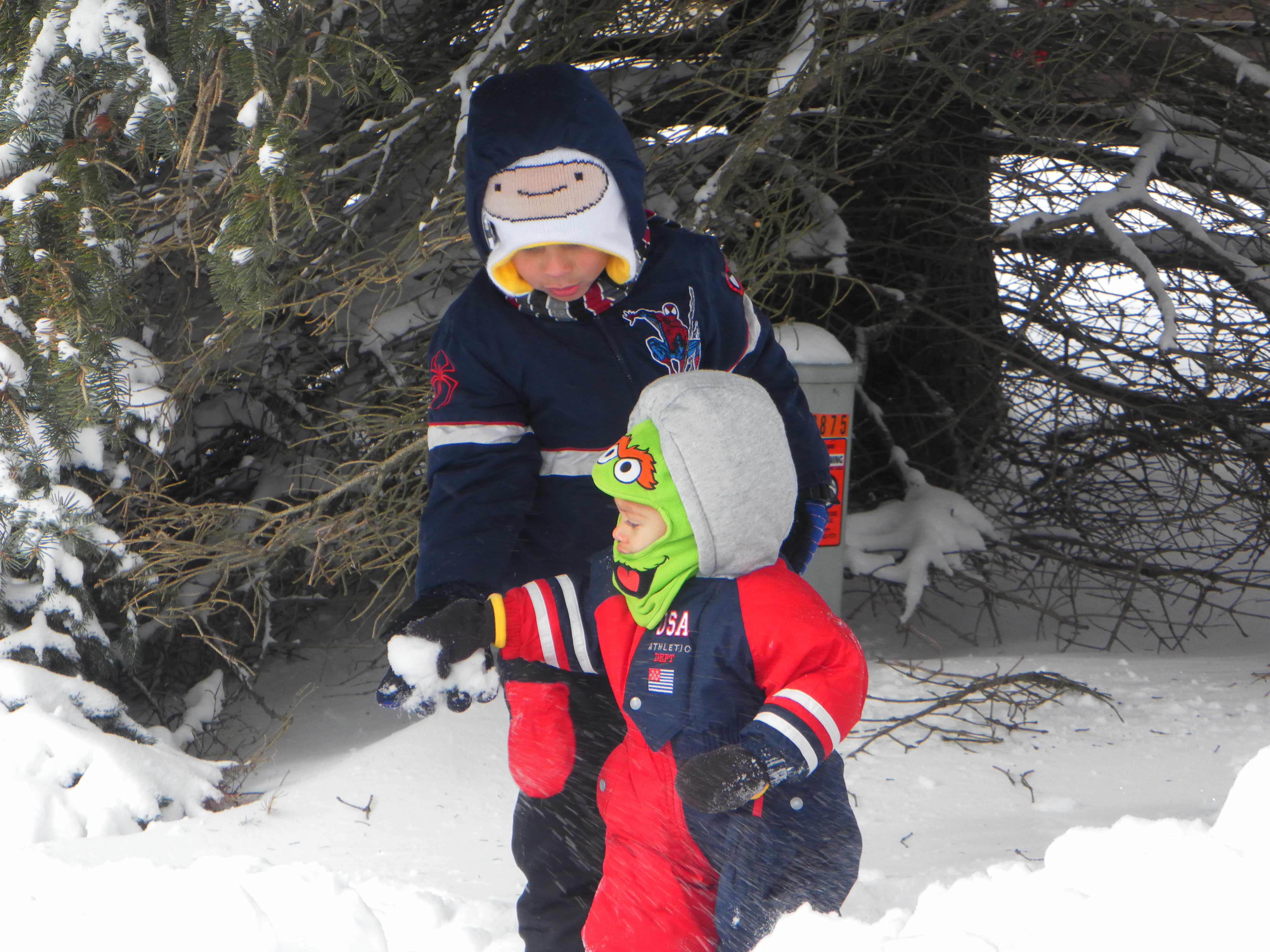
Making a snowball with his brother, whose name he always gets right.

This went on until my wife proved again why she is the smart parent. “I don’t think he’s actually referring to us when he says Mama or Dada,” she explained. “I think Mama means help and Dada means look.”

Upon careful reflection, it all fell into place. Whenever he was distraught, he called out “Mama!” When he wanted to point something out, he did so to Dada, regardless of the parent at hand.

It’s nice to imagine that Mama and Dada are baby’s first words, but that doesn’t seem wholly accurate here. He’s been spouting words that don’t mimic adult speech for months, and they all mean something to him. You don’t preach with such fire and brimstone if the words don’t mean anything to you. Are Mama and Dada truly first words because they sound like words we know, even if they don’t mean what we think they should?

When it comes to valid communication, Buster’s first real word is juice. We have it; he wants it. Nothing could be plainer than his demand when he plants himself in front of the fridge and says, “Juice!” He need not be concerned whether it’s Help or Look who’s in the kitchen with him. We both have reached the stage of development where we understand the proper meaning of juice.

Thank God his parents are finally catching on to this language thing. He was beginning to worry about us.

If only we would reach developmental milestones that allowed us to understand more words, he would be much less concerned about our progress as parents.