Where are your boob holes when you need them?

If you are like me, you probably think that all hospital gowns are pretty much the same. That just goes to show how wrong it is to be like me. You should try very hard not to do it anymore.

In the maternity ward, they have a special gown, just for mom, with holes cut out over the breasts. I don’t remember seeing these on our first visit to the maternity ward, in 2008, but I suspect I just didn’t notice. After all, I was passed out much of the time, and overwhelmed by the prospect of a lifetime of parenthood when conscious.

The ostensible purpose of these special gowns is to allow mothers to breastfeed their babies without having to navigate all the way around to the open edge of the gown. While this is a noble cause, and a team of engineers probably dedicated the better part of their careers to calculating the optimal number of holes, I think it must be the most underutilized piece of medical technology in existence.

I almost missed knowing about these medical advancements on this last visit too, and with good reason. Though my wife breastfed from the get-go, she most often did so by throwing the bulk of her gown up over her shoulder with the same abandon with which a cavalier would manage his cape.

Only once, entangled in the gown, bed sheets, and other sundry cloaks of fresh motherhood, did my wife attempt to use these helpful slits in her apparel. She wriggled around, searching the folds of her peculiar garment. “Where are your boob holes when you need them?” she muttered in frustration.

This was my first indication that such a thing existed. “What are boob holes?” I asked, a little embarrassed that, in my position as a repeat father, I might have been ignorant of an entire undiscovered acre of female anatomy.

She pointed to a spare gown hanging on the bathroom door. Unlike the gown she wore, this one clearly showed a hole, by virtue of its being hung from it. Before I could note the difference between this hole and the short sleeves at either side, I said, “I thought that was an arm hole.”
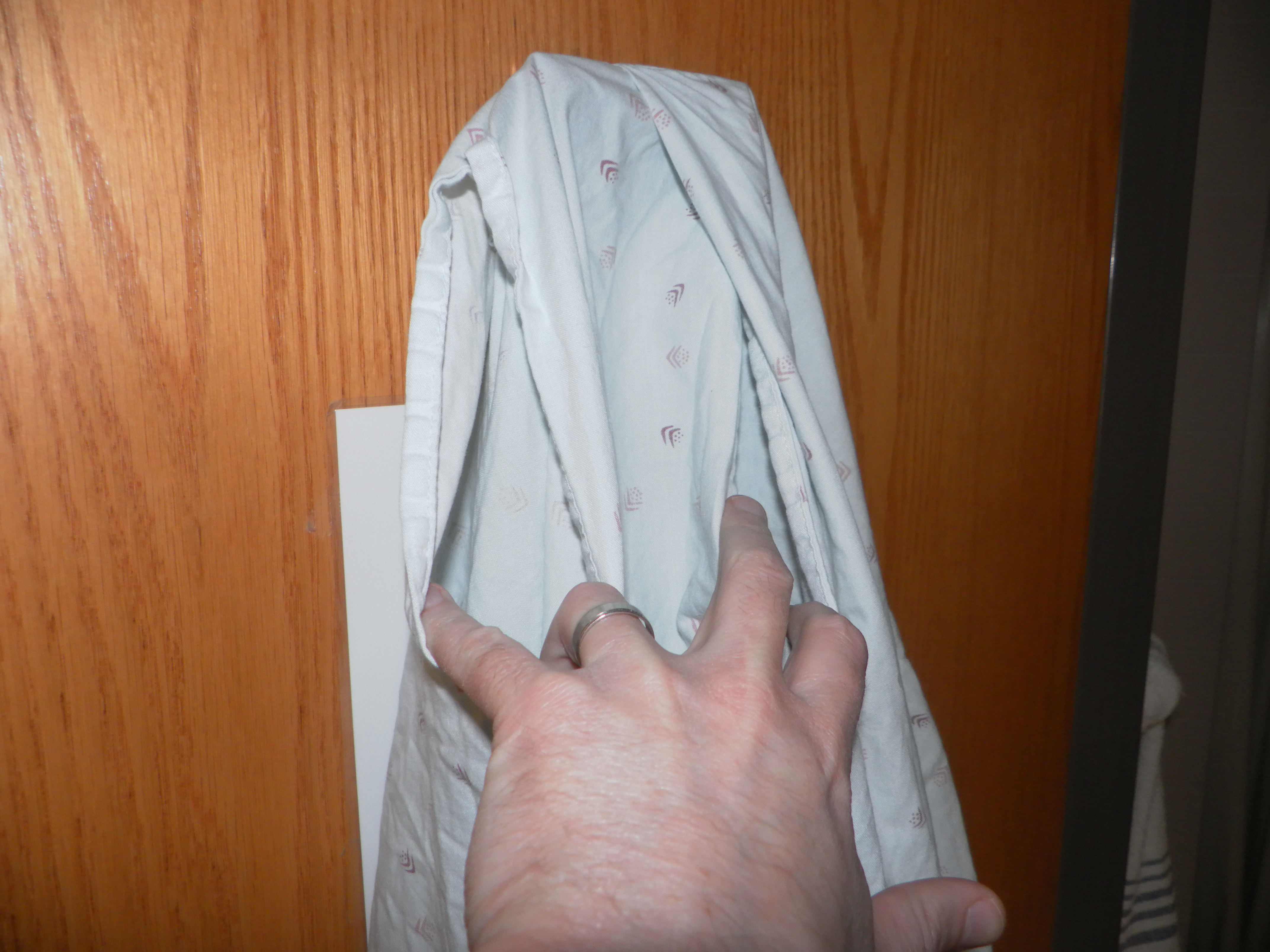
This gown must be defective. Who has arms this close together?

“How many arms do you think I have?” she asked. Clearly, her frustration with her own gown was making her sarcastic.

Intrigued, I took down the extra gown and examined it. True enough, there were two spare arm holes cut right smack into the front of it. “Science!” I whistled to myself. I was just at the point of thinking that we might be able to use one of these at home, when a couple of quick impulses cooled my ardor.

First, my wife had given up and slung the bulk of her gown off to the side. She had finally located one of the holes, but it was awkwardly situated and she had no success using it to lasso anything useful to a baby. I’m no expert on hospital gowns, but it seems to me that they are difficult to keep on straight.
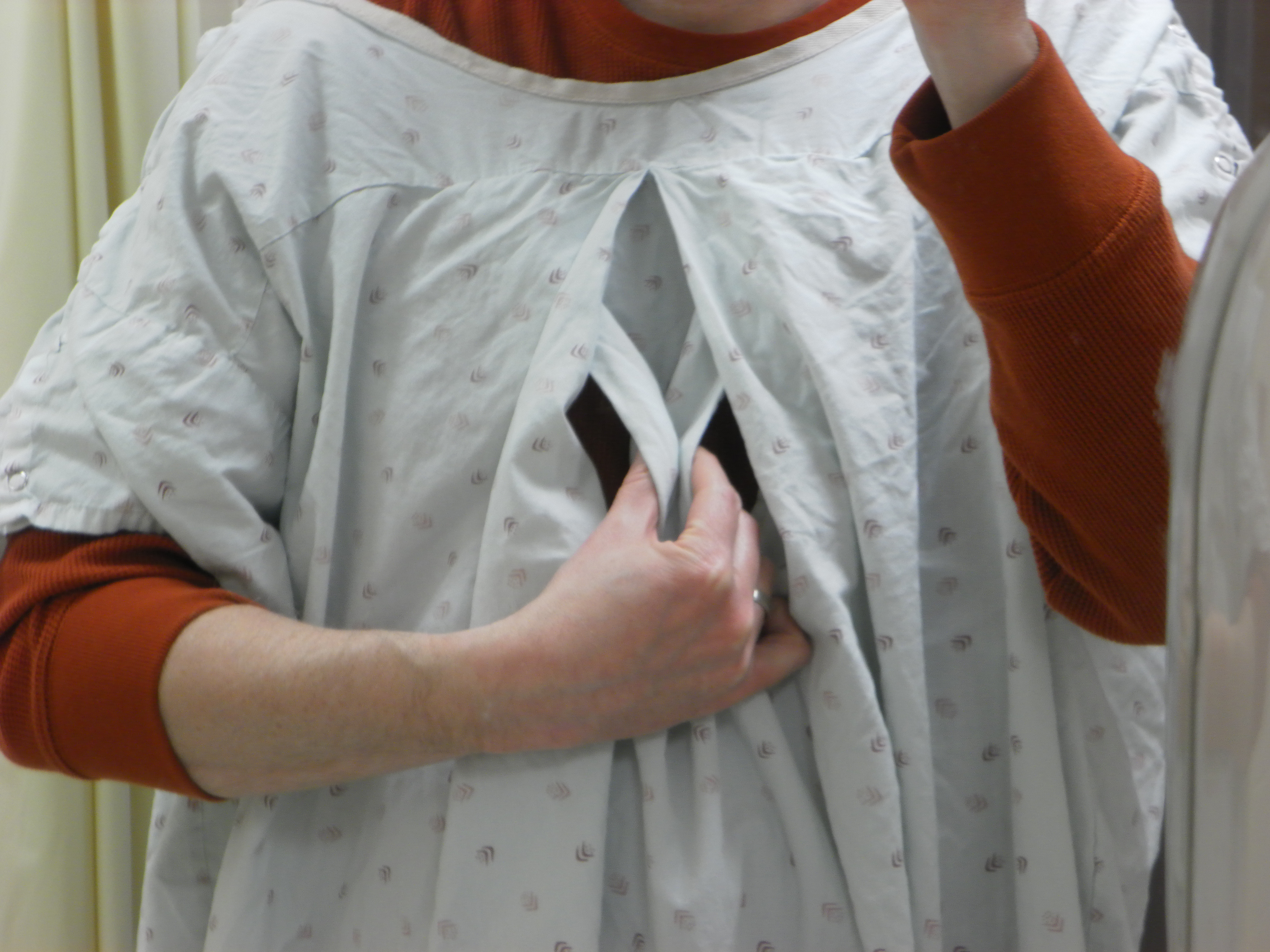
Some sicko with a camera playing dress-up in hospital dainties. They really ought to be more careful about who they let into the maternity ward.

By the time a woman gets into bed and maneuvers breast and baby onto a collision course, the boob holes (pardon my continued use of technical terms) might as well be arm holes. A baby stands a better chance of finding milk by shoving his head up a sleeve.

Second, the material of the hospital gown seems flimsy and unattractive to me. I think I’ll wait until they start making these chic little outfits in leather.

*****IF YOU LIKE THESE TRUE STORIES, CHECK OUT MY FICTION TOO!: My book of short stories, A Smile Through a Tear is currently being featured on Sandy’s Spotlight. Sandy’s Spotlight is a blog that features authors discussing their books. Click here to see what the writer of a really fantastic literary blog has to say about the book. Or just stop by to say hello.

Dispatches from the Delivery Room, Part 2: Dr. Jekyll and Mr. Labor Pain

Watching your wife go through labor is kind of like seeing the one you love turn into a werewolf. There is nothing you can do to stop the transformation; your wife possesses decreasing cognition of why she shouldn’t tear you apart; and the townspeople agree that you are not to be trusted to make the difficult decisions that might need to be made.

When my wife’s contractions were getting to be about five minutes apart, she could still speak to me as a friend. She very calmly made the arrangements for our three-year-old to be looked after. She put the house in order, and even accepted my comforting touch whenever her five minutes of peace expired. We got into the car and drove to hospital like married people.

Even though the contractions were only five minutes apart, the hospital wasn’t satisfied that she had made enough progress to be admitted. They made us walk the halls for an hour, after which they became convinced that we had no business there. They sent us home; we were welcome to come back when we were serious about having a baby.

A lot can go wrong when one finds himself alone in a car with a woman in labor. Even though we were heading home, I drove as though it were an emergency. I was sure that I would be pulled over for speeding at any moment. I imagined how I would explain myself to the cop. “My wife is in labor, Officer. So, naturally, we are driving away from the hospital as fast as we can.”

Back home, my wife’s contractions gained in intensity. There was no more quiet conversation in between. To make matters more frightfully confusing, those damned pains would not pace themselves at regular intervals like they do in all the training literature.

We tried every position, short of standing her on her head, to alleviate her agony. A warm bath helped for a few minutes, but soon became just another terror associated with the pain. All the while we debated the wisdom of returning to the hospital. What if all of our screaming and writhing were still not worthy of their hospitality? What if they sent us home a second time? That wouldn’t make us feel like social outcasts.

After three or four hours of this, my wife crossed an invisible line. I could no longer reach her. She had gone into werelabor. The transformation was manifest in her incongruous plea, “Help me! Help me! DON’T TOUCH ME!”

Her sister helped me load her into the car, for she was beyond the management of a single human. At the second stoplight, the cruel spirits of labor overcame her. “I can’t stand this!” she moaned. “I gotta get out of here!” Only my quick finger on the auto door lock kept her from laboring against traffic in a busy intersection and causing chaos in the streets.

Our son was nearly born in the middle of this intersection. Despite his mother’s fervent attempt to have it all out here, I stuck to my guns and insisted upon a hospital birth.

In the hospital again, the doctor did another cervix exam. She announced to us that it was four centimeters dilated, which was enough progress for us to earn a bed at their inn. I’m not sure if it were four centimeters or not. I truly believe that, having seen the wild light in my wife’s eyes, the doctor knew what answer she had better give before she pulled on her gloves.

Finally invited to give birth among polite society, my wife howled for pain medication.  The hospital staff insisted on observing certain formalities first. This only left my wife more desperate. I soon found myself caught between calculating civilization and the primal needs of raw nature, trying to forge a peace between two powers with which I held waning influence.

This was when I understood that they were both right. Raw nature had no good reason not to tear me apart. I was merely an annoying noise that brought relief no closer. At the same time, civilization could not trust me to make calculated decisions. The werewolf was too much a part of my heart.

In all fairness, my wife only turned werewolf under the most stressful conditions imaginable. I often turn into a Frankenstein while sitting around the house, without provocation. (Photo credit: my three-year-old son with his Fisher-Price camera.)

*****OFF TOPIC BONUS CONTENT: My book of short stories, A Smile Through a Tear is currently being featured on Sandy’s Spotlight. Sandy’s Spotlight is a blog that features authors discussing their books. Click here to see me looking all awkward on video as I talk about the book. I look a little Frankenstein-ish there too.

Dispatches from the Delivery Room, Part 1: It’s a Madhouse!

I’ve heard it said that there is a special provision of nature that allows a mother to forget the pain of childbirth. Without this special indulgence, it might be hard to imagine any family containing more than a single child. I have my own name for this natural phenomenon. I call it insanity.

Unfortunately, there is no magic wand to wipe a father’s memory clean. He is doomed to remember all of the many horrible hours in which a mother’s pain turned his wife into a stark raving lunatic. The height of her mental derangement comes in an otherwise very calm statement, when in a moment of seemingly stable reflection, the mother makes this declaration: “It wasn’t nearly this bad last time.”

The mother makes this laughable comparison as if to imply that at a similar point in her last labor, she was entertaining well-wishers with tea and scones. It was a nice little get-together in the delivery room, at the end of which a beautiful baby was delivered in a holiday basket garnished with fresh flowers and an assortment of candied fruit.

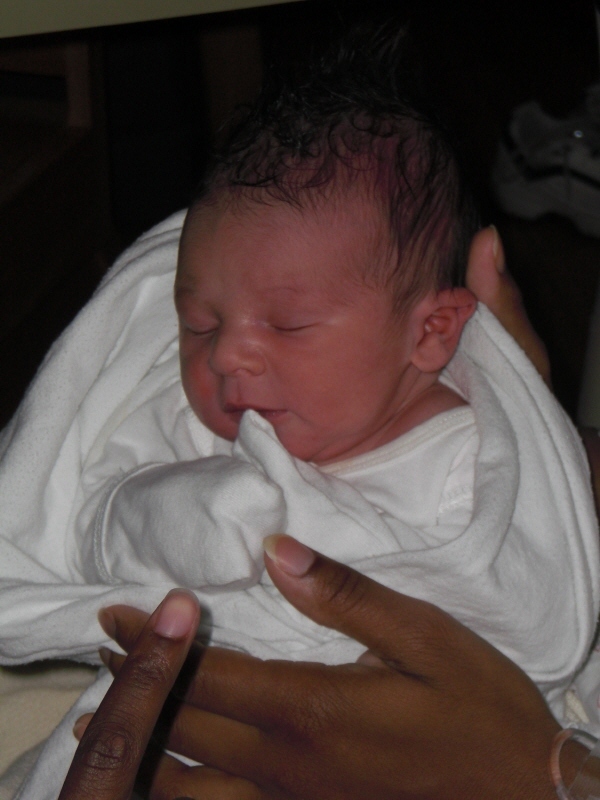
In 2008, this baby eased into the world as smoothly as strawberries and cream - according to contemporary lore.

Only the father recalls the piercing screams and tortured howls of the former occasion. Yet a sense of self-preservation makes him humor the mother’s madness. Only a fool would argue with bedlam.

The mother, in her delirium, feels betrayed by fate. How could such a pleasant occasion have been turned into such a nightmare on her? Surely, this injustice cannot last long. It’s not supposed to hurt like this. God knows, it never did before.

I’m not sure what God knows, but the father knows it hurt exactly like this before. He knows there is nothing he can do about it, and he knows that he will be scolded severely for whatever he does to help and whatever he doesn’t do to help. The contract has been signed, and the contract doesn’t mention scones or gift baskets. There’s no turning back now.

There are still hours and hours to go. The mother is in pain like (to the best of her recollection) she’s never felt before. Also, she’s mightily pissed off because somebody has changed the whole process on her since last time. No one is feeding her bonbons . . . in the shade . . . beside a babbling brook . . . to while away the carefree hours of labor like they did last time. Insult to injury, that’s what that is.

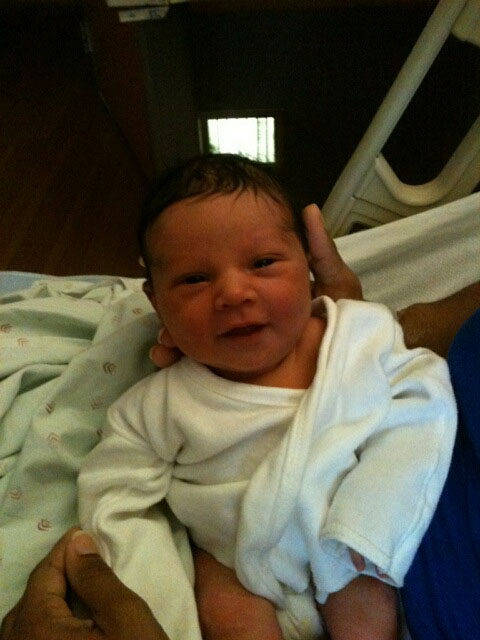
In 2012, this child's birth caused much gnashing of teeth. A mother's love will soon rewrite history to show that it was all sunshine and lollipops.

The father sighs. There are still hours to go. And the only little task he needs to accomplish in all that time is to soothe the physical and emotional pains of a hurting, pissed off, delirious woman who suspects that he is the main conspirator in the cruel joke that is being played upon her.

He will remember this instance too, long after it has been whitewashed with rose pedals.

Conversations with my wife: Royal Deodorant

Wife: You know our William and Kate?

Me: Our William and Kate?

Wife: The Duke and Duchess of Cambridge.

Me: Oooooh. Our William and Kate! Yes, of course.

Wife: Do you think they make a special, stronger deodorant for them?

Me: Why?

Wife: They do a lot of formal events. You know how when you go on a job interview, you get nervous and start to sweat a lot?

Me: If you had three job interviews a day, every day, I guess you wouldn’t sweat as much at them.

Wife: They must sweat a lot, with all those showers they make them take.

Me: I’m really not sure how many showers they are required to take.

Wife: Well, they have to change into a new outfit for every event.

Me: I didn’t know they had to take a shower every time they changed clothes.

Wife: And then, they’re always meeting with important people, and that’s got to make them nervous. Especially Kate, because she’s a commoner and not used to that sort of thing.

Me: At some point, she met the future king. If she’d had big, smelly sweat balls under her arms, he probably wouldn’t have started dating her.

Wife: But what about when they’re late and they have to run to catch their plane?

Me: I think the king’s plane will wait for the king.

Wife: Yes, but they still have to make it to their events on time. What if they’re late and they have to run to the plane to make their event on time?

Me: How often do you find yourself running late for an appointment?

Wife: All the time.

Me: And how many times do you find yourself running half a mile to make up the time? I’m sure they get dropped off closer to their destination than that.

Wife: I bet they do have some kind of special deodorant.

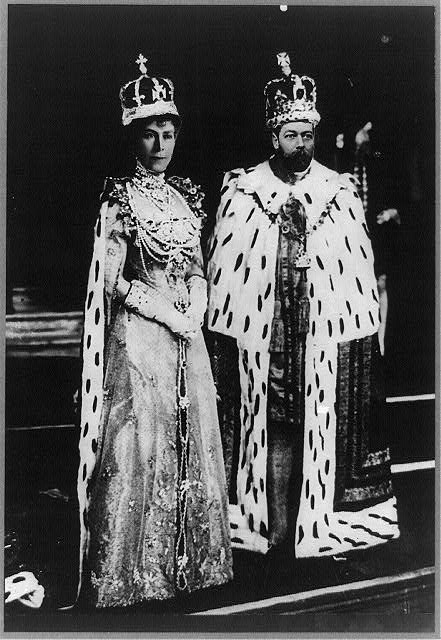
If our George and Mary, with all their hot fur and other dry-clean-only regalia, didn't need heavy-duty deodorant, why would anyone need it now?